
Last Updated 1 day ago
VL200II Overview
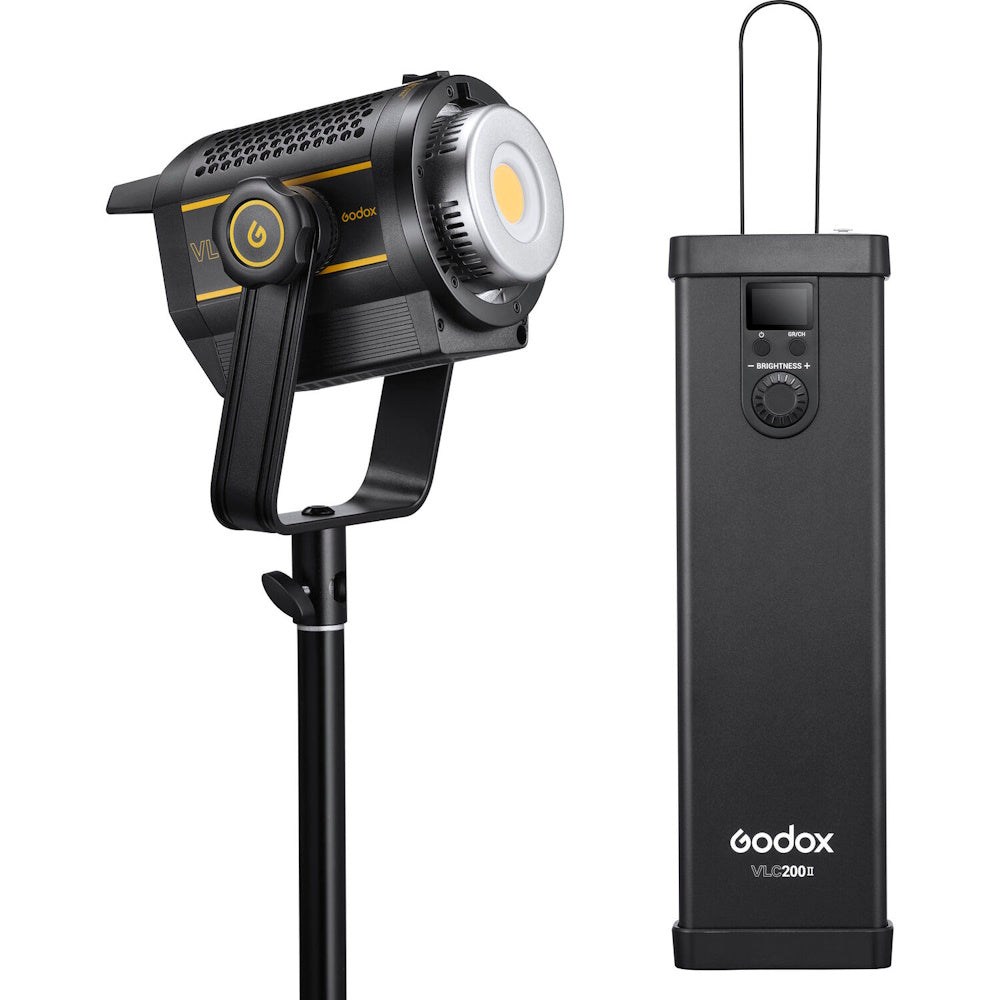
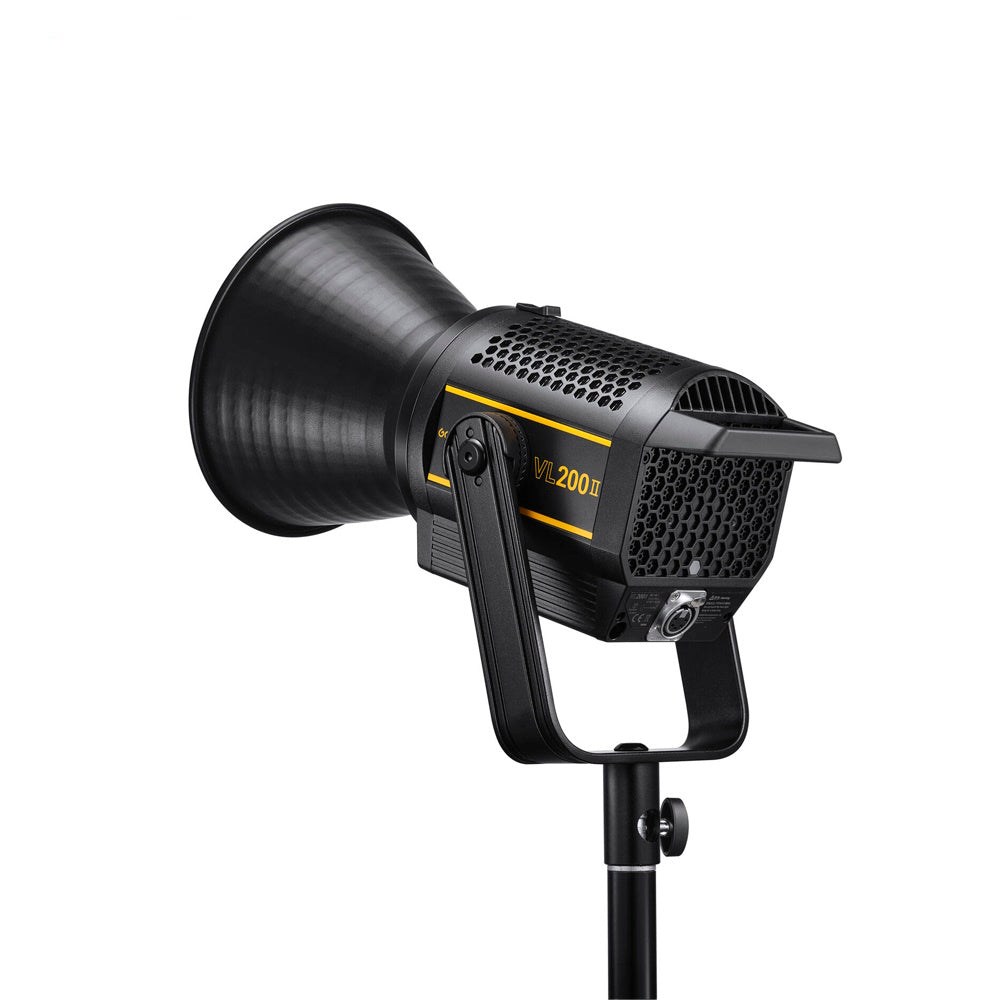
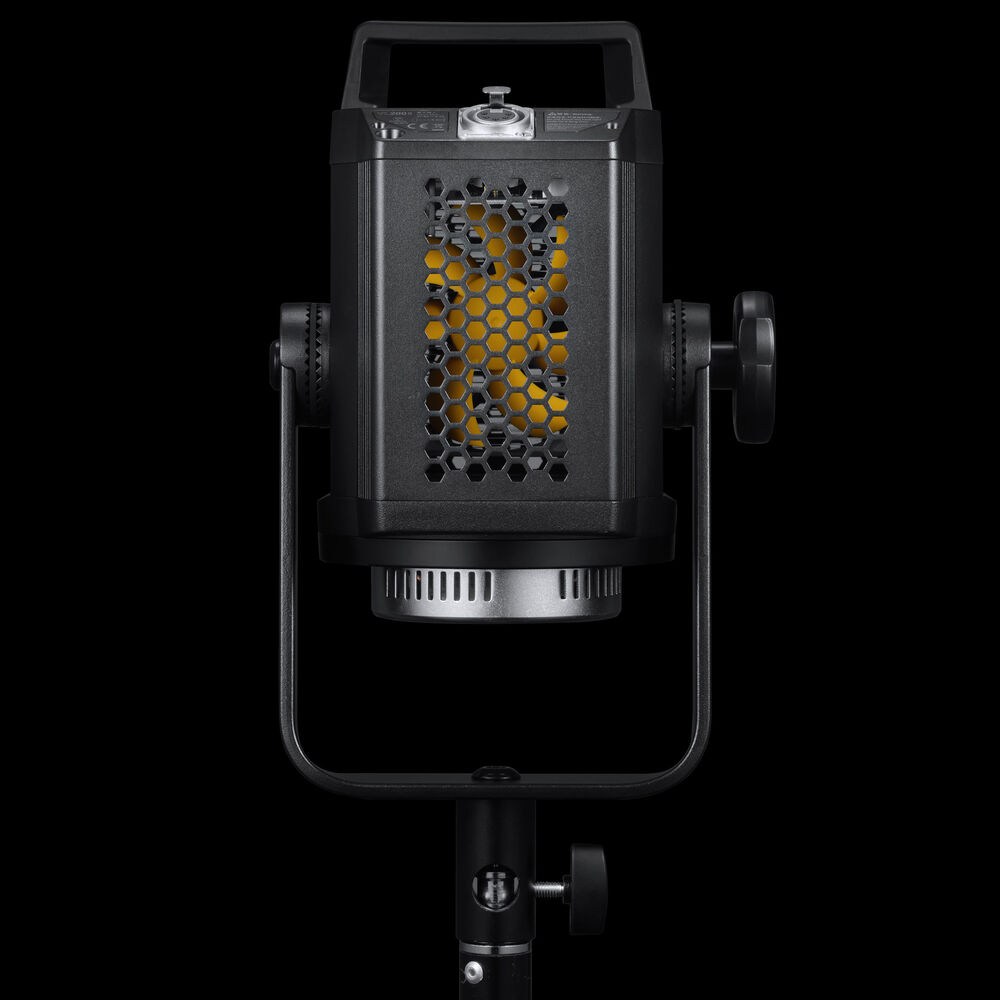
The Godox VL200II is the middle daylight head in the second-generation VL line. It gives 8,000 lux at 3 m with the supplied reflector and 1,100 lux bare. Its 1.77 kg head is only 50 g heavier than the VL150II head, although its separate controller is substantially larger.
Compare bare and reflector readings before choosing a throw; a softbox is a separate setup, not a value in Godox’s chart. The Output Calculator starts with Godox’s published 1–3 m measurements.
- Daylight COB LED Fixed-white Bowens S-mount head with a separate controller.
- 215 W Maximum Power 100–240 V AC adapter or suitable 14.8 V V-mount batteries at the controller.
- Colour Temperature 5,600 K Fixed daylight; Godox specifies ±200 K.
- Weight 1.77 kg head and 1.19 kg controller, before the power adapter and modifiers.
- Beam Angle The supplied reflector concentrates the bare beam. The Bowens mount accepts other compatible modifiers; the manual does not give a beam angle.
- IP Rating No numerical IP rating listed in the cited manual. Keep the head and controller dry. IP rating guide.
VL200II Specifications
| Specification | Details |
|---|---|
| Fixture | Daylight COB, Bowens S mount |
| White point | 5,600 K ±200 K |
| Maximum power | 215 W (Godox manual) |
| Power connection | 100–240 V AC adapter, 50/60 Hz, or compatible 14.8 V V-mount power |
| Head input | 47.8 V DC, 4.2 A |
| Colour rendering | CRI ≥96, TLCI ≥96 |
| Dimming and effects | 0–100%, 8 built-in effects |
| Control | Local controls, 2.4 GHz wireless remote and Bluetooth app |
| Dimensions | 270 × 175 × 212 mm |
| Weight | 1.77 kg head, 1.19 kg controller |
Output Calculator
Select the published setup and a manufacturer distance, or enter a custom throw where supported. The results describe centre-beam output, not the brightness across the whole beam.
Camera Settings
If the calculator does not load, use the published photometric table or source on this page. JavaScript is required.
F-stop is a planning estimate, not a meter reading. It uses direct, on-axis illuminance and includes only the optics and diffusion named in the selected setup. Meter on set to account for lens transmission, filters, added diffusion, bounce, dimming and ambient light.
How the exposure estimate works
N = √(E × ISO × t / C), where E is illuminance in lux and t = shutter angle ÷ (360 × fps). The default C = 340 is a dome reference; C = 250 is a flat reference. These are calibration constants, not a measured T-stop. A small nonzero digit is tenths of a stop above the displayed full stop.
Distance estimates and comparisons
Published points are used as given. Between published points the calculator fits a curve through the two nearest readings. Outside those points it uses the inverse-square law only when the fixture’s dataset permits it. Distances outside a configuration’s supported range are reported separately. Comparisons use one shared distance and camera setup; equal lux does not imply equal coverage.
View published readings for the selected configuration
Model and Family Fit
The VL200 II sits between the lighter VL150 II and heavier VL300 II. Check the manual’s numbers at the working distance with equivalent optics instead of comparing only the 1 m peak.
Strengths and Limitations
- Strength. The head has room to move away from a seated subject while the controller stays beside the operator. The same package accepts AC or compatible location battery power.
- Limitation. Eight thousand lux at 3 m describes the middle of the reflector beam. Lighting a full-length subject through diffusion needs considerably more coverage than that one number describes.
Practical Uses
| Setup | Placement |
|---|---|
| Full-length portrait | Place the daylight head far enough back to cover the top and bottom of the diffusion. Take head and knee readings before asking the subject to hold a mark. |
| Window-side interview | Work a white bounce near the window and flag spill off the wall behind the subject. A small trim on the low-mounted controller leaves the position of the bounce untouched. |
Output and Colour
Godox measured the following configurations at full brightness. Each cell gives lux followed by the equivalent foot-candles, rounded to the nearest whole foot-candle.
| Configuration | 1 m lux / fc | 2 m lux / fc | 3 m lux / fc |
|---|---|---|---|
| 5,600 K · bare head | 7,400 / 687 | 2,100 / 195 | 1,100 / 102 |
| 5,600 K · supplied reflector | 88,900 / 8,259 | 19,000 / 1,765 | 8,000 / 743 |
At 3 m the supplied reflector gives about half a stop more centre light than the VL150II with its reflector, 8,000 versus 5,400 lux. The white card or diffusion you put in front of either lamp still determines the usable area on the subject.
Power and Batteries
The VLC200II controller takes power from its matching AC adapter or compatible 14.8 V V-mount batteries. Godox specifies 100–240 V AC and 3.9 A for the adapter input. The head’s 47.8 V DC rating describes the downstream head circuit. Use the supplied controller and cable between those components.
Control, Cooling and Camera Operation
For a separate software reference, see Godox’s Light App 4.0 overview. It covers the app across Godox fixtures, not VL200 II performance.
Brightness and eight effects are adjusted at the controller. The Godox Light app adds Bluetooth control. The optional 2.4 GHz remote uses a channel, group and fixture ID. On a multi-light interview, confirm that each group responds separately before raising the heads. For a dialogue scene, run the fan at working temperature and listen from the intended mic position.
Modifiers, Rigging and the Working Package
The yoke accepts conventional aiming positions with the Bowens reflector or a softbox fitted. Allow space behind the lamp for the head connector when aiming steeply down. A separate position for the controller keeps a battery change clear of the modifier.
Choosing the Optic or Modifier
For a full-length setup, test the width with the chosen modifier at the distance that keeps the stand out of frame. The stock reflector reading does not tell you what lands through a softbox.
Alternatives and Related Fixtures
| Related fixture | When to compare it |
|---|---|
| Godox KNOWLED M200D | Another Godox daylight head in the same general power class, with its own controller and accessory package. |
| amaran 200d S | A daylight Bowens alternative for an interview kit already using amaran lights. |
What People Are Saying
The notes below distinguish published specifications, demonstrations and practical setup advice from independent owner measurements.
Field Feedback at a Glance
What worked
- More room to place a full-length key. Retailer Hypop recommends the VL200II over the VL150II for full-length work. It is setup advice, not an owner test. Godox’s exact VL200II reading is 8,000 lux at 3 m with the supplied reflector. View source.
- The head stays relatively light. The 1.77 kg head is separate from the controller and adapter, so those components can remain lower when the light needs to be above eye level. Godox operating manual.
- One head accepts hard and soft Bowens modifiers. Keep the supplied reflector for a tight accent, or use a compatible softbox for closer portraits. Record the modifier and meter at the intended distance. Godox operating manual.
Drawbacks to plan for
- The reflector reading is not the bare reading. At 3 m, Godox lists 1,100 lux bare versus 8,000 lux with the supplied reflector. A hard reflector’s centre value does not describe the level through diffusion. Godox operating manual.
- Fixed daylight, not a bi-colour control. The VL200II is rated at 5,600 K ±200 K. Use suitable CTO and allow for light loss when a warmer balance is needed. Godox operating manual.
- Battery and controller need to match the 200 II. Confirm approved 14.8 V V-mount configuration and output limits. Don’t substitute the VL150II controller or assume it has the same head input. Godox operating manual.
Working distance
Hypop suggests the VL200II over the VL150II for full-length portraits because the head can sit farther from the subject. Godox’s own 3 m figures give a way to judge the size of that gain for the planned optic. Hypop’s VL II comparison. This is a retailer’s setup recommendation, not an owner review.
Videos
RINGFOTO’s product overview covers the exact VL200 II daylight fixture. It shows the named model rather than measuring output or battery runtime.
Rental and Used-Fixture Checks
Check for the VLC200II controller and the adapter marked for the 200. Test dimming and wireless pairing on both the intended AC supply and the rental batteries.
Before You Book
Check the matched controller and head cable. Run the intended wireless group and battery setup, not just a quick AC power-on.
Documentation and Specifications
- Godox operating manual and illuminance tables (PDF)
- Godox series specifications
- GodoxOnline product photographs and kit listing
Browse Godox lights · COB lights · all equipment.