
Last Updated 7 hours ago
Overview
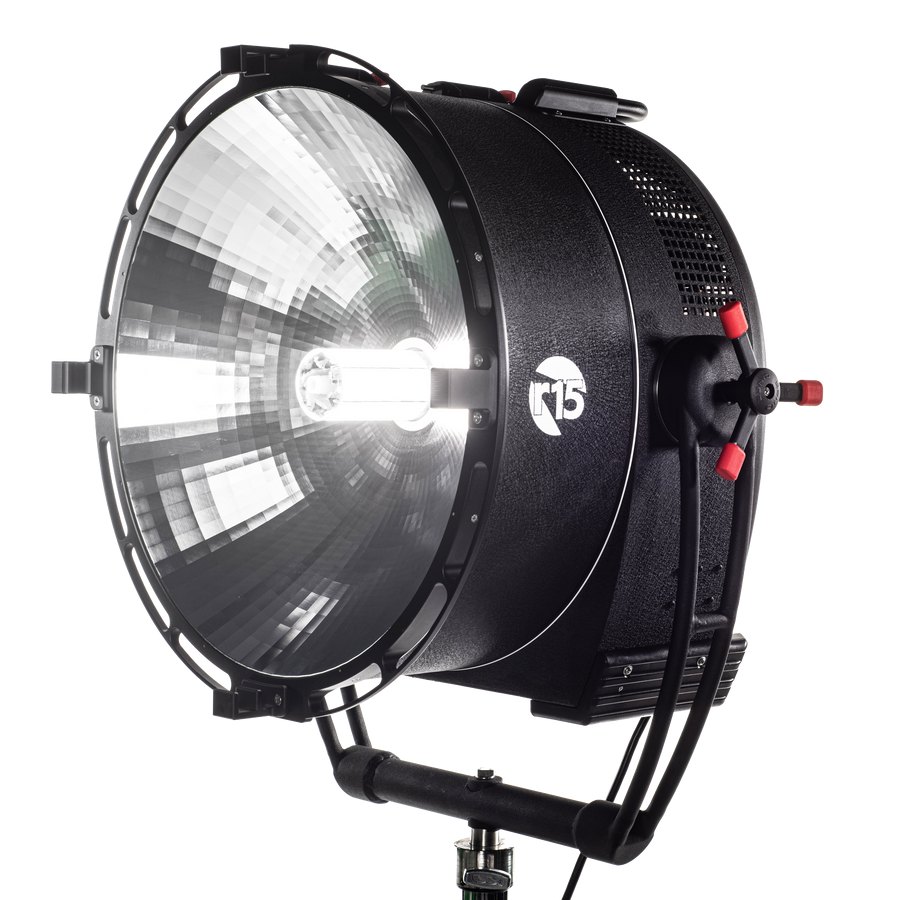
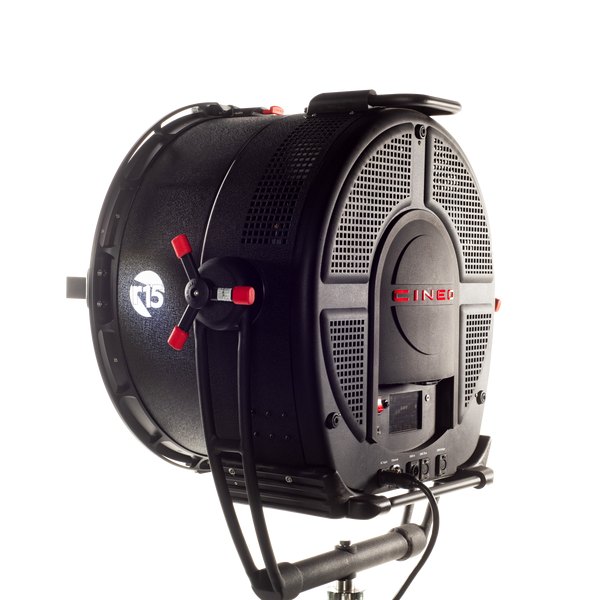

The ReFlex R15 is a liquid-cooled, focusable hard light. Its narrow setting gives a strong centre for a distant bounce. Opening the beam changes both coverage and exposure without a lens swap.
- Type Liquid-cooled LED PAR
- Power 1,500 W; 120–240 V AC
- Colour Temperature 2,500–6,500 K
- Weight 34 kg / 75 lb published fixture weight
- Beam Control 15°–75° electronic beam adjustment
- IP Rating IP23 under the manufacturer’s rating. Not waterproof. Read the IP rating guide.
Key Specifications
| Specification | Details |
|---|---|
| Manufacturer and model | Cineo ReFlex R15 |
| Source or rated power | 1,500 W hard LED |
| Optics, colour or format | 15° to 75° variable beam |
| Head or system detail | 34 kg fixture |
| Ingress protection | IP23; see the Cineo user guide |
Output Calculator
Select the published setup and a manufacturer distance, or enter a custom throw where supported. The results describe centre-beam output, not the brightness across the whole beam.
Camera Settings
If the calculator does not load, use the published photometric table or source on this page. JavaScript is required.
F-stop is a planning estimate, not a meter reading. It uses direct, on-axis illuminance and includes only the optics and diffusion named in the selected setup. Meter on set to account for lens transmission, filters, added diffusion, bounce, dimming and ambient light.
How the exposure estimate works
N = √(E × ISO × t / C), where E is illuminance in lux and t = shutter angle ÷ (360 × fps). The default C = 340 is a dome reference; C = 250 is a flat reference. These are calibration constants, not a measured T-stop. A small nonzero digit is tenths of a stop above the displayed full stop.
Distance estimates and comparisons
Published points are used as given. Between published points the calculator fits a curve through the two nearest readings. Outside those points it uses the inverse-square law only when the fixture’s dataset permits it. Distances outside a configuration’s supported range are reported separately. Comparisons use one shared distance and camera setup; equal lux does not imply equal coverage.
View published readings for the selected configuration
Strengths and Limitations
- Continuous focus makes it practical to change coverage without swapping glass.
- A 34 kg head places different demands on the stand and crew than a portable COB.
Working with the ReFlex R15
For a stage window, place the head where the shadow angle looks right, then set focus for the desired patch. The 15° and 75° readings show how much output that choice costs.
Output and Photometrics
| Configuration | Manufacturer Distance Labels | Lux (Printed) | Foot-candles (Printed) |
|---|---|---|---|
| 3,200 K · 15° | 6 m / 20 ft | 7,691 | 715 |
| 3,200 K · 15° | 9 m / 30 ft | 3,418 | 318 |
| 3,200 K · 15° | 12 m / 40 ft | 1,923 | 179 |
| 3,200 K · 75° | 6 m / 20 ft | 1,137 | 106 |
| 3,200 K · 75° | 9 m / 30 ft | 505 | 47 |
| 3,200 K · 75° | 12 m / 40 ft | 284 | 26 |
| 5,600 K · 15° | 6 m / 20 ft | 8,740 | 812 |
| 5,600 K · 15° | 9 m / 30 ft | 3,884 | 361 |
| 5,600 K · 15° | 12 m / 40 ft | 2,185 | 203 |
| 5,600 K · 75° | 6 m / 20 ft | 1,292 | 120 |
| 5,600 K · 75° | 9 m / 30 ft | 574 | 53 |
| 5,600 K · 75° | 12 m / 40 ft | 323 | 30 |
Cineo ReFlex R15 photometric table, September 6, 2023, page 4. The calculator uses the printed metric lux data and is limited to 6–12 m. Values between the three published distances are estimates, not additional manufacturer measurements.
Power and Controls
Cineo’s 2023 data sheet specifies 120–240 V AC and 1,500 W. The touchscreen, wired DMX and CRMX can each serve different stage positions.
The 2023 data sheet lists 2,500–6,500 K, 120–240 V AC and 34 kg / 75 lb. Cineo’s earlier user guide lists 2,700–6,500 K and 33 kg / 73 lb with the reflector. Its connection instructions say 100–240 V AC and 1,460 W, while its condensed specification says 110–240 V AC and 1,500 W. Use the rating label on the head for electrical planning, and confirm the menu and actual assembled weight on the rental head.
Control and Camera Operation
The R15’s touchscreen, wired DMX and CRMX are separate control paths. Record the selected beam and colour temperature with the console patch: an unchanged dimmer value does not preserve centre output if the beam width changes.
Console Modes and High-Speed Checks
Basic mode exposes dimming, colour temperature and beam width. Beam and Beam K let you address groups within the reflector; Beam K adds colour-temperature control per group. Choose a console personality that exposes the controls you intend to cue. The DMX output regenerates the control signal, but does not carry RDM. Cineo advertises high-speed operation; check banding and exposure at your actual frame rate, shutter and selected dim level. ReFlex R15 user guide.
Optics and Mounting
The housing focuses from 15° to 75°. A change from spot to flood at a fixed throw also changes the meter reading.
With the supplied reflector fitted, the R15 is a focusable hard source. For a wider soft source, Cineo describes removing the front reflector and fitting the compatible soft-accessory ring, or running without the reflector as directed in the guide. That is a different configuration from the factory photometric table. The fixture uses its own 24-inch four-leaf barndoors. Check whether the rental includes the reflector, barndoors and any ring or softbox you plan to use.
Comparable Fixture
For a daylight discharge alternative with a different power and colour workflow, see ARRI M18.
What People Are Saying
What Crews Liked
- Change beam shape from the board. On Winning Time, gaffer Josh Hensley adjusted intensity, colour and coverage remotely. An overhead R15 array let the cameras cover the court in every direction without floor lights. Read the crew interview.
- Match a period lighting look. Cinematographer Mihai Mălaimare Jr. reports that the crew tested the R15 against real sodium-vapour, mercury and metal-halide fixtures and got the looks they needed. That is a camera and production result, not a guarantee of identical spectra. See the side-by-side testing account.
- One package for stage and location. Gaffer Cullum Ross carried R15s in both packages on Man vs. Bee. When tinted set windows cut more light than planned, his crew repurposed the heads with Octodomes on rolling stands. Read Ross’s setup notes.
What to Check at Prep
- Hard shadows are not automatically clean. Phil Rhodes saw a fairly tidy beam but less convincing shadow definition at a trade-show demo. Put a stand-in or branch at the actual distance before committing to a sharp, single-shadow effect. Read Rhodes’s observations.
- Plan around the head weight. Rhodes found the unit substantially heavier than his M18 reference package even with that HMI’s ballast included. His demo weight differs from Cineo’s published 34 kg figure; check the specific rental head, yoke and hardware rather than using the demo figure for rigging. See the weight comparison.
- Test through the actual glazing. Ross’s initial plan to fly the heads near large windows changed when the tinted panes cut output. The bare-head numbers above do not account for that kind of transmission loss. See why the window setup changed.
The Digital Cinema Society’s hands-on demonstration is useful for seeing the fixture operate. It is not a substitute for measured output or the two production case studies.
Videos
Rental and Used-fixture Checks
IP23 is not a rainproof operating setup. Check the Cineo user guide for protection and connection requirements before putting the fixture where it can be exposed to water.
Check the yoke and focus travel, run the fixture long enough to assess cooling noise, and confirm the control mode and power feed for the stage.
Before You Book
Confirm the reflector and selected modifier, the total weight of the supported package, the correct AC lead, and your control method. Run a test in the intended orientation, listen at the mic position and meter through the real window or diffusion. Pick the same beam angle and colour temperature in the calculator before using its number to plan exposure.
Documentation
Phil Rhodes’ RedShark report discusses the trade-off between this high-output LED design and a conventional HMI package. It describes the design and launch context, not a controlled independent output test.