
Last Updated 5 days ago
Wasp 100-C Overview
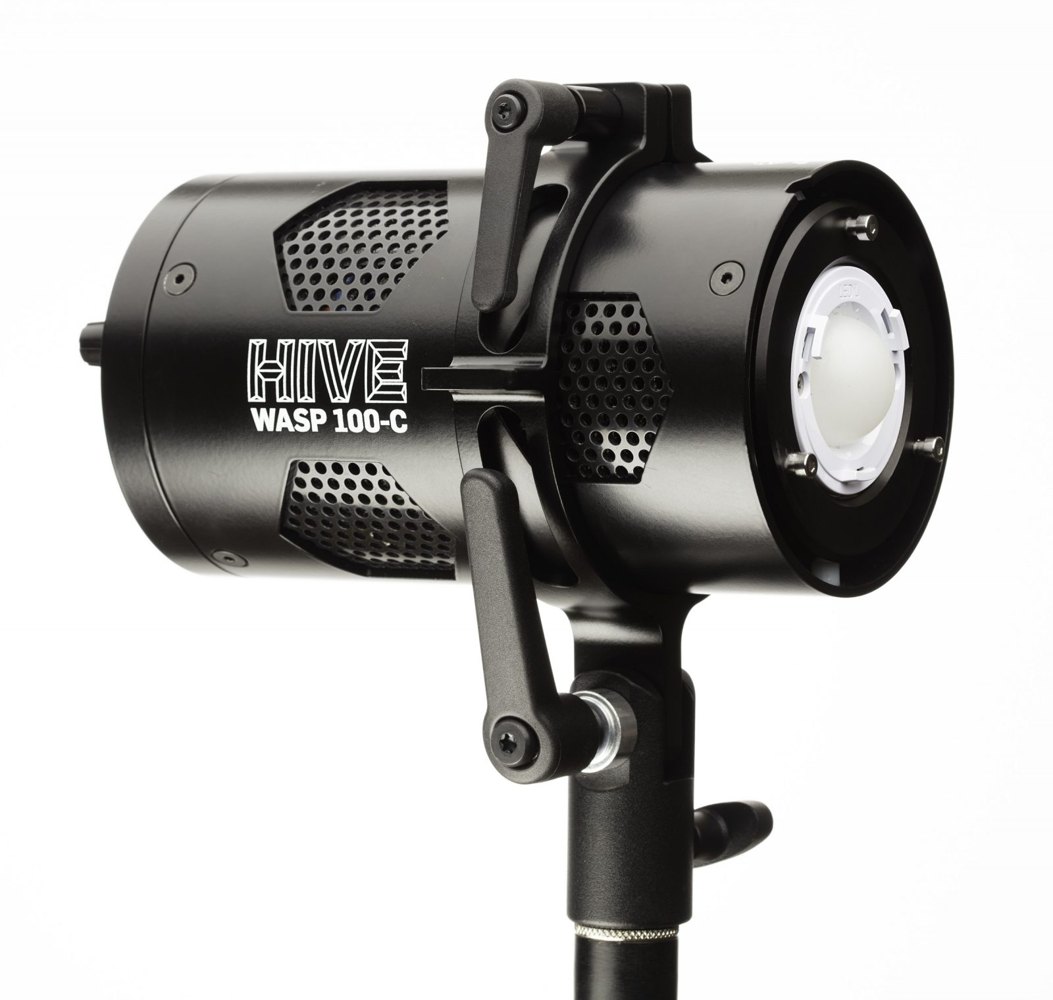
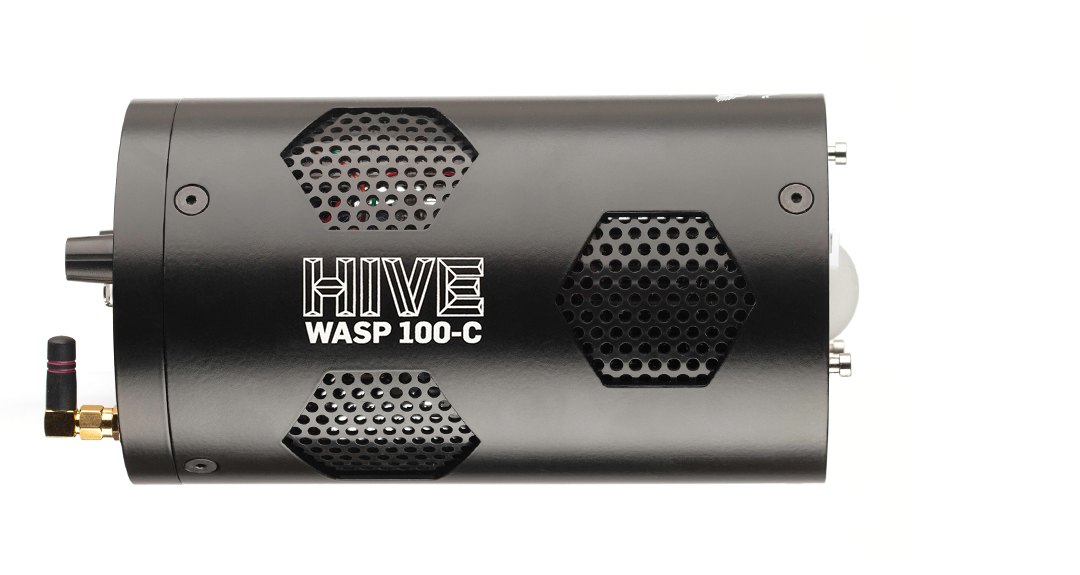
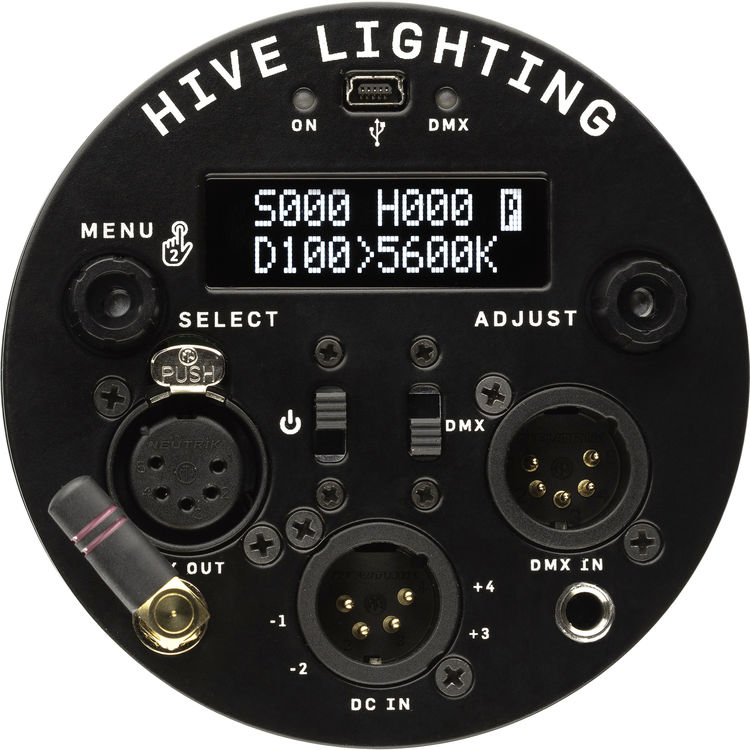
The Wasp 100-C is a 75 W colour head with local control of saturation, hue, brightness and colour temperature.
The name can be misleading when estimating battery load. Hive rates this version at 75 W.
- Omni-Color LED Hive colour engine; five emitter colours.
- Power 75 W; 12–20 V DC via XLR.
- Colour Temperature1,650–8,000 K Tunable white and saturated colour.
- Weight 1.0 kg head per Hive’s data sheet; Hive and Profoto modifiers.
- Beam Angle 22° PAR spot reflector in the PAR kit; other optics change the spread.
- IP RatingNot published No outdoor weather rating verified. Read the IP Rating.
Wasp 100-C Specifications
| Specification | Details |
|---|---|
| Manufacturer and model | Hive Lighting Wasp 100-C |
| Source or rated power | 75 W colour-tunable LED |
| Optics, colour or format | 1,650 to 8,000 K |
| Head or system detail | 12 to 20 V DC, 1 kg |
The calculator uses Hive’s single PAR chart, from 1 to 6 m (about 3.3–19.7 ft). The chart does not identify the colour temperature. Use the readings as planning estimates for that setup, not for other optics.
Output Calculator
Select the published setup and a manufacturer distance, or enter a custom throw where supported. The results describe centre-beam output, not the brightness across the whole beam.
Camera Settings
If the calculator does not load, use the published photometric table or source on this page. JavaScript is required.
F-stop is a planning estimate, not a meter reading. It uses direct, on-axis illuminance and includes only the optics and diffusion named in the selected setup. Meter on set to account for lens transmission, filters, added diffusion, bounce, dimming and ambient light.
How the exposure estimate works
N = √(E × ISO × t / C), where E is illuminance in lux and t = shutter angle ÷ (360 × fps). The default C = 340 is a dome reference; C = 250 is a flat reference. These are calibration constants, not a measured T-stop. A small nonzero digit is tenths of a stop above the displayed full stop.
Distance estimates and comparisons
Published points are used as given. Between published points the calculator fits a curve through the two nearest readings. Outside those points it uses the inverse-square law only when the fixture’s dataset permits it. Distances outside a configuration’s supported range are reported separately. Comparisons use one shared distance and camera setup; equal lux does not imply equal coverage.
View published readings for the selected configuration
Strengths and Limitations
- The broad accessory choice can turn one head from a spot into a close soft key.
- The original 75 W head has limited reach once a large modifier absorbs light.
Practical Uses
Fit the PAR reflector for a coloured edge behind talent, then switch to a photo softbox for a close key. Each setup has a different working distance.
Output and Colour
| Configuration | Distance | Lux | Foot-candles |
|---|---|---|---|
| PAR reflector · CCT unspecified | 1 m | 14,563 | 1,353 |
| PAR reflector · CCT unspecified | 5 ft (1.524 m) | 4,736 | 440 |
| PAR reflector · CCT unspecified | 10 ft / 3 m (as printed) | 1,184 | 110 |
| PAR reflector · CCT unspecified | 15 ft (4.572 m) | 527 | 49 |
| PAR reflector · CCT unspecified | 20 ft / 6 m (as printed) | 215 | 20 |
Photometric source and test conditions.
The 2019 manufacturer sheet mixes distance labels: 1 m, 5 ft, 10 ft / 3 m, 15 ft and 20 ft / 6 m. The calculator uses the stated metric values where available and exact feet-to-metre conversion for the two feet-only positions; the dual labels are approximate, not equivalent. Calculation is restricted to the resulting 1–6 m range. All five original lux readings remain unchanged. Intermediate values are estimates, not additional factory measurements. The PAR chart does not specify CCT, dimmer setting or test supply. Its first-distance reading does not follow the same inverse-square progression as the next two; the source does not explain the difference, and no replacement measurement is inferred.
Power and Controls
The original Wasp draws 75 W. It offers wired DMX, wireless control and local adjustment. The DC range is 12 to 20 V.
Control, Cooling and Camera Operation
On the Wasp 100-C revision shown in the manual, the left dial selects a parameter and the right dial changes it; pressing the right dial while turning gives finer steps. For wired control, select DMX mode on the head and confirm the starting address before bringing up a cue. Hive Wasp 100-C operating manual.
Modifiers, Rigging and the Working Package
A Profoto-compatible accessory can change coverage substantially. Keep the specific optic in your test notes alongside the colour setting.
Alternatives and Related Fixtures
Compare the higher-powered Hive Lighting Hornet 200-C.
For a larger full-colour COB, see amaran 150c.
What People Are Saying
Field Feedback at a Glance
What worked
- Battery power worked away from mains. Matthew Allard powered the Wasp from a V-mount camera battery through a separate cable, useful when there was no outlet near the light. Matthew Allard ACS, Newsshooter
- The sliding bracket made it easy to aim straight up or down. Allard could move the mounting point along the body to clear the stand while tilting the head. Matthew Allard ACS, Newsshooter
- Local controls were easy to learn. Allard made coarse adjustments by turning the dial and finer changes by pressing and turning it, without needing the manual. Matthew Allard ACS, Newsshooter
Drawbacks to plan for
- The fan was audible in a quiet room. Allard found it subtle, but worth listening for near a mic on a quiet set. Matthew Allard ACS, Newsshooter
- The daylight setting read warm on his meter. At a nominal 5,600 K with the 22° reflector, his C-700 read 5,058 K in the published results table. Check the fixture against the other daylight sources on set. Matthew Allard ACS, Newsshooter
- Warm settings left less output for diffusion. With the 22° reflector at 1 m, Allard recorded 3,260 lux at the 1,650 K setting versus 9,780 lux at 5,600 K. In his setups he found the light lacked punch through diffusion at 3,200 K and below. Matthew Allard ACS, Newsshooter
Videos
Hive Lighting Wasp 100C Omni Color LED Light Review
Rental and Used-Fixture Checks
Before You Book
- Package: Check that the rental package is the original 100-C and identify its reflector.
- Control: Test the selected wireless or wired control path.