
Last Updated 16 hours ago
5K Molebeam Overview
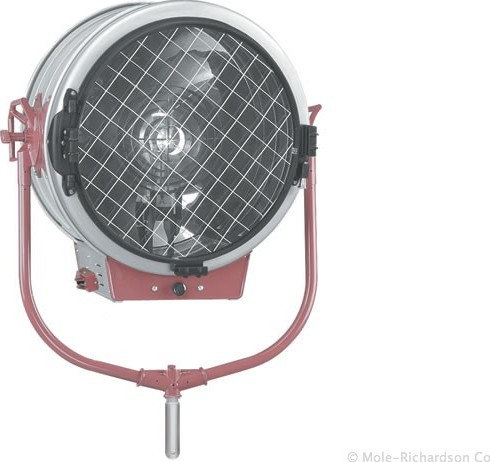
At 25 ft its spot is 2 ft across.
Opening to flood widens that field to 6 ft, useful when a window frame or cucoloris needs more coverage.
- Tungsten Beam Projector Type 8331; 1⅛ in junior pin.
- 5,000 W Maximum Use with the specified lamp and supply.
- Colour Temperature3,200 K With the DPY lamp.
- Weight79 lb / 35.8 kg With cable. Check the complete mounted load.
- Beam Angle Mole’s focus scale runs −5° to +15°. At 25 ft, the measured field spans 2 ft spot or 6 ft flood.
- IP RatingNot specified in the linked factory sheet. IP rating guide.
5K Molebeam Specifications
| Component | Details |
|---|---|
| Model | Type 8331 |
| Optical system | 24-inch reflector, adjustable beam |
| Head weight | 79 lb with cable |
| Mount | 1⅛-inch junior pin |
Output Calculator
Select the published setup and a manufacturer distance, or enter a custom throw where supported. The results describe centre-beam output, not the brightness across the whole beam.
Camera Settings
If the calculator does not load, use the published photometric table or source on this page. JavaScript is required.
F-stop is a planning estimate, not a meter reading. It uses direct, on-axis illuminance and includes only the optics and diffusion named in the selected setup. Meter on set to account for lens transmission, filters, added diffusion, bounce, dimming and ambient light.
How the exposure estimate works
N = √(E × ISO × t / C), where E is illuminance in lux and t = shutter angle ÷ (360 × fps). The default C = 340 is a dome reference; C = 250 is a flat reference. These are calibration constants, not a measured T-stop. A small nonzero digit is tenths of a stop above the displayed full stop.
Distance estimates and comparisons
Published points are used as given. Between published points the calculator fits a curve through the two nearest readings. Outside those points it uses the inverse-square law only when the fixture’s dataset permits it. Distances outside a configuration’s supported range are reported separately. Comparisons use one shared distance and camera setup; equal lux does not imply equal coverage.
View published readings for the selected configuration
Strengths and Limitations
Strength: At 25 ft, the documented spot is about 2 ft across and flood is about 6 ft. That makes it possible to choose coverage without changing heads. Limitation: Those are centre readings and field widths, not a promise of even exposure across the field. The 79 lb head-and-cable package also needs support rated for the complete load.
Practical Uses
Use the narrow field for a long shaft across a set. Open the beam when the pattern needs to fill a larger window or breakup. The chart gives centre readings, not exposure across the entire field.
Lamps
The factory chart uses DPY, 5,000 W, 3,200 K. Mole lists a 500-hour life for the 120 V DPY.
Output and Photometrics
The two columns are measured at the spot and flood settings. The calculator stays within the documented distances.
| Throw | Spot | Flood |
|---|---|---|
| 25 ft | 4,032 | 1,152 |
| 75 ft | 448 | 128 |
| 125 ft | 161 | 46 |
| 225 ft | 82 | 24 |
| 300 ft | 50 | 14 |
| 350 ft | 29 | 8 |
Alternatives and Related Fixtures
If the shot calls for a hard key rather than a narrow shaft, compare a tungsten Fresnel. Choose from the measured coverage and output at the working distance, not wattage alone; a Fresnel chart is not a substitute for the Type 8331 chart.
What People Are Saying
Panavision links the 5 kW fixture used on James Rhodes’s Union Chapel shoot to its Type 8331 rental listing. The accounts from Declan Quinn, Tim Palmer and Robbie Ryan describe the 5 kW tungsten Molebeam without naming the exact type number. The factory output chart above is specific to Type 8331.
Field Feedback at a Glance
What works
- Works as a directional key: James Rhodes used a 5 kW Molebeam as the key for Laura Marling at Union Chapel. Smaller fixtures lit the architecture separately. Panavision’s interview with James Rhodes.
- Makes long shafts visible in a large interior: Declan Quinn used 5K Molebeams to send shafts down from the upper level of a library hall in an ASC lighting demonstration. ASC account of Declan Quinn’s demonstration.
- A compact alternative to a ballasted rig: Palmer’s crew hung four 5 kW tungsten Molebeams from one bar and could slide them into new positions. He chose the tungsten heads in part because the bar could not also support the HMI ballasts. Tim Palmer, Cinematography and Lighting for Television.
What to watch for
- A visible shaft needs atmosphere: Palmer found that without smoke the beam did not read clearly and the contrast was too strong for his scene. Tim Palmer, Cinematography and Lighting for Television.
- Deep dimming makes the beam warmer: Palmer found that dimming down far enough changed the colour from useful warmth to too red for his skin tones. Tim Palmer, Cinematography and Lighting for Television.
- Correction gels can discolour: The tungsten heads in Palmer’s scene needed cooling to work with his camera balance and outside light. He noted that the correction gel could discolour in use. Tim Palmer, Cinematography and Lighting for Television.
Videos
In Panavision’s production account, James Rhodes describes using a Type 8331 as the key for Laura Marling at Union Chapel. The video shows the finished performance, not an isolated fixture test. In the same article, cinematographer Robbie Ryan describes using 5 kW Molebeams through doorways on Nick Cave’s Idiot Prayer.
Rental and Used-Fixture Checks
Before You Book
Confirm the Type 8331 marking, lamp voltage, cable condition and full focus travel. Check that the rental includes support for a 79 lb head-and-cable package before adding any other hardware.