
Last Updated 2 days ago
300W Junior Overview
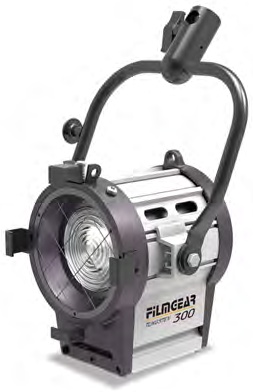

The 300 W Junior has an 80 mm lens, accepts 5-inch scrims and fits a baby pin. At 6 m its spot setting delivers 497 lx across a 1.37 m beam. The flood setting gives 109 lx across 6.11 m.
The 300 W Junior uses its own 80 mm lens and 127 mm scrim set. The 150 W Junior housing and accessories are smaller; don’t order a kit by wattage alone.
- Tungsten Fresnel 80 mm lens.
- 300 W single-ended lamp Match lamp voltage to the local supply.
- Colour Temperature3,200 K FilmGear lamp specification.
- Weight 1.8 kg lamphead; 2.1 kg with barndoor.
- Beam Angle Spot 13°; Flood 54°.
- IP RatingIP23 Lamphead. Read the IP Rating.
300W Junior Specifications
- Model: L00300TJ
- Rated supply: 100–250 V AC
- Fresnel lens: 80 mm. Scrim diameter: 127 mm
- Lamp socket: GY9.5
- Mount: 16 mm (⅝-inch) baby receiver
- Lamphead weight: 1.8 kg
Output Calculator
FilmGear’s spot and flood readings cover 2–10 m. The calculator estimates between those published readings and does not extrapolate. The exact lamp code and test voltage were not stated.
Output Calculator
Select the published setup and a manufacturer distance, or enter a custom throw where supported. The results describe centre-beam output, not the brightness across the whole beam.
Camera Settings
If the calculator does not load, use the published photometric table or source on this page. JavaScript is required.
F-stop is a planning estimate, not a meter reading. It uses direct, on-axis illuminance and includes only the optics and diffusion named in the selected setup. Meter on set to account for lens transmission, filters, added diffusion, bounce, dimming and ambient light.
How the exposure estimate works
N = √(E × ISO × t / C), where E is illuminance in lux and t = shutter angle ÷ (360 × fps). The default C = 340 is a dome reference; C = 250 is a flat reference. These are calibration constants, not a measured T-stop. A small nonzero digit is tenths of a stop above the displayed full stop.
Distance estimates and comparisons
Published points are used as given. Between published points the calculator fits a curve through the two nearest readings. Outside those points it uses the inverse-square law only when the fixture’s dataset permits it. Distances outside a configuration’s supported range are reported separately. Comparisons use one shared distance and camera setup; equal lux does not imply equal coverage.
View published readings for the selected configuration
Strengths and Limitations
The 80 mm Fresnel and 1.8 kg bare head make it useful as a small accent or backlight. A 300 W tungsten light gives up centre output in flood and needs a different source or colour correction to match daylight.
Practical Uses
Use spot for a smaller pool or a backlight and flood when you need wider coverage. Use the barndoors or an external flag to control spill, while keeping the specified clearances. At 6 m, the 13° spot gives 497 lx at centre over a 1.37 m published beam diameter, useful for a small accent across a room.
Output and Colour
FilmGear gives centre illuminance in lux and beam diameter in metres. Its chart identifies the head, lamp wattage and focus position. The test voltage and lamp part number are unspecified.
| Throw | Illuminance | Beam diameter |
|---|---|---|
| 2 m | 4,469 lx | 0.46 m |
| 6 m | 497 lx | 1.37 m |
| 10 m | 179 lx | 2.28 m |
| Throw | Illuminance | Beam diameter |
|---|---|---|
| 2 m | 985 lx | 2.04 m |
| 6 m | 109 lx | 6.11 m |
| 10 m | 39 lx | 10.19 m |
Power and Batteries
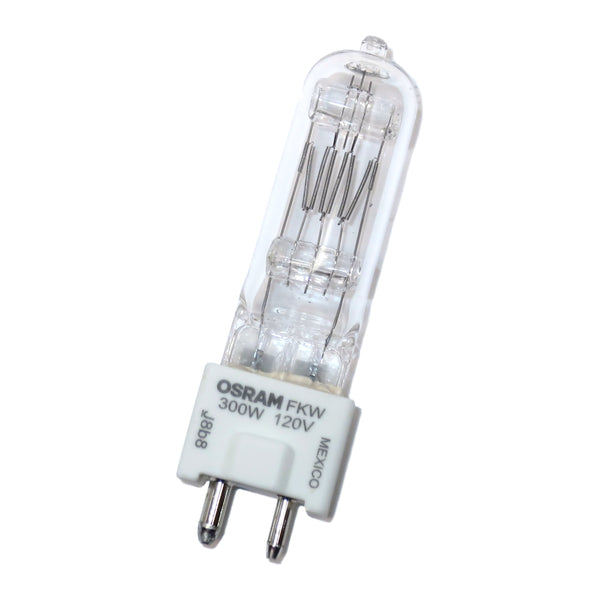
Ushio’s FKW 1000540 is a 300 W, 120 V GY9.5 lamp rated 3,200 K and 200 hours.
The fixture supply rating does not make an individual tungsten lamp multi-voltage. Confirm the lamp voltage before switching on.
Control, Cooling and Camera Operation
Set the beam with the mechanical focus control before trimming with barndoors. A scrim reduces output without the warmer colour that comes from dimming the tungsten lamp. Test colour and exposure at the actual dimmer level on camera. The manufacturer lists a 190 °C maximum surface temperature; allow the head to cool before handling the lamp or accessories.
Modifiers, Rigging and the Working Package
FilmGear specifies at least 1 m to the illuminated object and 0.5 m to flammable objects. Fit accessories without blocking the fixture vents. The standard head has a 16 mm receiver and weighs 2.1 kg with the barndoor. FilmGear specifies Class I/IP23 and an operating tilt range of −45° to +45°; verify the nameplate and keep accessories and their retention within that package.
Alternatives and Related Fixtures
Compare the 150 W Junior where a lower-load detail light is enough, or the 650 W Junior for more punch and a larger Fresnel. The charts and scrims are model-specific.
What People Are Saying
Field Feedback at a Glance
The FilmGear 300W Junior model sheet and Film Gear USA’s model listing identify this head. These are documented working characteristics and limits, not independently reported owner reviews.
What worked
- Small mounting package: the 1.8 kg head uses a 16 mm receiver, and the barndoor adds 0.3 kg.
- Choice of coverage from one head: at 2 m FilmGear shows 0.46 m diameter spot and 2.04 m flood.
- Ready for ordinary small-Fresnel control: the kit includes a four-leaf door and FilmGear lists 127 mm full and half scrims.
Drawbacks to plan for
- Output is limited in flood: the manufacturer lists 109 lx at 6 m in flood, compared with 497 lx spot.
- The FKW is a 120 V example, not a lamp for the entire input range or an identified lamp from FilmGear’s test.
- Obey the Junior’s operating clearances. FilmGear specifies at least 1 m to illuminated objects and 0.5 m to flammable objects.
Videos
Use the illustrated 300W Junior fixture sheet for the exact head, yoke, cable, retention and spot/flood tables. Generic FilmGear tungsten footage can include different wattages and Studio heads; it does not establish the control layout for this model.
Rental and Used-Fixture Checks
Verify the exact Junior head, its lamp base and lamp voltage. Check the lens, focus travel and cable before accepting the fixture. Request 127 mm scrims if needed.
Documentation and Specifications
Tungsten Fresnel directory · Tungsten and PAR lamp code lookup