
Last Updated 2 days ago
FilmGear 5 kW Junior Tungsten Fresnel Overview
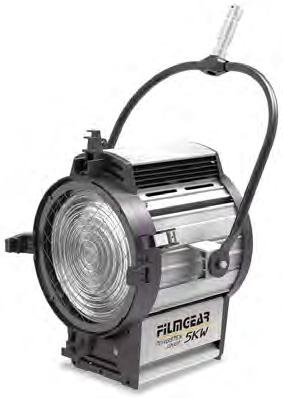

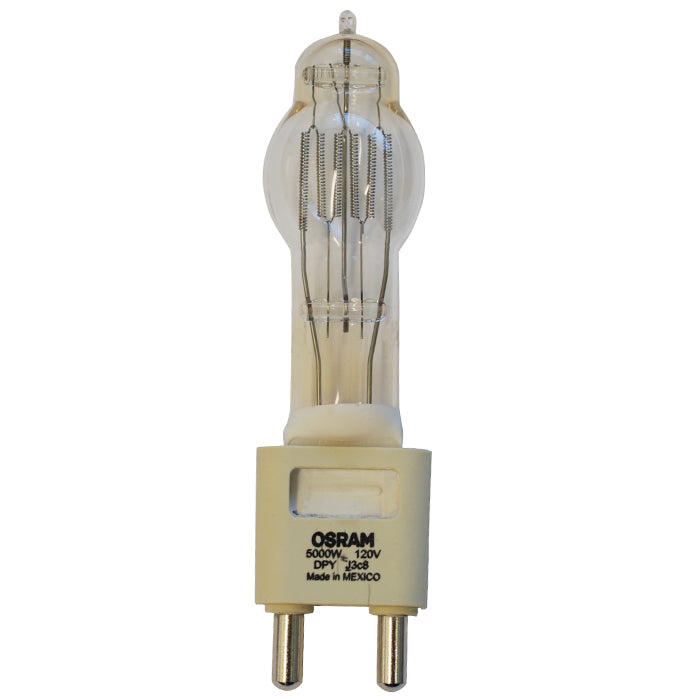
The Junior 5 kW has a 250 mm lens and a tighter flood than the 300 mm Studio. At 10 m, FilmGear gives 5,808 lx in spot and 894 lx in flood for the Junior.
The L05000TJ and L05000TJ1 have different supply and lamp requirements. Verify the suffix and the exact lamp before use, and don’t substitute the Studio’s scrim set.
- TypeJunior tungsten Fresnel
- Power5,000 W; voltage depends on variant
- Colour Temperature3,200 K nominal
- Weight14.4 kg head
- Beam Angle10° spot / 54° flood
- IP RatingIP20FilmGear’s published fixture rating. IP ratings guide.
Specifications
- Model: L05000TJ / L05000TJ1
- Rated supply: 200–240 / 100–120 V AC
- Fresnel lens: 250 mm. Scrim diameter: 330 mm
- Lamp socket: G38
- Mount: 28 mm (1⅛-inch) junior spigot
- Lamphead weight: 14.4 kg
Photometrics are not safety clearances. The Junior sheet lists 5 m (16.4 ft) minimum to illuminated objects and 1.5 m (4.9 ft) to flammable objects. FilmGear Junior datasheet.
Output Calculator
Select the published setup and a manufacturer distance, or enter a custom throw where supported. The results describe centre-beam output, not the brightness across the whole beam.
Camera Settings
If the calculator does not load, use the published photometric table or source on this page. JavaScript is required.
F-stop is a planning estimate, not a meter reading. It uses direct, on-axis illuminance and includes only the optics and diffusion named in the selected setup. Meter on set to account for lens transmission, filters, added diffusion, bounce, dimming and ambient light.
How the exposure estimate works
N = √(E × ISO × t / C), where E is illuminance in lux and t = shutter angle ÷ (360 × fps). The default C = 340 is a dome reference; C = 250 is a flat reference. These are calibration constants, not a measured T-stop. A small nonzero digit is tenths of a stop above the displayed full stop.
Distance estimates and comparisons
Published points are used as given. Between published points the calculator fits a curve through the two nearest readings. Outside those points it uses the inverse-square law only when the fixture’s dataset permits it. Distances outside a configuration’s supported range are reported separately. Comparisons use one shared distance and camera setup; equal lux does not imply equal coverage.
View published readings for the selected configuration
Strengths and Limitations
Its 250 mm Fresnel concentrates a documented 10° spot, while the 54° flood gives a larger field from the smaller head.
Practical Uses
Choose it for a relatively narrow tungsten shaft or hard edge through a set opening. At 10 m, spot covers 1.75 m versus 10.19 m at flood, before accessories.
Output and Colour
FilmGear gives centre illuminance in lux and beam diameter in metres. Its chart identifies the head, lamp wattage and focus position. The test voltage and lamp part number are unspecified.
| Throw | Illuminance | Beam diameter |
|---|---|---|
| 5 m | 23,230 lx | 0.87 m |
| 10 m | 5,808 lx | 1.75 m |
| 15 m | 2,581 lx | 2.62 m |
| Throw | Illuminance | Beam diameter |
|---|---|---|
| 5 m | 3,575 lx | 5.10 m |
| 10 m | 894 lx | 10.19 m |
| 15 m | 397 lx | 15.29 m |
Power and Batteries
L05000TJ1 is the 100–120 V head. Ushio 1000215 DPY is rated 5,000 W, 120 V, 3,200 K and 500 hours. L05000TJ is the 200–240 V head and takes a lamp rated for that supply.
Control, Cooling and Camera Operation
The manufacturer sheet specifies at least 5 m to an illuminated object and 1.5 m to a flammable object. These are separate clearances, not interchangeable limits. Maximum ambient temperature is 45 °C; the listed maximum surface temperature is 220 °C. The fixture is Class I, IP20, with an operating tilt range of ±38°. Published weight with barndoor is 16.1 kg.
The calculator retains the documented 5–15 m photometric range. Its output estimates do not override the clearance, tilt or temperature limits, and the manufacturer’s table does not identify the tested lamp part number or voltage. Match the lamp rating to the actual supply.
Modifiers, Rigging and the Working Package
Use the 330 mm scrim family and the matching Junior filter frame. Its 16.1 kg published weight with doors is distinct from the bare 14.4 kg and from Studio figures.
Alternatives and Related Fixtures
The Studio is the separate L05000TF/TF1 family with a larger 300 mm lens and its own chart. A shared 5 kW lamp class does not imply the same field.
What People Are Saying
Practical takeaways from FilmGear’s exact Junior specifications, not independent owner reviews.
What worked
- At 10 m, the 10° spot delivers 5,808 lux at centre through an approximately 1.75 m field.
- The shorter 250 mm optical package and 14.4 kg bare head give a smaller rig than FilmGear’s 16.3 kg Studio.
- FilmGear lists 330 mm full and half scrims, a variable snoot and a spill ring for the Junior.
Drawbacks to plan for
- The Junior is IP20. Do not use the Studio’s IP23 rating for this head.
- FilmGear lists 5 m to illuminated objects and 1.5 m to flammables; its outer surface can reach the specified maximum of 220°C.
- Read the TJ/TJ1 nameplate and installed lamp separately. The 120 V Ushio DPY is not the lamp to assume for a 200–240 V Junior.
Videos
Illustrated fixture reference: FilmGear’s 5 kW Junior drawing and accessory sheet shows the head, dimensions and model-specific operating limits.
Rental and Used-Fixture Checks
Before You Book
Read the exact nameplate: L05000TJ1 is the 100–120 V head and L05000TJ is the 200–240 V head. Check for the 330 mm scrims; the larger Studio takes different accessories.
Documentation and Specifications
Tungsten Fresnel directory · Tungsten and PAR lamp code lookup