
Last Updated 4 days ago
Overview
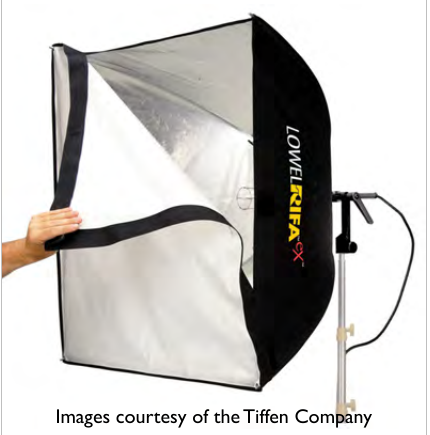


The Lowel Rifa eX 88 (LC-88EX) is a collapsible tungsten softlight with a 32 × 32 in / 81 × 81 cm diffusion front. The supplied TH-X1000 lamphead accepts a 1,000 W lamp and specified lower-wattage lamps.
The reflector, lamphead and diffuser are a system. Lock the light fully open and fit the correct front diffuser before powering it. Use the approved lamp for the supply voltage; changing the lamphead changes the available lamp types.
- Fixture Type Collapsible tungsten softlight · LC-88EX
- Power 1,000 W maximum; supplied TH-X1000.
- Colour Temperature3,200 K with the standard lamps in Lowel’s output table.
- Weight 4.5 lb / 2 kg with captive cable.
- Beam Angle 75° nominal with the bare diffuser in Lowel’s beam diagram. 32 × 32 in front; optional 30°, 40° and 50° grids shape spill.
- IP Rating No numerical IP rating stated in the checked material. Read the IP Rating.
Specifications
- Manufacturer code: LC-88EX
- Collapsed length: 34 in / 86 cm
- Supplied lamphead: TH-X1000
- Front diffuser: 32 × 32 in / 81 × 81 cm
- Maximum lamp power: 1000 W
- Maximum current: 8.3 A at 120 V
- Weight with captive cable: 4.5 lb / 2 kg
- Standard tungsten lamphead with eXchange accessory-lamphead system
Output Calculator
Select the published setup and a manufacturer distance, or enter a custom throw where supported. The results describe centre-beam output, not the brightness across the whole beam.
Camera Settings
If the calculator does not load, use the published photometric table or source on this page. JavaScript is required.
F-stop is a planning estimate, not a meter reading. It uses direct, on-axis illuminance and includes only the optics and diffusion named in the selected setup. Meter on set to account for lens transmission, filters, added diffusion, bounce, dimming and ambient light.
How the exposure estimate works
N = √(E × ISO × t / C), where E is illuminance in lux and t = shutter angle ÷ (360 × fps). The default C = 340 is a dome reference; C = 250 is a flat reference. These are calibration constants, not a measured T-stop. A small nonzero digit is tenths of a stop above the displayed full stop.
Distance estimates and comparisons
Published points are used as given. Between published points the calculator fits a curve through the two nearest readings. Outside those points it uses the inverse-square law only when the fixture’s dataset permits it. Distances outside a configuration’s supported range are reported separately. Comparisons use one shared distance and camera setup; equal lux does not imply equal coverage.
View published readings for the selected configuration
Strengths and Limitations
Strengths
- The 32 in square front gives more source area than the 55 and 66 when the light is set at the same distance.
- The collapsible frame combines the reflector and softbox instead of needing a separate speed ring and fabric box.
- The TH-X1000 supports the listed lower-wattage tungsten lamps without changing the size of the diffusion front.
Limitations
- A full-power 1,000 W tungsten lamp adds substantial heat; it requires the original heat-rated diffuser and specified clearance.
- The tungsten head has no electronic colour-temperature control. The standard FEL is nominally 3,200 K.
- The box is not focusable; use a grid or external flags for tighter spill control rather than trying to make it behave like a Fresnel.
Practical Uses
The 32-inch Rifa eX 88 makes a useful larger interview key or two-person coverage where tungsten balance is wanted. Begin with the light high enough to keep faces visible, then check whether the 32-inch front and grid clear the camera and subject as you move it. Lowel’s measured grid curves show an output loss, so compare the bare factory reading with a meter reading through what you actually mount. See Lowel’s grid diagrams.
Lamps and voltage
| Lamp | Voltage | Power | CCT | Average life | 5 ft / 1.524 m | 10 ft / 3.048 m |
|---|---|---|---|---|---|---|
| FEL | 120 V | 1000 W | 3200 K | 300 h | 195 fc / 2110 lux | 56 fc / 608 lux |
| FEP | 240 V | 1000 W | 3200 K | 150 h | 160 fc / 1730 lux | 45 fc / 491 lux |
| FEP/240 | 240 V | 1000 W | 3200 K | 150 h | 148 fc / 1598 lux | 40 fc / 432 lux |
Output and photometrics
The manufacturer sheet’s Lamp/Beam Data table and beam-angle diagrams contain slightly different centre readings for some matching lamps. The saved measurements consistently use the Lamp/Beam Data table; the two presentations are not combined. This extended soft source is limited to the published 5–10 ft (1.524–3.048 m) measurement range. Values between those distances are estimates, not additional manufacturer tests; no values are extrapolated outside that range.
These are centre readings through the normal Rifa diffuser with the specified standard lamphead and globe. Lamp choice changes output and operating colour; the larger Rifa sizes may accept some lower-wattage lamps, but those combinations are not assigned another model’s readings.
Lampheads and Light Control
The supplied TH-X1000 is shared by the Rifa eX 55, 66 and 88. The TH-X300 can be fitted as an accessory for lower-power or low-voltage lamps; the measurements above apply only to the supplied head and listed lamp.
Optional fabric egg crates are offered in 30°, 40° and 50° versions. They reduce spill and output; the ungridded measurements above do not describe output with an egg crate installed.
Use and safety
Mount the light on a stand with one leg under the forward load, lock the frame open, fit the diffuser, and then connect the switched extension. Do not pull the power cable to unfold the fixture. Unplug and cool it before changing lamps or lampheads, and never exceed the model’s maximum wattage.
Match the lamp voltage and approved power cable to the supply. A low-voltage lamp must not be connected to a higher-voltage source. Use only one supplied Lowel diffuser, and let the light cool for at least five minutes before packing it. Roll the diffuser around its storage tube rather than folding it.
Control and Camera Operation
Choose the colour temperature by lamp, not by an electronic CCT control. If external tungsten dimming is used on a compatible supply, check the warmer colour at lower dim levels against the camera white balance. Change distance, or use the fixture’s compatible soft egg crate where spill needs to be reduced. Meter the altered setup to check both exposure and coverage. The optional fluorescent lamphead is a separate setup and should not be treated as a dimmable tungsten head.
Related fixtures
Compare softbox sizes and lamp options: Rifa eX 66.
Compare the Rifa eX 66 when a smaller 25-inch source and a 750 W ceiling are sufficient. The Rifa eX 55 is the compact 500 W model.
What People Are Saying
These accounts cover different lampheads. The fluorescent results do not describe the tungsten eX88 in the calculator above.
What people liked
- A broad interview key that packs down. In Helmut Kobler’s documentary field report, the documentary DP names the 32 × 32-inch eX88 as his interview key. He valued the umbrella-style opening and used an egg crate when he needed tighter spill control.
- A usable fluorescent key at close range. In Steve Anchell’s hands-on Shutterbug review, the eX88 with one 65 W lamp in the FLO-X1 head served as key for a portrait, with a smaller Rifa for fill. Anchell also found the eX boxes quick to fold and compact to store.
- A flattering tungsten beauty source. In this gaffer’s firsthand account, a 1,000 W Rifa was quick to deploy and gave a look the gaffer liked when dimmed. The post does not identify the original or eX revision.
What to watch for
- Low-wattage fluorescent lamps do not compete with bright windows. Kobler found that three 27 W lamps were little more than fill in bright rooms. The larger 80 W lamps helped at close range, but three needed separate protective packing rather than his eX88 tube case.
- Heat changes how fast you can strike. Anchell flagged the heat and power draw of tungsten continuous lights. For the eX88, Lowel’s eXchange instructions requires the supplied diffuser in place, unobstructed ventilation and at least five minutes of cooling after unplugging before disassembly. Fast setup does not make this a hot-fold fixture.
- Check the actual lamp and supply. Lowel tables the FEL at 120 V/1,000 W and separate 240 V/1,000 W FEP lamps. A plug adapter does not make the 120 V lamp usable at 230–240 V. Match the supply, approved cable, lampholder and rating before use.
Videos
Brooklyn Free Speech’s equipment team demonstrates the folding, setup and handling of a Rifa eX 55. It shows the family’s umbrella-style design, not the eX 88 lamp options or output. Use the eX 88 lamp table above and Lowel’s instructions for this fixture.
Rental and Used-Fixture Checks
Before You Book
- Match head, lamp and supply. Check the exact eX 88 fixture and tungsten lamphead. Verify lamp voltage and code against the factory table; a physical fit does not make a different voltage acceptable.
- Inspect what holds the box open. Check the lock, frame ends, tilt lock, diffuser, fabric and cable before powering the fixture. If using a soft egg crate, meter through it.
- Pack for the lamp you’re using. Let the head cool before handling it. If you have the optional fluorescent head, Lowel requires that head and lamps to be removed before collapsing the box. Check the instructions and leave time before wrap.
Documentation
Browse Lowel lights · browse tungsten lights · all equipment