
Last Updated 12 hours ago
Overview
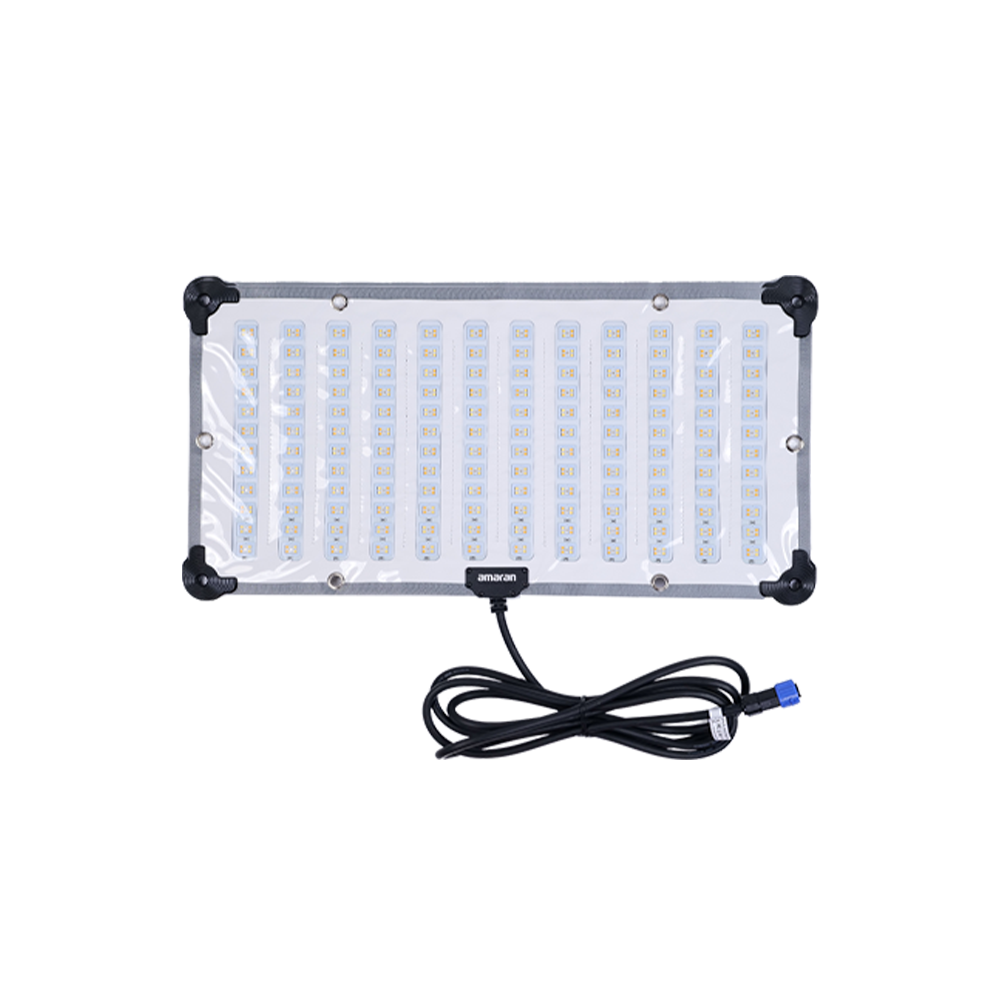
The amaran F21c is a nominal 2 × 1 ft flexible RGBWW LED mat with a separate controller. Its broad rectangular emitting area is useful for interviews, small interiors, close overhead light and places where a conventional panel housing would take too much space. The supplied-style support frame turns the flexible mat into a more conventional stand-mounted source.
The “c” model supplies full colour as well as 2500–7500 K white light. It is a different fixture from the bi-colour F21x and the larger 2 × 2 ft F22c. In particular, the F21c’s 100 W output class and battery/cooling arrangement should not be replaced with figures copied from the 200 W F22 models.
Key specifications
| Specification | Details |
|---|---|
| Format | Nominal 2 × 1 ft flexible LED mat with external controller |
| Engine | RGBWW |
| Maximum LED output / consumption | 100 W / 120 W |
| White-light range | 2500–7500 K |
| Colour metrics in July 2023 manual | CRI ≥95; TLCI ≥98 |
| Control | Local, Sidus Link Bluetooth mesh, wired DMX via the specified adapter |
| DMX accessory | USB-C to DMX input/output adapter, separately supplied |
| Controller/adaptor voltage | 48 V DC from the appropriate AC adapter |
| Battery input range | 12–28.8 V in the manufacturer manual |
| Full-output battery guidance | Manual lists 16.8 V, 26 V and 28.8 V compatibility; battery current capability still matters |
| Cooling in manual | Passive panel and passive controller |
| Operating temperature | −10 to 40°C |
| Mounting | Correct X bracket and tilting support; verify bracket generation |
| Light shaping | Documented softbox, diffusion and control-grid arrangements; separate F21 lantern option |
Strengths and limitations
Strengths
- A rectangular 2 × 1 ft mat fits narrow spaces and low-profile rigs.
- Passive cooling includes the controller, helping with close dialogue work.
- RGBWW adds tint adjustment and full colour.
Limitations
- The complete fixture still needs its bracket, diffusion, controller and cables.
- Battery current capability still needs to meet the selected output.
- Wired DMX needs the specified adapter; CRMX is not built into the controller.
Practical uses
The long, narrow format can sit above a small window, light a seated interview from close range or create a strip-shaped reflection on a product. Horizontal and vertical placements give different reflection geometry and coverage. For a face, choose orientation and distance for the desired wrap rather than judging softness only by the product’s “flexible” description.
The mat can occupy a shallow space, but the full working package still includes a support frame, modifier, cable, controller and power source. Plan where the controller goes before dressing the light into a set. Keeping its weight off the mat and connector helps preserve the advantage of a light head.
| Setup | Working approach |
|---|---|
| Soft interview key | Build the supplied softbox and choose diffusion for the desired softness and output, then add the grid for spill control. |
| Low-profile overhead | Use the correct support bracket, rated rigging and independent retention, keeping controller weight off the mat. |
| Confined location | Use the mat’s shallow profile where a deeper light would enter the frame or restrict movement. |
| Colour interaction | Choose a repeatable colour setting through the camera and allow for lower saturated-colour output. |
Output and colour
The manual’s photometric table separates the bare mat from the softbox with half-stop diffusion. The commonly advertised 3,560 lux maximum occurs at 6500 K in that table; it is not the listed bare 5600 K result. These are averaged manufacturer measurements.
| CCT | Bare at 1 m | Softbox, half-stop at 1 m | Softbox, half-stop at 3 m |
|---|---|---|---|
| 3200 K | 2,890 lux | 1,754 lux | 240 lux |
| 5600 K | 3,360 lux | 2,048 lux | 280 lux |
| 6500 K | 3,560 lux | 2,182 lux | 299 lux |
The RGBWW engine provides white-light CCT and saturated-colour control. Dedicated warm and cool white emitters are useful for conventional skin-tone lighting, while HSI and effects suit coloured accents and motivated cues. A strong white-light CRI score does not guarantee that every saturated hue will expose equally or reproduce identically on every camera.
Choose an output mode appropriate to a CCT transition, record colour and intensity settings, and check the camera when combining the mat with other LED brands. Use the same diffusion arrangement for matching and the take. Moving from bare mat to softbox changes both the metered level and the apparent source.
Power and batteries
The 100 W output label is separate from the 120 W maximum consumption. Use the specified 48 V adapter/controller arrangement for mains operation, and the approved battery connection for DC. The battery input’s wide voltage range does not mean a random 48 V supply can be attached to a battery port.
The F21c manual lists 16.8 V, 26 V and 28.8 V batteries as compatible with full output. Confirm the battery’s continuous discharge capability, connector and actual voltage during the run. Capacity in watt-hours estimates endurance; it does not establish that the pack can deliver the required current.
The larger F22c manual specifies different low-voltage battery limits. Do not apply that model’s half-output rule indiscriminately to the F21c, or apply the F21c’s guidance to a 200 W mat. Test the specific fixture, battery and intensity before an inaccessible overhead installation.
Control, cooling and camera operation
The July 2023 F21c manual lists natural heat dissipation for both mat and controller, making this a useful model to distinguish from the fan-cooled F22 controllers. Passive cooling still needs unobstructed heat dissipation. Do not bury the controller in soft furnishings or operate a folded, unsupported mat in a way the instructions prohibit.
Check the mat for damaged traces, dead or discoloured sections, worn corner fittings and strained cables. Verify the controller, approved adapter, bracket, diffusion and any DMX cable are included. Test CCT, saturated colours, dimming and the actual remote-control route. A larger LiteMat 4 Plus offers a different size and control package; the F21c’s appeal is a compact rectangular full-colour mat with a relatively simple location kit.
Modifiers, rigging and the working package
Diffusion smooths the LED array’s visible pattern and changes the source’s appearance in reflections. A grid controls off-axis spill; it does not increase the emitting area. The photometric table gives an actual half-stop-softbox example, which is more useful for an interview plan than the highest bare-mat headline.
The dedicated F21 lantern creates a different surrounding-light arrangement and has its own output data and skirt. At 5600 K, that manufacturer chart lists 1,365 lux at one metre for the F21c. It is a separate setup, not another label for the shallow softbox. Include its extra volume and mounting load in an overhead plan.
Use the intended corner retention and frame rather than allowing the power lead to carry the mat. The current product page shows a revised spring-loaded X bracket, while older kits may contain an earlier bracket design. Check the supplied components, locking action and support before assuming two used kits are identical.
Flexible does not mean crease-proof. Follow the prescribed folding and packing method, protect the emitting surface and avoid stressing a connector at a sharp bend. Provide appropriate secondary retention above people, and use a mounting method suited to the surface and total load. Protect the controller, supply and connections from weather as instructed.
Alternatives and related fixtures
| Fixture | Choose it for |
|---|---|
| amaran F22c | A larger RGBWW source with different controller cooling and battery-output limits. |
| amaran F22x | Bi-colour white light in the larger mat format. |
| LiteGear LiteMat | A different supported panel and power system for a professional soft-light package. |
What people are saying
Erik Naso: keep controller noise in the package decision
Naso’s hands-on family review confirms that the F21 controllers use passive cooling. He valued the low profile for tight spaces and the flexible mounting options.
Graham Sheldon: useful mounting and travel format
In his field review of all four models, Sheldon found the mounting system held up over several shoots. He liked the compact kit but considered the supplied grid relatively flimsy and gave the controller extra protection during travel.
Videos
CineD: F21 and F22 flex-light review
A review covering both sizes and the colour and bi-colour versions.
Gaffer & Gear 196: F21c and F22c
A comparison of the two RGBWW mats.
Rental and used-fixture checks
Identify the exact mat, controller, bracket generation and battery-mount version. Inspect emitting sections, corner retention, cable locks and strain relief. Test the intended battery voltage, low-level dimming and remote-control path with the correct DMX profile. Pack the mat without sharp creases and secure the controller independently.
Documentation and specifications
Official F21c information, operating manual and photometrics and F21 lantern specifications.
Product photograph: amaran.
Browse amaran lights · LED mats · all equipment.