
Last Updated 2 days ago
Overview
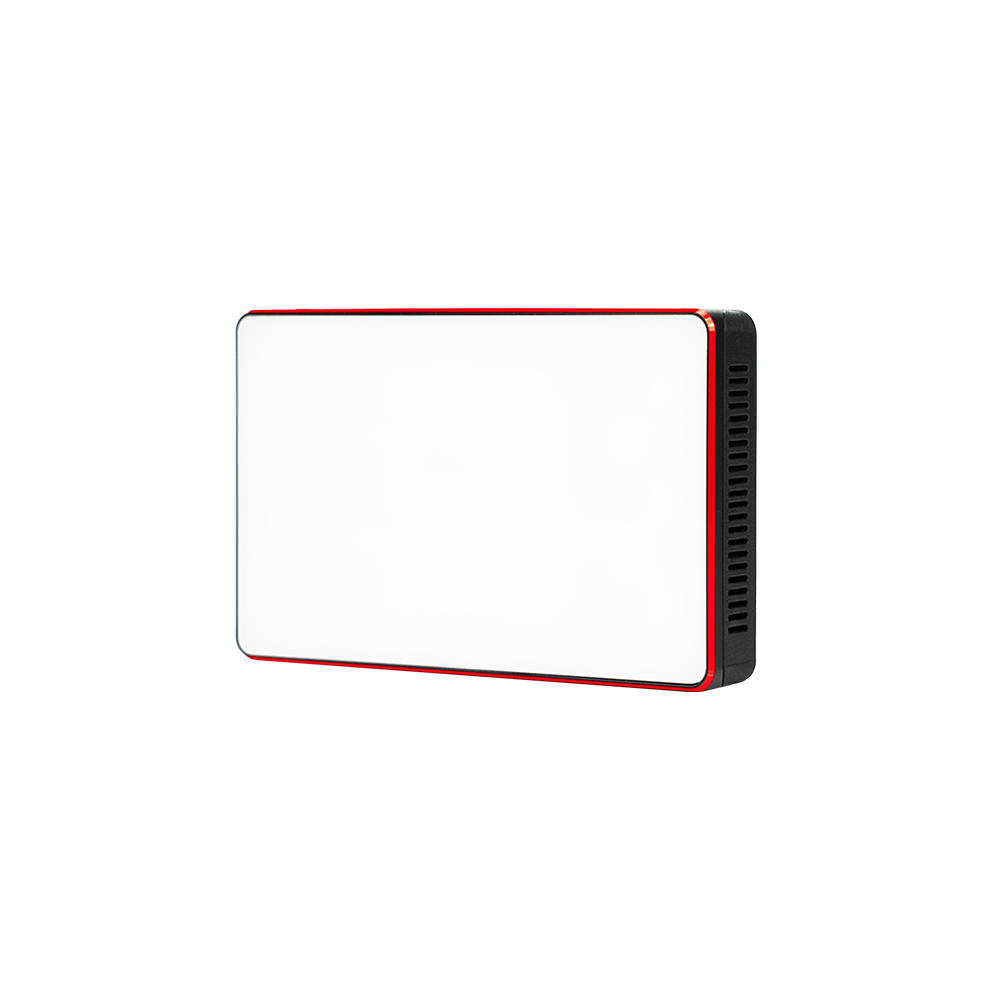
The Aputure MC is a small RGBWW LED panel with an internal rechargeable battery, magnetic mounting and Sidus Link control. It works as a hidden accent, close fill, practical enhancement, product detail light or quick colour source. Its main advantage is getting a controllable light into a place where a larger head and power cable would be inconvenient.
The original MC uses Bluetooth mesh control and a broad emitting face. The MC Pro is a separate model with different optics, weather protection and control features. Original MC charging kits contain multiple fixtures with the same individual output and controls.
Key specifications
| Specification | Details |
|---|---|
| Light engine | RGBWW; red, green, blue and separate warm/cool white emitters |
| Rated output power | 5 W in the manufacturer specification |
| White-light CCT range | 3200–6500 K, with 100 K steps documented in the original product description |
| Colour modes | CCT, HSI and built-in effects; further control through Sidus Link |
| Published colour metrics | CRI 96+; TLCI 97+ in the specification table |
| Dimensions | 93 × 61 × 17 mm |
| Weight | 130 g in the product description |
| Battery | Internal lithium-polymer, 3.7 V / 2600 mAh |
| Published runtime | More than 2 h at maximum brightness; more than 15 h at minimum brightness |
| Published recharge times | About 1.5 h via USB PD, 2 h via USB 5 V / 2 A, 3.5 h wirelessly |
| Mounting | Built-in magnets and 1/4-20 thread |
| Remote control | Sidus Link / Bluetooth mesh; no native CRMX or wired-DMX receiver |
| Included beam accessory | Silicone diffuser in the documented single-light package |
| Operating temperature | 0–45°C |
Strengths and limitations
Strengths
- A small magnetic body and internal battery fit behind set dressing.
- RGBWW, local controls and Sidus Link provide flexible accents.
- USB-C and Qi charging suit multi-light preparation.
Limitations
- Its useful throw is limited; a visible glow does not establish enough exposure for a face.
- The original model has no built-in CRMX or wired DMX.
- The internal battery is not swappable, and the original MC does not have the MC Pro’s IP65 protection.
Practical uses
The MC is most effective close to the thing it is lighting. It can add a little separation behind a small object, brighten a shelf, motivate a screen glow or lift a face in a tight space. A pair of hidden MCs can also give different areas of a set independent colour and intensity without running power to each position.
Its small luminous surface still behaves as a small source. The silicone diffuser smooths and spreads the light but does not turn it into a large interview softbox. For a broader, softer result, bring it close or bounce it from a larger nearby surface, accepting the output loss. The one-metre reference makes its limited reach clear.
| Setup | Working approach |
|---|---|
| Practical enhancement | Hide the MC near a shelf, appliance or small prop to reinforce an existing motivated glow. |
| Close product detail | Use a small amount of white or coloured light to separate a nearby edge or reflection. |
| Screen or television effect | Place it close to the face or a small bounce and check the effect at the production shutter. |
| Tight fill | Work close to the subject; use a larger nearby bounce when a softer result matters more than output. |
Output and colour
Aputure’s maximum-brightness table gives the following values. The table does not identify CCT or diffuser configuration. These are maximum references for the original MC.
| Distance | Published maximum illuminance |
|---|---|
| 0.3 m | 1,100 lux |
| 0.5 m | 400 lux |
| 1 m | 100 lux |
RGBWW adds dedicated white emitters instead of building every white setting from red, green and blue alone. Use CCT mode when matching a conventional white source, and HSI when a deliberate colour is wanted. The original white range starts at 3200 K; a warm saturated orange selected in HSI is not the same thing as a calibrated 2000 K white mode.
Colour metrics describe specified white-light conditions, not the quality or brightness of every saturated colour. Judge unusual hues through the actual camera and subject. Sidus Link’s phone-camera colour picker is convenient for a starting point, but the phone’s processing and the scene’s exposure mean it is not a substitute for measuring or visually matching the final shot.
Power and batteries
The manufacturer lists more than two hours at maximum brightness with the internal 3.7 V / 2600 mAh battery. Age, temperature, selected colour and battery condition can change practical runtime. Check the fixture at the intended setting before hiding it where the power switch or charging port will be difficult to reach.
USB-C is the connector; it does not by itself establish charging speed. Aputure quotes separate times for USB PD, ordinary 5 V / 2 A USB and wireless charging. Align the MC correctly on a compatible wireless pad or charging case, and verify the charging indication. A physically compatible phone charger may not deliver the fastest documented method.
The battery is built into the light. Treat a swollen, damaged or unusually hot unit as a service issue, rather than trying an improvised cell replacement on set. Check that a used MC charges, holds a charge and can complete a realistic lighting interval, not merely that its display turns on.
Control, cooling and camera operation
Local controls handle quick changes; Sidus Link makes multiple hidden units much easier to manage. The original MC uses Bluetooth mesh, not a built-in CRMX radio. Keep the control route clear when specifying a console package: an app-controlled light is not automatically a directly addressable wireless-DMX fixture.
The original effect list includes paparazzi, fireworks, faulty bulb, lightning, television, pulsing, fire, party and cop car. Effects can suggest a motivated source, but exposure, direction and the surrounding scene determine whether they look convincing. Record the chosen settings and test the intended camera shutter when a repeatable cue matters.
Modifiers, rigging and the working package
The magnets work only on an appropriate ferrous surface, and their holding force changes with paint thickness, dirt, contact angle and vibration. Aluminium set pieces, glass and many stainless-steel surfaces will not behave like a clean steel plate. Use the threaded mounting point or suitable mounting accessory when that gives a more secure placement.
For overhead or moving placements, provide appropriate independent retention and keep the light away from pinch points or hot equipment. The manual warns against attaching its magnets to very hot surfaces. Do not transfer the MC Pro’s weather rating to this model; protect the original MC and its charging connections from moisture.
Alternatives and related fixtures
| Fixture | Choose it for |
|---|---|
| Aputure MC Pro | Different lensed optics, IP65 protection and professional control options. |
| Aputure MT Pro | A short linear source with 36 pixels and CRMX for moving gradients. |
| Larger LED panel | More emitting area and useful reach when a face or wider space needs a key light. |
What people are saying
BoopCreate: useful for close accents and small creator setups
Chloe at BoopCreate bought an original MC for films and music videos, then also used it for streaming and short-form video. Her examples show it hidden as fill or an accent. She reports almost exactly two hours at maximum brightness during one unplugged stream, while recognising that it will usually be too small to serve as a general key light.
Videos
Scott Dumas: Aputure AL-MC review
A review of the original MC pocket light.
Mark Arnett: original MC versus MC Pro
A comparison that distinguishes the original fixture from its later Pro counterpart.
Rental and used-fixture checks
Inspect the diffusion surface, case, USB socket, control wheel, mounting thread and magnets. Test a full charge, an extended run, several white settings and saturated colours. Uneven colour, a loose charging socket or sharply reduced runtime can matter more than cosmetic marks.
Choose the MC Pro when its documented optics, protection and professional control are required. A longer pixel bar is more useful for moving gradients and elongated reflections, while a larger panel gives more useful facial coverage. The original MC remains a practical small accent light when its battery, output and app workflow fit the job.
Documentation and specifications
Official MC product page and MC operating manual. See also the site’s pocket-light guide for this source class.
Product photograph: Aputure.
Browse Aputure lights · pocket lights · all equipment.