
Last Updated 4 days ago
ARRILITE 1000 Overview
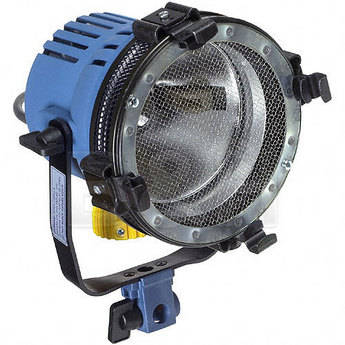


The ARRI ARRILITE 1000 is a focusing, open-face tungsten light, catalogue number 571100. The 1K redhead shares its 571110 barndoor and scrim size with the ARRILITE 650. At 10 ft the DXW puts 145 fc into the centre of a flood beam about 13 ft wide.
It fits a 5/8-inch stand stud and weighs 2.4 kg with its switched cable.
- TypeFocusing open-face tungsten; R7s
- Power1,000 W DXW reference
- Colour Temperature3,200 K DXW; alternate DXN 3,400 K
- Weight2.4 kg with switched cable
- Beam Angle24° spot / 65° flood with DXW
- IP RatingNot documented for 571100 IP rating guide.
ARRILITE 1000 Specifications
This head uses a R7s socket and 7¼ in scrims. The catalogue rates DXW at 3200 K and DXN at 3400 K. The chart below was taken with DXW.
| Lamp | Power | Rated voltage |
|---|---|---|
| DXW | 1000 W | 120 V |
| DXN | 1000 W | 120 V |
Output Calculator
Select the published setup and a manufacturer distance, or enter a custom throw where supported. The results describe centre-beam output, not the brightness across the whole beam.
Camera Settings
If the calculator does not load, use the published photometric table or source on this page. JavaScript is required.
F-stop is a planning estimate, not a meter reading. It uses direct, on-axis illuminance and includes only the optics and diffusion named in the selected setup. Meter on set to account for lens transmission, filters, added diffusion, bounce, dimming and ambient light.
How the exposure estimate works
N = √(E × ISO × t / C), where E is illuminance in lux and t = shutter angle ÷ (360 × fps). The default C = 340 is a dome reference; C = 250 is a flat reference. These are calibration constants, not a measured T-stop. A small nonzero digit is tenths of a stop above the displayed full stop.
Distance estimates and comparisons
Published points are used as given. Between published points the calculator fits a curve through the two nearest readings. Outside those points it uses the inverse-square law only when the fixture’s dataset permits it. Distances outside a configuration’s supported range are reported separately. Comparisons use one shared distance and camera setup; equal lux does not imply equal coverage.
View published readings for the selected configuration
Strengths and Limitations
Spot and flood let one head light both a small target and a broad bounce. The original open face is not a Fresnel and is less useful when the job depends on precise direct-beam cuts.
Practical Uses
At 10 ft, a 65° flood gives a broad bounce field; spot for more centre intensity.
Output and Colour
ARRI measured the DXW at 1000 W and 120 V. The values below are in foot-candles.
| Throw | Spot at 24° | Flood at 65° |
|---|---|---|
| 5 ft | 2780 | 580 |
| 10 ft | 695 | 145 |
| 15 ft | 309 | 65 |
| 20 ft | 174 | 36 |
| 25 ft | 111 | 23 |
Power and Batteries
The tested DXW and the 3400 K DXN are both 1,000 W at 120 V. The head takes a mains lamp directly; there is no ballast or onboard battery. Verify the nameplate and lamp code as a pair before accepting a used head.
Control, Cooling and Camera Operation
The mechanical focus sets beam spread. Use a correctly rated external dimmer if needed and check the warmer colour at reduced levels. Keep heat-sensitive material clear and let the head cool before handling its lamp, scrims or doors.
Modifiers, Rigging and the Working Package
ARRI’s original kit pairs the 571100 with 571110 four-leaf doors, 7¼ in scrims and a matching lightbank ring where specified. Check the front retainer and safety mesh and use accessories rated for this head.
Alternatives and Related Fixtures
Compare the ARRILITE 650 if lower lamp draw and the same accessory diameter matter. Choose a tungsten Fresnel for a cleaner direct edge or an ARRISOFT for indirect fill. Neither the 1000 W Plus Fresnel nor later ARRILITE Plus heads supply the photometry here.
What People Are Saying
Field Feedback at a Glance
Bill Holshevnikoff demonstrates the original ARRILITE 1000 on ARRI’s channel. ARRI’s catalogue and original kit list give the measurements and package details; the operating drawbacks below are documented limits, not quoted owner complaints.
What worked
- An adjustable field: the original DXW chart shows 24° spot and 65° flood, useful for switching between a narrower patch and a broad bounce.
- A workable soft source with the right front: ARRI’s kit information shows the original 1,000 W ARRILITE paired with a small Chimera lightbank and its matching ring.
- Documented kit spares: the 571925 three-head kit identifies the 571100 and the matching 571145 DXW lamp, useful when checking older rental kits.
Drawbacks to plan for
- Centre exposure falls in flood: at 10 ft ARRI reports 695 fc spot versus 145 fc flood under the same lamp test.
- The common 120 V lamp codes do not match in colour: ARRI lists DXW at 3200 K and DXN at 3400 K. Match the code before blending fixtures.
- The 1,000 W head runs hot and takes separate front control. Do not assume a lower-wattage softbox or a Plus/Fresnel accessory is suitable.
Videos
Watch Bill Holshevnikoff demonstrate the original ARRILITE 1000. ARRI identifies this as the 1,000 W ARRILITE, not the 1000 Plus Fresnel or ARRISOFT.
Rental and Used-Fixture Checks
Before You Book
Check DXW vs DXN before matching other tungsten; confirm 571110 doors.
Documentation and Specifications
ARRI Lighting catalogue, printed page 32 · Model 571100 product photograph