
Last Updated 2 days ago
Overview
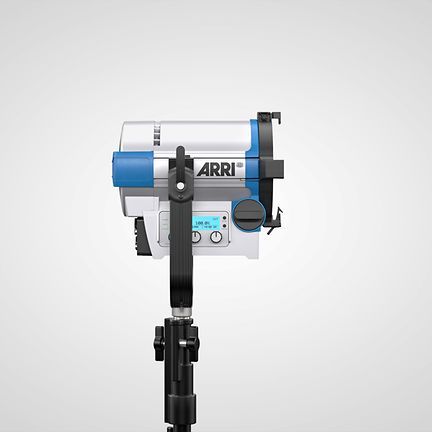
The ARRI L5-C Plus is an RGBW LED Fresnel for compact studios, controlled interview keys and low-ceiling lighting positions. It combines mechanical focus with variable white, tint and colour operation, plus Ethernet control and configuration.
This is the Plus generation. Its 135 W maximum input, 5.4 kg manual-yoke reference and current network interfaces belong to this exact model, rather than to the original L5-C.
Key specifications
| Specification | Details |
|---|---|
| Exact model | L5-C Plus; RGBW LED Fresnel |
| Version order-code family | L1.0048800–L1.0048803; colour/yoke variants |
| Light aperture | 137 mm / 5-inch class |
| Published focus range | 12–46° half-peak |
| White / tint | 2800–10000 K; full minusgreen to plusgreen |
| Colour operation | RGB+W gamut; hue/saturation control |
| CRI / TLCI averages | >95 / >92 |
| Dimming | 0–100% continuous |
| Maximum input consumption | 135 W |
| Mains supply | 100–240 V AC, 50/60 Hz |
| Manual / pole-operated mass | 5.4 kg / 7.3 kg |
| Mount / tilt | 16 mm / 28 mm combo pin / ±90° |
| Network | EtherCon in/thru; Art-Net, sACN, HTTP web control |
| DMX / RDM | Five-pin input/through via specified adapter cable |
| Wireless | External third-party receiver; no built-in radio listed |
| Service | USB-A; supported ARRI service software |
| Daisy-chain / protection | Power/data through connections; Class I / IP20 indoors |
| Operating ambient | −20 to +45°C |
Strengths and limitations
Strengths
- A focusable colour LED provides beam shaping and remote white matching.
- Electronic controls support repeatable settings.
Limitations
- Spot, flood and saturated settings have different exposure behaviour.
- Check generation, firmware and the installed wireless hardware.
Practical uses
The L5-C Plus suits compact studios, controlled interview keys and low-ceiling lighting positions. Its focusable Fresnel lens gives a repeatable hard-light field that can be shaped with matching barndoors, then bounced or diffused when a softer apparent source is required.
The five-inch-class aperture and 5.4 kg manual-yoke reference make it the smaller Plus model. The pole-operated version is 7.3 kg. Its combo pin and compact face suit positions where the L7-C Plus would create more mounting and clearance demand.
Pole operation adjusts pan, tilt and focus mechanically from below. It is not a moving-light pan/tilt system. The sliding stirrup helps balance the assembly, but large modifiers, cable strain and movement still need to be included in the mounting plan.
| Setup | Working approach |
|---|---|
| Shaped key | Focus for the required area, then use doors or flags for spill. |
| Colour accent | Check the actual hue and level through the camera. |
Output and colour
The values below are read from ARRI’s currently displayed L5-C Plus photometric graphic, with CCT, focus and distance retained. The graphic asset is still named “DRAFT” on the manufacturer site; these are identified published reference values, not independent measurements or a claim that the graphic is a final test certificate.
The graphic uses 12° spot, 31° medium and 46° flood references, consistent with the technical overview’s 12–46° focus range.
The narrower spot raises central intensity while reducing coverage. A direct comparison with an original L-Series unit needs matching CCT, beam angle, engine revision and distance. The family’s “up to 90%” improvement claim is not a uniform multiplier for every setting.
| CCT / focus | 3 m, lux | 5 m, lux | 9 m, lux |
|---|---|---|---|
| 3200 K, spot 12° | 5,322 | 1,916 | 591 |
| 5600 K, spot 12° | 5,700 | 2,052 | 633 |
| 3200 K, middle 31° | 1,344 | 484 | 149 |
| 5600 K, middle 31° | 1,433 | 516 | 159 |
| 3200 K, flood 46° | 580 | 209 | 64 |
| 5600 K, flood 46° | 622 | 224 | 69 |

The RGBW engine provides 2800–10000 K white, green/magenta adjustment and saturated-colour operation. The current technical page lists CRI average above 95 and TLCI average >92 for this model. L5-C Plus and L7-C Plus do not share the same listed TLCI average.
Those metrics describe white-light fidelity, not the intensity or spectral behaviour of every saturated cue. Test mixed brands and critical fabrics through the production camera. Record CCT, tint, intensity, colour mode and firmware when reproducing a look.
The Plus generation revises light output and control interfaces. A similar housing, L-Series name or lens class does not justify importing the original model’s power, battery connection or photometric table.
Power and batteries
The current specification lists 135 W maximum consumption from 100–240 V AC at 50/60 Hz. That is distinct from the original L5-C’s 115 W maximum and its documented DC battery input.
Power and data through connections support daisy-chaining with the correct cables. The permitted chain length and load depend on the connector, cable, supply voltage and circuit limit; the presence of a through connector does not establish an unlimited chain.
The current Plus specification lists AC supply. Do not assume the original L5-C’s 23–36 V battery socket is present on this model. Any portable power arrangement must be verified as a complete supported system.
Both Plus fixtures are explicitly Class I / IP20 indoor products, with −20 to +45°C ambient operation listed. Keep the lamp and connections within that environment and maintain the specified cooling clearances. Check fan behaviour and microphone pickup after warm-up using the intended settings.
Control, cooling and camera operation
EtherCon input and through connections carry the supported Art-Net and sACN control routes. The fixture also offers HTTP web access for light settings and configuration. Plan addressing, network topology and console output before treating a connected Ethernet cable as a working control link.
Five-pin DMX input/through and RDM use the specified adapter cable. Include it in a rental or purchase package when the job uses a conventional DMX chain. Match the personality, starting address, dimmer resolution and colour mode between console and lamp.
USB-A provides fixture service, configuration, status and firmware functions with supported ARRI software. It is a different interface from the original model’s Mini-USB. Use the exact firmware and instructions for Plus, and verify stored settings after an update.
Wireless operation requires an external compatible receiver. The technical overview lists third-party receivers rather than a native CRMX radio. Include the receiver, cabling, power and compatible protocol in the actual system plan.
Modifiers, rigging and the working package
Choose the matching barndoors, filter holder, soft-light accessory and mounting hardware for the actual Plus size. Confirm clearance and retention with the manufacturer compatibility information. A mechanical bayonet or accessory diameter alone does not establish that an older attachment is appropriate.
Inspect the Fresnel, focus travel, sliding stirrup, yoke locks, power/data through connectors and adapter cable. Test CCT endpoints, tint, saturated colour, low fades, network control, RDM and the intended signal-loss behaviour. On a pole-operated model, check all three mechanical adjustments.
The original L7-C remains a different reference point with older interfaces and specifications. Choose L5-C Plus for its documented optical size, current output references and Ethernet workflow rather than applying a family brightness claim to every cue.
Alternatives and related fixtures
| Fixture | Choose it for |
|---|---|
| ARRI L-Series Plus | A newer Fresnel generation; compare its own photometrics and connectivity. |
| ARRI tungsten Fresnels | A lamp-based alternative with different power, colour and heat behaviour. |
What people are saying
Matthew Allard: the Plus generation
Matthew Allard’s introduction identifies L5-C Plus and L7-C Plus as the updated L-Series generation, with network control and revised output. The article reports ARRI’s claims rather than an independent photometric comparison. View the source.
Videos
ARRI L5-C Plus: family guide
ARRI’s ISE 2025 explanation of the L7-C Plus; L5-C Plus specifications differ.
Rental and used-fixture checks
Check the exact model and revision, complete power package, mounting hardware and control leads. Inspect emitting surface, connectors and support points. Test the intended operating level, fade and camera settings before rigging.
Documentation and specifications
official L-Series Plus overview, technical and photometric references, model-specific technical drawing and manufacturer documentation downloads.
Product photograph: ARRI official L5-C Plus product photograph.
Browse Arri lights · LED Fresnels · all equipment.