
Last Updated 22 hours ago
ARRI X12 Overview
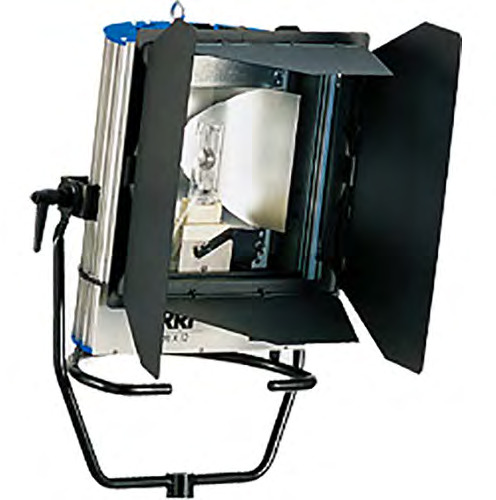
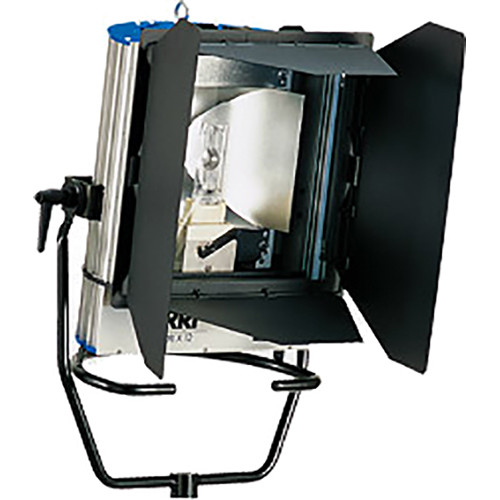
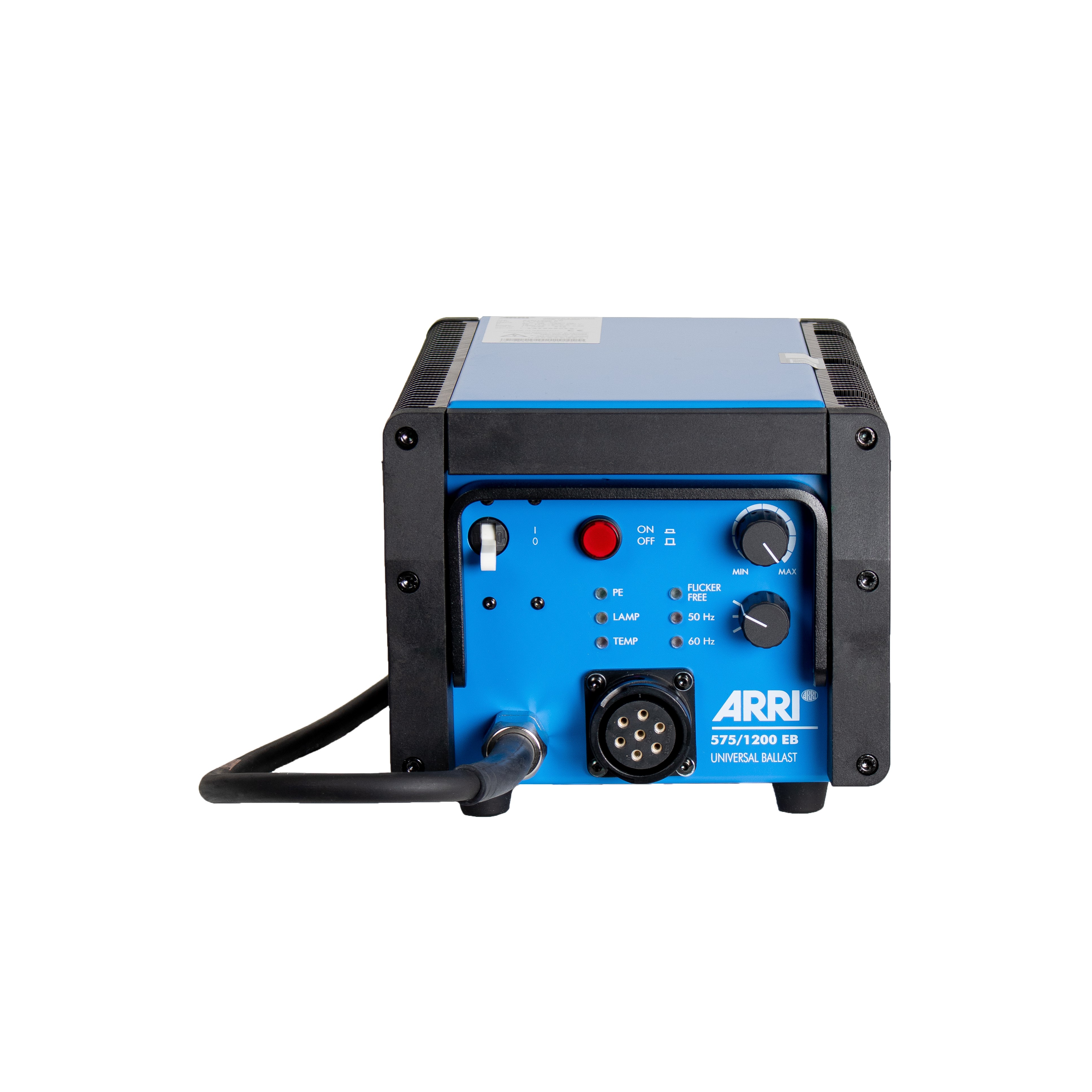
The ARRI X12 is a 1,200 W single-ended HMI broad light with an approximately 128° fixed beam. Its silver reflector is intended to wash large backings, bounce surfaces and diffusion frames evenly at short throw.
Unlike a Fresnel, it does not spot down. Choose the silver or optional black reflector to suit the job and use the matching ballast and cable. Some packages include barndoors and a frosted glass diffuser; confirm both when booking.
- Colour Temperature 6,000 K Nominal daylight lamp class; actual CCT depends on the lamp and its condition.
- Weight 12 kg head (manual); 14 kg in period brochure
- Beam Angle Approx. 128° fixed flood; silver/black reflector
- IP Rating IP23 Check the actual head and complete connected system; not waterproof. Read the IP Rating Guide.
- Power 1,200 W G38 HMI + external matched ballast
- Fixture Type Broad open-face HMI flood
X12 Specifications
| Specification | Details |
|---|---|
| Lamp / base | 1,200 W single-ended metal-halide / G38 |
| Nominal lamp circuit | 100 V; ballast mains input is separate |
| Nominal colour | 6,000 K daylight lamp class |
| Optic | Interchangeable silver or black reflector |
| Published beam | Approximately 128° |
| Head weight | 12 kg in the operating manual; older brochure lists 14 kg |
| Brochure dimensions | 525 × 505 × 260 mm |
| Mount | 28 mm junior spigot |
| Published ballast | EB 575/1200 family; verify connector and generation |
| Clearances | 3.5 m to illuminated surfaces; 1.0 m to flammable material |
| Thermal / tilt | 180°C maximum surface; 45°C ambient; ±90° tilt |
| Status | Discontinued in 2017 |
The Lexicon row correctly identifies the 1,200 W class. Its 120 V arithmetic is not a specification for the lamp circuit or the ballast input.
Output Calculator
Select the published setup and a manufacturer distance, or enter a custom throw where supported. The results describe centre-beam output, not the brightness across the whole beam.
Camera Settings
If the calculator does not load, use the published photometric table or source on this page. JavaScript is required.
F-stop is a planning estimate, not a meter reading. It uses direct, on-axis illuminance and includes only the optics and diffusion named in the selected setup. Meter on set to account for lens transmission, filters, added diffusion, bounce, dimming and ambient light.
How the exposure estimate works
N = √(E × ISO × t / C), where E is illuminance in lux and t = shutter angle ÷ (360 × fps). The default C = 340 is a dome reference; C = 250 is a flat reference. These are calibration constants, not a measured T-stop. A small nonzero digit is tenths of a stop above the displayed full stop.
Distance estimates and comparisons
Published points are used as given. Between published points the calculator fits a curve through the two nearest readings. Outside those points it uses the inverse-square law only when the fixture’s dataset permits it. Distances outside a configuration’s supported range are reported separately. Comparisons use one shared distance and camera setup; equal lux does not imply equal coverage.
View published readings for the selected configuration
Strengths and Limitations
| Strengths | Limitations |
|---|---|
| Extremely broad even field; useful for large flat surfaces and modifiers; conventional G38 single-ended daylight lamp. | Separate ballast and cable; no spot-to-flood focus; substantial safety distance and heat; discontinued system. |
Practical Uses
| Setup | Working approach |
|---|---|
| Backing wash | Cover a broad scenic wall from a relatively short stand-off and overlap multiple heads by meter reading, not eye alone. |
| Large bounce | Place the full field inside the bounce to avoid a bright centre and wasted spill. |
| Diffusion fill | Use the wide silver reflector to fill a frame; change to the black reflector only when the harder direct character is intentional. |
A very wide direct field is not automatically soft. Apparent softness comes from the size of the bounce, diffusion or illuminated surface.
Output and Colour
The ARRI X brochure publishes the complete three-distance table for the single 1,200 W lamp configuration.
| Distance | Centre illuminance | Published field diameter |
|---|---|---|
| 3 m | 2,000 lux | 12.3 m |
| 4 m | 1,125 lux | 16.4 m |
| 5 m | 720 lux | 20.5 m |
Distance Limits: ARRI’s January 2007 X-series operating manual specifies 3.5 m minimum to illuminated surfaces. This control is conservatively restricted to the retained published distances, 4–5 m; values between those distances are interpolations, not additional manufacturer measurements. No output is extrapolated outside that interval. Follow the instructions and nameplate for the exact head in use. The historical 3 m table reading is retained above for source reference only, not as an operating-distance recommendation, and excluded from the calculator.
The historical table retains all three documented readings; only the 4 m and 5 m readings are used in the restricted calculator. Do not apply this configuration to the black reflector or to a fixture whose reflector is damaged or incorrectly fitted.
Power and Batteries
The X12 requires a matching EB 575/1200 or approved period-equivalent ballast and head cable. Connector identity matters. The lamphead is not connected to mains or a conventional dimmer. ARRI also catalogued the EBB 575/1200 battery ballast; the X12 does not accept a battery directly.
Use the ballast input rating for distribution, not 1,200 W divided by a convenient outlet voltage. Confirm the selected operating mode, permitted cable length, protective earth and camera behaviour after warm-up.
Control, Cooling and Camera Operation
The X12 head has an on/off switch, hour counter and safety switch. Dimming and camera modes are ballast functions, not head controls. ARRI lists X12 in the output wiring for specific EB 1200/1800 High Speed ballast versions; confirm the exact variant and connector instead of assuming all 1.2–1.8 kW ballasts fit.
Test the assembled package with the lamp at stable output at the intended camera frame rate and shutter setting. For a quiet scene, check audible lamp and ballast noise from the actual mic position. Keep cooling paths open.
Modifiers, Rigging and the Working Package
Operate only with the required double safety glass and reflector installed. ARRI gives 3.5 m to illuminated surfaces, 1.0 m to flammable objects and a 180°C maximum surface reference.
Support the complete load, including barndoor, cable pull and modifier. Keep the cable away from the housing and leave ventilation paths open. A damaged reflector, glass, latch, cable or lamp holder removes the head from service.
Alternatives and Related Fixtures
| Fixture | Why compare it |
|---|---|
| ARRI M8 | A lensless MAX-reflector head for a more concentrated daylight beam. |
| ARRI True Blue D12 | A conventional daylight Fresnel when focusable beam control matters more than very wide flood coverage. |
| ARRI M18 | A 1.2/1.8 kW MAX head for greater throw without a spread-lens kit. |
What People Are Saying
Field Feedback at a Glance
These practical takeaways are based on ARRI’s original X brochure and the operating manual, not independent owner reviews.
What works
- The silver reflector’s roughly 128° field is intended to fill a wide bounce or backing without moving the head as far back as a narrower fixture.
- ARRI lists 1,125 lux at 4 m with a 16.4 m field in the published flood configuration; check coverage and centre reading together.
- The brochure lists a dedicated 4-leaf door set and optional black reflector, giving the 1.2 kW head separate ways to trim spill or change shadow character.
Drawbacks to plan for
- ARRI sets 3.5 m (11.5 ft) minimum to illuminated areas and 1 m (3.3 ft) to flammables. The 3 m brochure row is not an acceptable operating position.
- The EB 575/1200 name covers more than one head class; the X12 itself requires the approved 1,200 W single-ended G38 lamp and a matching head cable.
- The broad beam is not focusable to a narrow spot. Choose a different optic if a controlled shaft is the priority.
Related X-Series demonstration: Dave Lock used an X5, not an X12, to explain why a broad beam can cover a bounce or fabric from a short throw. Follow the X12’s own clearances regardless of that example. Read PLASA’s account.
Videos and Operating Reference
Use the illustrated ARRI X-Series operating manual to locate the lamp-lock lever, glass frame and safety switch. The illustration covers the family; use the X12 row in the manual for model-specific clearances and operating limits.
Rental and Used-Fixture Checks
Confirm the exact X12 identity, connector and ballast. Inspect the reflector finish, both safety-glass layers, lamp contacts, interlock, barndoor retention, yoke and head cable. Test cold start, stable output, hot restrike and the intended camera settings.
Documentation and Specifications
Official discontinued-series page · ARRI X brochure · ARRI X operating manual · ARRI approved lamps.
Product photograph: ARRI product photograph reproduced in the Lexicon Carbone source document for model identification.
Browse ARRI lights · HMI lights · all equipment.