
Last Updated 22 hours ago
ARRI X5 Overview
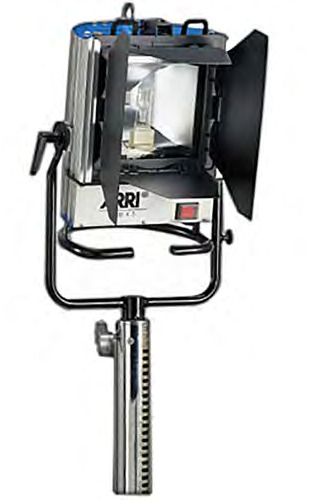
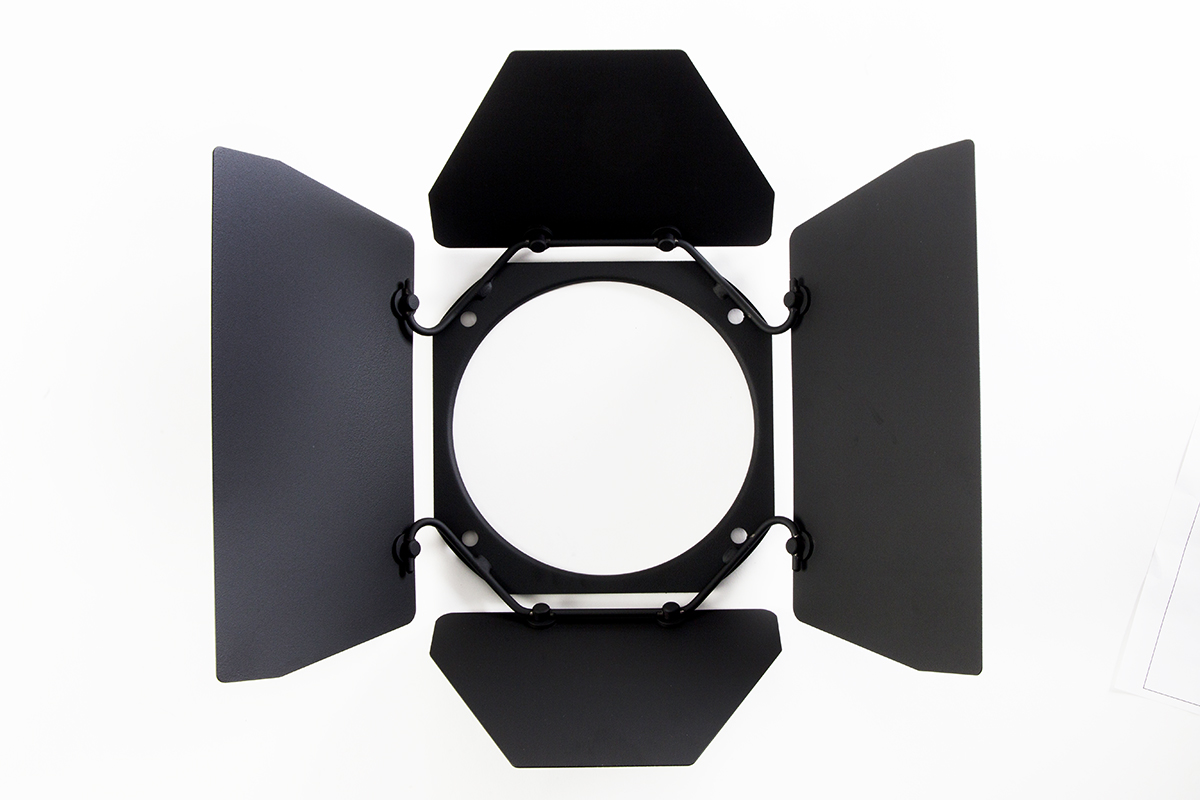
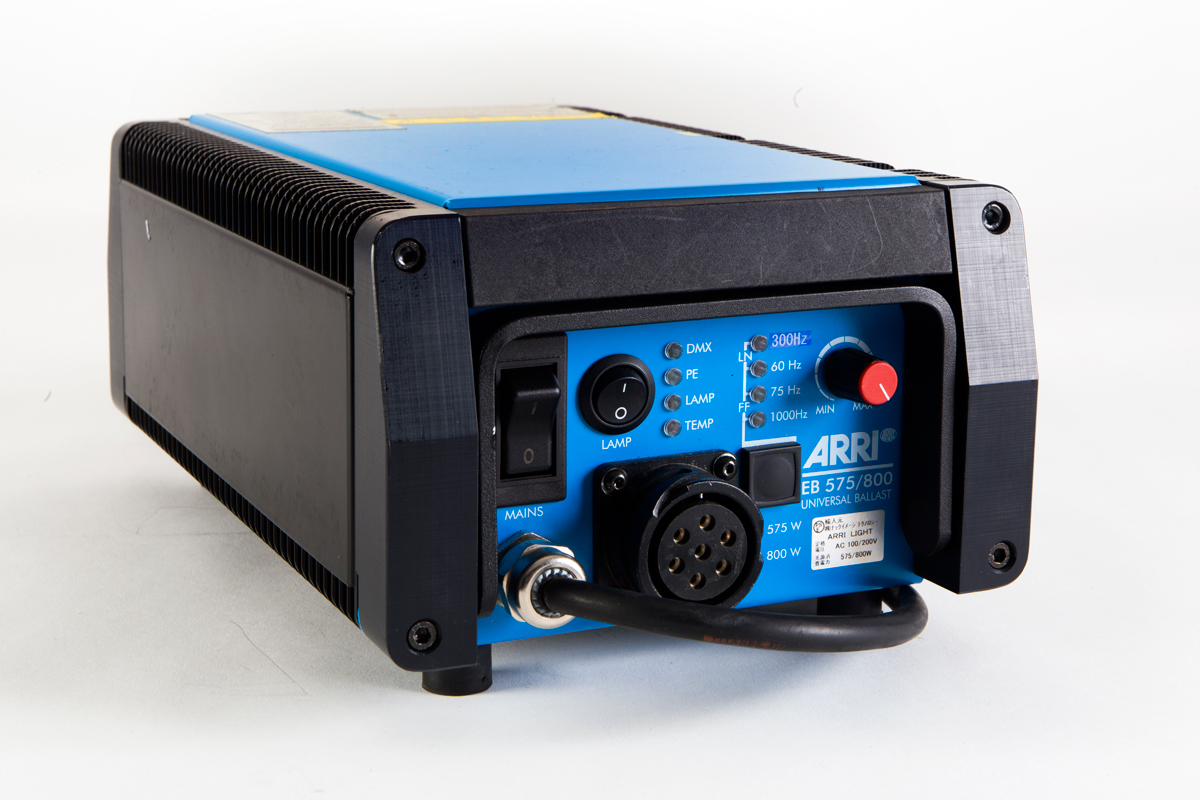
The ARRI X5 is a 575 W single-ended HMI broad light. With the silver reflector it gives an approximately 127° fixed beam for washing flat surfaces at short throw. It is not a Fresnel and does not take PAR spread lenses.
The optional black reflector changes the light distribution rather than giving the head a focusing mechanism. Allow room for its separate ballast and the head cable, and verify the connector at both ends.
- Colour Temperature 6,000 K Nominal daylight lamp class; actual CCT depends on the lamp and its condition.
- Weight 7 kg head (manual); 8 kg in period brochure
- Beam Angle Approx. 127° fixed flood; silver/black reflector
- IP Rating IP23 Check the actual head and complete connected system; not waterproof. Read the IP Rating Guide.
- Power 575 W G22 HMI + external matched ballast
- Fixture Type Broad open-face HMI flood
X5 Specifications
| Specification | Details |
|---|---|
| Lamp / base | 575 W single-ended metal-halide / G22 |
| Nominal lamp circuit | 95 V; the ballast mains input is separate |
| Nominal colour | 6,000 K daylight lamp class |
| Optic | Interchangeable silver or black reflector; no focus mechanism |
| Published beam | Approximately 127° |
| Head weight | 7 kg in the operating manual; an older sales brochure lists 8 kg |
| Brochure dimensions | 372 × 376 × 208 mm |
| Mount | 28 mm junior spigot |
| Published ballasts | EB 400/575 or EB 575/1200; connector version must match |
| Clearances | 2.0 m to illuminated surfaces; 0.5 m to flammable material |
| Thermal / tilt | 130°C maximum surface; 45°C ambient; ±90° tilt |
| Status | Discontinued in 2017 |
The Lexicon row correctly pairs the X5 with a 575 W lamp. Its lamp-wattage calculation is not the ballast input current. Use the actual ballast nameplate and supply voltage for distribution.
Output Calculator
Select the published setup and a manufacturer distance, or enter a custom throw where supported. The results describe centre-beam output, not the brightness across the whole beam.
Camera Settings
If the calculator does not load, use the published photometric table or source on this page. JavaScript is required.
F-stop is a planning estimate, not a meter reading. It uses direct, on-axis illuminance and includes only the optics and diffusion named in the selected setup. Meter on set to account for lens transmission, filters, added diffusion, bounce, dimming and ambient light.
How the exposure estimate works
N = √(E × ISO × t / C), where E is illuminance in lux and t = shutter angle ÷ (360 × fps). The default C = 340 is a dome reference; C = 250 is a flat reference. These are calibration constants, not a measured T-stop. A small nonzero digit is tenths of a stop above the displayed full stop.
Distance estimates and comparisons
Published points are used as given. Between published points the calculator fits a curve through the two nearest readings. Outside those points it uses the inverse-square law only when the fixture’s dataset permits it. Distances outside a configuration’s supported range are reported separately. Comparisons use one shared distance and camera setup; equal lux does not imply equal coverage.
View published readings for the selected configuration
Strengths and Limitations
| Strengths | Limitations |
|---|---|
| Very wide, even short-throw coverage; interchangeable reflector changes the field character; conventional HMI daylight output. | Separate ballast and head cable; no focus range; high UV and heat controls; discontinued parts and reflector condition must be checked. |
Practical Uses
| Setup | Working approach |
|---|---|
| Scenic backing | Use the silver reflector to spread an even field across a flat backing from limited depth. |
| Bounce or diffusion | Fill a large modifier without the hot centre typical of a narrower source; confirm edge coverage with a meter. |
| Direct hard flood | Use the black reflector when a harder arc-light-style shadow is wanted, while keeping the safety glass installed. |
The X-series can look soft only after it fills a bounce or diffusion. Used directly, it remains a hard source despite the very wide field.
Output and Colour
The ARRI X brochure publishes three centre-illuminance readings for the 575 W X5 with the flood reflector. The table also identifies the 127° field and corresponding coverage diameters.
| Distance | Centre illuminance | Published field diameter |
|---|---|---|
| 2 m | 2,003 lux | 8 m |
| 3 m | 890 lux | 12 m |
| 4 m | 501 lux | 16 m |
Distance Limits: ARRI’s January 2007 X-series operating manual specifies 2 m minimum to illuminated surfaces. This control is conservatively restricted to the retained published distances, 2–4 m; values between those distances are interpolations, not additional manufacturer measurements. No output is extrapolated outside that interval. Follow the instructions and nameplate for the exact head in use.
All three documented readings are retained within the restricted calculator range. The control is for the stated silver flood-reflector configuration, not the optional black reflector or an unknown rental lamp.
Power and Batteries
The lamphead connects to a compatible ballast, not directly to mains. ARRI lists EB 400/575 and EB 575/1200 families in the period brochure. VEAM, Schaltbau and generation-specific versions are not interchangeable merely because the wattage matches.
The 575 W figure and 95 V lamp circuit do not describe the ballast input. Plan current from the selected ballast nameplate and manual, including starting behaviour, power factor and the actual supply. ARRI also catalogued an EBB 575/1200 battery ballast. That is an external period ballast option, not a direct battery input on the X5; verify its supply and head connector against the actual kit.
Control, Cooling and Camera Operation
The X5 has a head switch, hour counter and safety switch, not an LED-style control interface. Any remote control or electronic dimming depends on the ballast supplied. See the EB 400/575 operating instructions for the ballast listed in the period brochure.
Test at the intended frame rate and shutter with the lamp warmed up. Electronic ballast modes can trade audible lamp noise against flicker behaviour; ARRI describes this explicitly for its EB 575/800, which lists the X5 as a compatible head. Use the instructions for the ballast actually supplied. Avoid blocking the head’s ventilation or enclosing it in an unventilated space.
Modifiers, Rigging and the Working Package
ARRI requires the double safety glass and reflector to be installed and undamaged. Do not bridge the enclosure interlock. The manual gives 2.0 m to illuminated surfaces and 0.5 m around the head to flammable material.
The 28 mm spigot identifies the interface, not the capacity of a stand. Include the head, barndoor, reflector, cable pull and any modifier in the load. Keep ventilation open and keep the cable away from the hot housing.
Alternatives and Related Fixtures
| Fixture | Why compare it |
|---|---|
| ARRI M8 | A lensless MAX-reflector head for a more concentrated daylight beam. |
| ARRI True Blue D12 | A conventional daylight Fresnel when focusable beam control matters more than very wide flood coverage. |
| ARRI M18 | A 1.2/1.8 kW MAX head for greater throw without a spread-lens kit. |
What People Are Saying
Field Feedback at a Glance
These points come from ARRI’s X5 literature and operating instructions, not from an independent crew test.
What works
- The silver reflector gives a 127° flood. ARRI’s X5 chart lists an 8 m field diameter at 2 m, useful when the set does not leave much room behind the lamp. ARRI X5 brochure.
- A removable black reflector is available when the silver flood is not the look you want; this changes the field without changing heads. ARRI accessory list.
- ARRI offered X5-specific barndoors, frosted UV-protective safety glass and a softbox adapter. That gives the fixture three different ways to manage the broad field without pretending it is a focusable head. ARRI accessory list.
Drawbacks to plan for
- The broad reflector is fixed, not a spot-to-flood control. For a narrower shaft of light, pick a focusing HMI rather than expecting the black reflector to turn this into one. ARRI X5 brochure.
- The manual requires 2 m to the lit surface and 0.5 m around flammable material. The broad shape may fit a shallow set, but the clearances still apply. ARRI X operating manual.
- A matching ballast and head cable are essential. The lamp’s 575 W rating cannot tell you which ballast connector or supply arrangement is present on a rental package. ARRI ballast list; ARRI X operating manual.
Videos and Operating Reference
For a prep reference, the illustrated ARRI operating manual identifies the glass frame, lamp-lock lever, safety switch and hour counter. The diagram covers the X range; follow the X5 entries and the label on the head.
Rental and Used-Fixture Checks
Identify X5, X5 Event and any connector variation separately. Inspect both safety-glass layers, silver or black reflector, lamp holder, interlock, yoke, spigot and head cable. Confirm which ballast and reflector are included, then perform a hot-restrike and camera test.
Documentation and Specifications
Official discontinued-series page · ARRI X brochure · ARRI X operating manual · ARRI approved lamps · ARRI head cables.
Product photograph: ARRI product photograph reproduced in the Lexicon Carbone source document for model identification.
Browse ARRI lights · HMI lights · all equipment.