
Last Updated 1 day ago
Overview
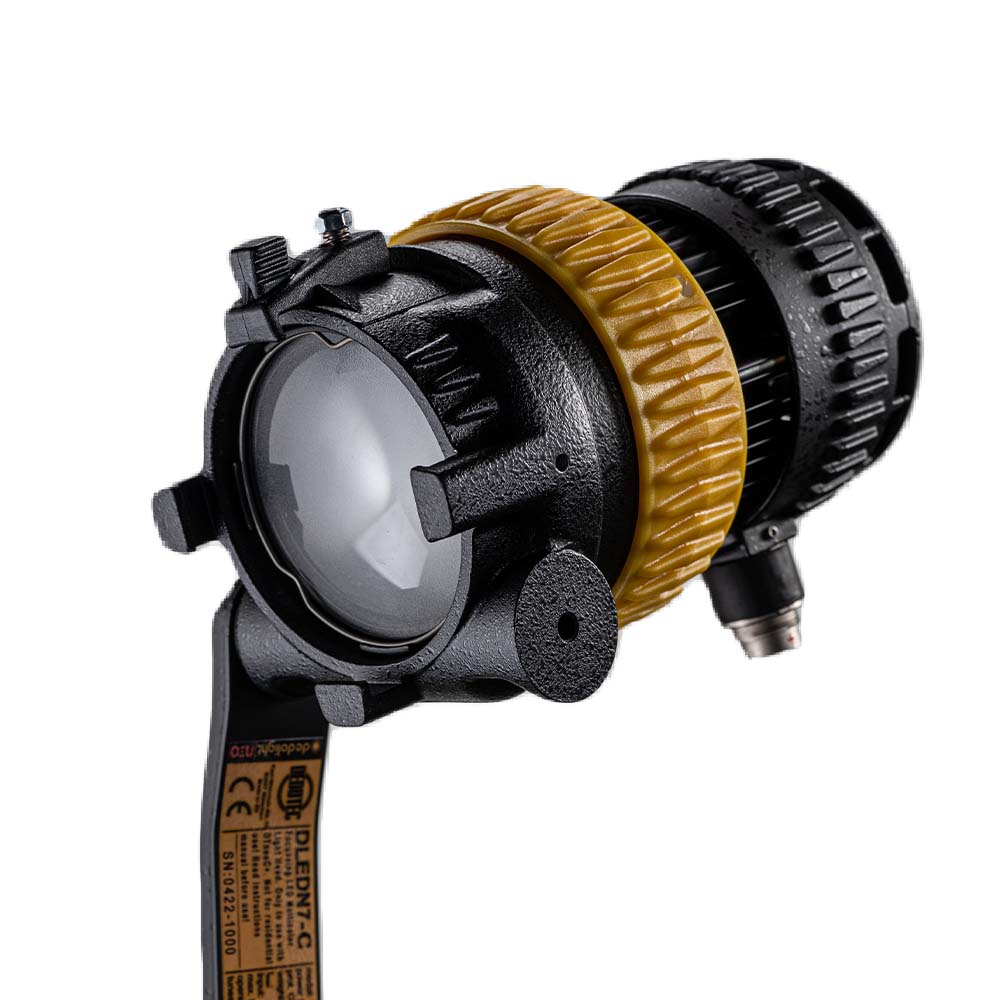
The Dedolight DLED7N-C NEO Color is an 80W RGBACL focusing spotlight using a Prolycht-developed six-colour engine. It adds saturated colour, white-light tuning, tint correction and effects to the compact dedolight system.
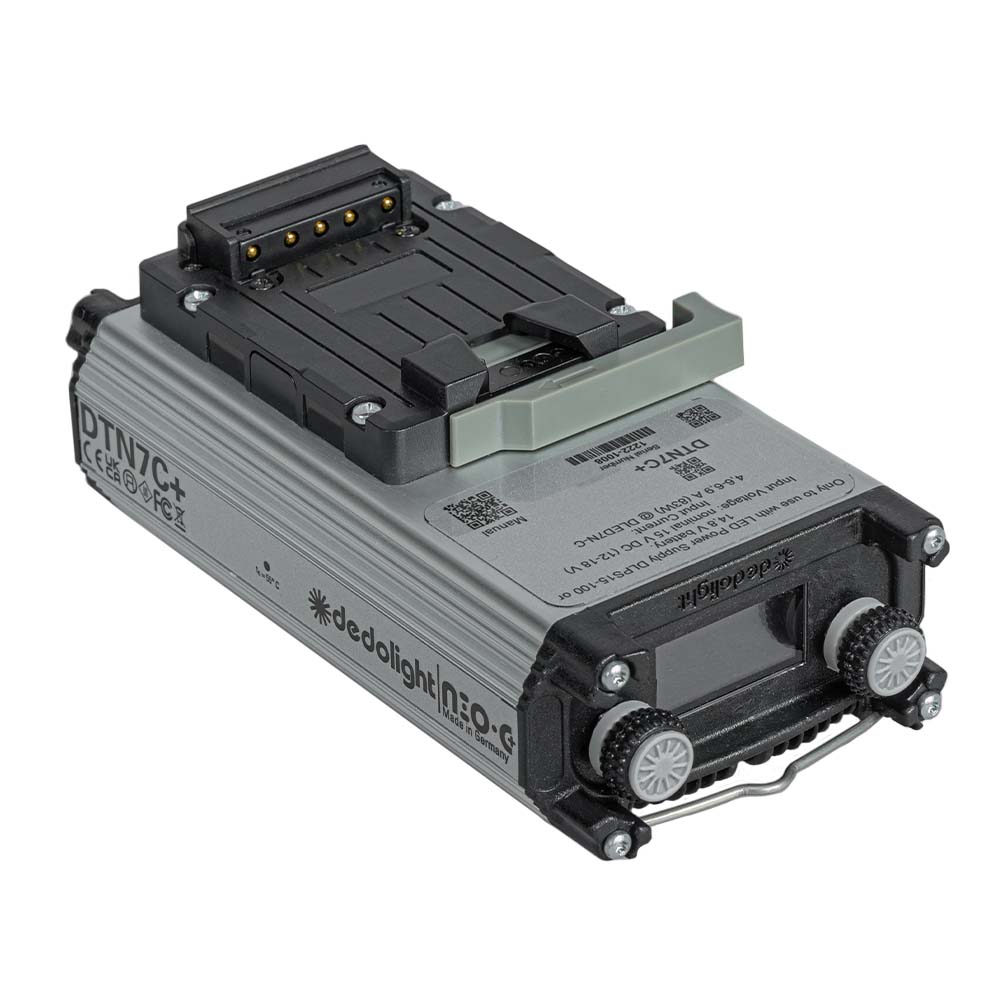
Product views: Dedolight California. Select an image to enlarge.
The engine combines red, green, blue, amber, cyan and lime emitters. Its dedicated colour controller and DPOWN7C cable differ from the white-light NEO package. The wider colour range comes with different beam and shadow behaviour from the DLED7N-BI.
Key specifications
| Specification | Details |
|---|---|
| Source | RGBACL LED with aspheric focusing optics |
| Power reference | 80W head |
| Colour / white-light range | 1,800–20,000K in the controller technical sheet; early launch copy starts at 2,000K |
| Native beam | 15–50° in the current product table |
| Optical accessory family | M |
| Cooling | Active cooling |
| Control | Dedicated colour controller: local, DMX, CRMX and supported app/network paths |
| Working package | Head, fitted optics, support, appropriate power electronics and cables; battery/AC accessories depend on configuration |
Strengths and limitations
Strengths
- Full-colour control in a compact focusing head.
- Dedicated controller provides CRMX and effects.
Limitations
- Narrower native focusing range than the bi-colour head.
- Colour-specific controller and cable are required.
Practical uses
| Setup | Working approach |
|---|---|
| Passing-light effects | Build the cue, then check skin and wardrobe through the production camera. |
| Coloured projection | Fit an approved M-size projector and inspect edge colour at the intended hue. |
| Source matching | Use CCT/tint or x,y, checking actual materials instead of only the Kelvin display. |
Set the head position for the direction and shadow first, then choose focus and accessories for coverage. A sharp gobo or precisely shuttered image needs imaging optics; closing barn doors around a small spot does not create the same optical result.
Output and colour
The manufacturer controller sheet specifies 1,800–20,000K; early launch descriptions often begin at 2,000K. The current head table lists a 15–50° beam. Neither the original launch’s beam-ratio wording nor the bi-colour head’s range should replace that model-specific angle reference.
For a useful comparison, record colour setting or lamp, dimming level, optic, focus position, distance and illuminated area. Measure after diffusion or reflection when that is the working setup. Wattage, centre intensity and coverage describe different parts of the result.
Power and batteries
Use the colour-specific DTN7C+/DTneoC+ controller and DPOWN7C-series head cable. This is a different package from the ordinary mono/bi-colour DTneo system. The documented DC supply range is 12–18V, nominally 15V, through a suitable V-mount battery or the specified AC adapter.
Confirm the colour controller, cable and adapter are included in a rental. Battery capacity determines stored energy, while continuous discharge capability determines whether the pack can carry the working load.
Control, cooling and camera operation
| Control path | Operating notes |
|---|---|
| Local | OLED menu, intensity, CCT/tint and colour controls through the dedicated controller. |
| Wired/wireless | 5-pin DMX and CRMX; the manufacturer sheet also documents Art-Net and Bluetooth. Confirm the implementation and network path on the supplied controller. |
| App and cues | ChromaLink offers colour selection and effects. Match the console personality and firmware before cueing a fade or colour transition. |
Cooling reference for this head: Active cooling. Listen to the complete working package, including its controller or ballast, rather than checking only the head.
Modifiers, rigging and the working package
| Item | Compatibility and working notes |
|---|---|
| Accessory family | M-size; check the compatibility list for the actual head and generation. |
| Projection | Compatible DP1/DP2-family M-size imager, projection lens and desired shutter/gobo/iris assembly. |
| Beam control | Model-approved barn doors, light shield ring and wide-angle/parallel-beam attachments. |
| Soft light | Compatible speedring/softbox or a properly supported diffusion/bounce surface. |
Aspheric focusing optics are different from a conventional Fresnel. Check the actual accessory’s compatibility list, locking method and lens choice. A brand name or similar front diameter is not enough to establish fit.
Fit the intended front accessory before choosing the stand position. Check tilt clearance, balance, cable movement and independent support for any external electronics. Use the documented mounting hardware and appropriate secondary retention for the installation.
Alternatives and related fixtures
| Fixture | Reason to compare |
|---|---|
| Dedolight DLED7N-BI NEO | Useful output in a compact M-size package. 80W head in the current California NEO listing; M-size optical system. |
| Dedolight DLED7-BI Turbo | Higher output class than the original 40W DLED4. 90W-labelled original Turbo head; M-size optical system. |
| Dedolight DLED10-BI | Tunable white in the larger A-size optical system. 220W light-engine class; published maximum power 245W; A-size optical system. |
Classic Dedolight DLH4: the original low-voltage tungsten alternative with a separate supply. Compare the full power and accessory package, rather than the bare-head price.
What people are saying
Manufacturer and distributor demonstrations
Dedo Weigert / Sean Boyriven: NEO Color DLED7N-C controls, ChromaLink and colour-picker operation. View the demonstration.
Sean Boyriven’s bi-colour versus multicolour comparison highlights differences in output, focusing and shadows. It is a distributor demonstration, rather than an independent measurement.
Videos
Dedo Weigert / Sean Boyriven: NEO Color DLED7N-C controls, ChromaLink and colour-picker operation.
Watch the demonstration on YouTube.
NEO Color versus NEO Bi-Color: choosing between the two optical and colour systems.
Watch the demonstration on YouTube.
Rental and used-fixture checks
- Verify the colour-specific controller and DPOWN7C cable are present.
- Check saturated hues, white light, tint correction and fades on camera.
- Test CRMX pairing and inspect projection-edge colour with the actual accessory.
Confirm availability of service and replacement parts with the relevant supplier before buying older equipment. Check the actual kit contents against the shot: a missing controller, imager, lens or cable can matter more than a low head-only price.
Documentation and specifications
- Dedolight California: Dedolight DLED7N-C NEO Color product and package information
- Dedolight manuals, technical sheets and photometric documents
- Dedolight imaging systems and optical size families
- Manufacturer NEO Color controller technical sheet
- Dedolight manufacturer and dealer contacts
Product photographs: Dedolight California. Published specifications describe the referenced configuration; check the markings and instructions of the actual head, controller and fitted accessories.
Browse Dedolight lights · directional LED lights · all equipment.