
Last Updated 5 hours ago
Desire Fresnel 7 Overview
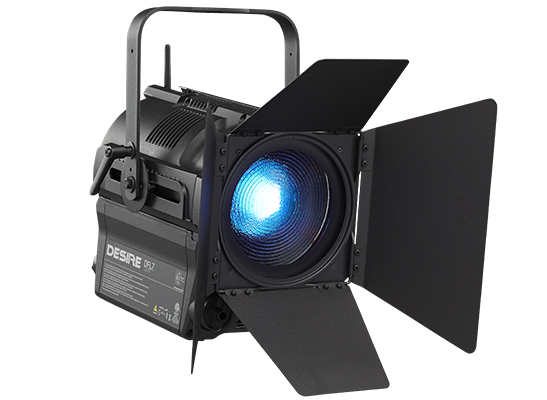
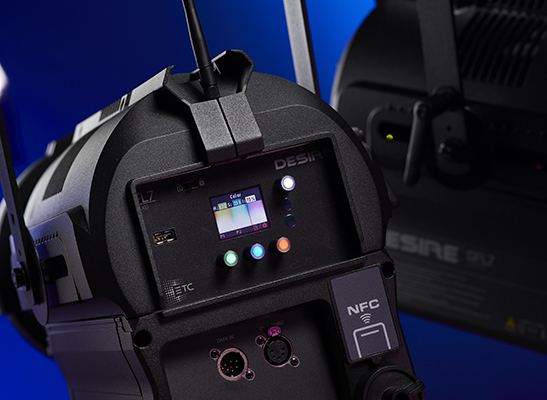

The ETC Desire Fresnel 7 is a 7-inch full-colour LED wash fixture with a Lustr X8 engine, manual beam adjustment and onboard colour controls. It brings the soft edge and overlap of a theatre Fresnel to studios, stages and filmed performance setups, with deep red included in its eight-colour mix.
- LED Fresnel Lustr X8 eight-colour array
- Power 138 W, typical at 120 V AC
- Colour Temperature 1,900–10,450 K
- Weight 10.8 kg
- Beam Angle 13–55° manual zoom
- IP Rating IP20 · indoor dry locations. IP ratings guide.
Desire Fresnel 7 Specifications
| Specification | Details |
|---|---|
| Light engine | Lustr X8 eight-colour array |
| White-light range | 1,900–10,450K |
| Optical system | 7 inch Fresnel lens |
| Beam coverage | 13–55° |
| Typical input at 120V | 138W; see power section for test conditions |
| Published weight | 10.8kg; see working-package notes |
| DC operation | AC powered; no direct DC input listed |
| Protection | IP20; indoor dry-location equipment |
| Control | 5-pin DMX/RDM; Multiverse on equipped models; NFC configuration |
| Flicker settings | 5kHz / 25kHz |
| Zoom drive | Manual |
Desire Fresnel 7 Output Calculator
Estimate centre-beam output or compare two settings at the same throw. The calculator uses candela from the ETC Desire Fresnel datasheet, rev F, pp. 7–9. The three focus settings are ETC’s measured zoom positions. They do not necessarily cover the same area as the corresponding positions on the 5-inch model.
Camera Settings
At 5 m (16.4 ft) in spot, 5,600 K Brightest gives about 2,049 lx at beam centre; 5,600 K Spectral gives about 1,771 lx. The reference table works without JavaScript.
Published intensity data and calculation method
Lux = candela ÷ distance in metres squared. Foot-candles = lux ÷ 10.7639. The camera estimate uses f-number = √(lux × ISO × shutter time ÷ meter reference). The small digit is tenths of a stop, not a T-stop.
The minimum throw is 3.048 m, the closest tabulated throw used here. Beyond that, these are inverse-square estimates at beam centre, not measurements or coverage predictions. Only ETC’s published focus and output settings are included; diffusion, accessories and dimming are not modelled. Meter the working setup.
| Focus | Full On | 3,200 K Brightest | 3,200 K Spectral | 4,500 K Brightest | 4,500 K Spectral | 5,600 K Brightest | 5,600 K Spectral |
|---|---|---|---|---|---|---|---|
| Spot | 58,492 | 52,585 | 45,068 | 60,238 | 51,769 | 51,224 | 44,274 |
| Mid | 20,550 | 18,345 | 15,816 | 21,344 | 18,073 | 17,937 | 15,776 |
| Flood | 8,582 | 7,827 | 6,722 | 8,991 | 7,704 | 7,646 | 6,659 |
Strengths and Limitations
| Aspect | Working implication |
|---|---|
| Strength | Adjustable coverage without replacing the whole head. |
| Strength | NFC setup and a console control path for repeatable programming. |
| Limitation | Wash optics cannot project sharp gobos or shutter cuts. |
| Limitation | Active cooling and IP20 protection require attention to sound and location conditions. |
Practical Uses
- Build an overlapping stage wash without the hard-edged circles associated with profile optics.
- Use as a soft-edged backlight in a filmed performance; choose beam coverage before balancing level against the front key.
- Create colour changes on scenery without moving gel frames, keeping a repeatable console cue for each scene.
The zoom is a mechanical focus adjustment, not the DMX-motorised zoom of ColorSource Fresnel V. Use barn doors to contain spill; if a projected pattern or exact shutter cut is needed, move to a profile fixture.
Output and Colour
| Manufacturer reference | Published value |
|---|---|
| Published maximum flux | 6,176 lumens |
| Typical input, 120V | 138W |
| Beam adjustment | 13–55° |
Lumen ratings describe total flux, while lux describes light arriving at a surface. Do not read the flux table as a lux measurement at a particular distance. Use ETC’s linked photometry for the exact array, lens, focus and diffusion configuration. Meter the working setup after adding colour, diffusion or other modifiers.
Lustr X8’s eight emitters include deep red alongside red, amber, lime, green, cyan, blue and indigo. Calibrated colour modes and direct-emitter control behave differently. ETC’s calibration guide explains which modes retain calibration; bypassing it can change fixture matching.
Power and Batteries
The current combined datasheet lists 138W typical at 120V for this 7-inch model. It lists 100–230V AC operation. The 5-inch and 7-inch figures are not a simple power ladder, so do not estimate draw from lens size. Use the nameplate and regional manual for the actual fixture.
Check the supply lead, grounding, connector rating and total circuit load. Published fixture-per-circuit counts assume a particular breaker and supply condition; they are not a universal instruction for every outlet or distribution system. Account for startup current as well as steady running draw.
Control, Cooling and Camera Operation
| Control path | Operation |
|---|---|
| Wired control | 5-pin DMX and RDM. Match operating mode and DMX footprint to the console profile. |
| Wireless control | City Theatrical Multiverse on equipped versions. It is a different system from CRMX; confirm the transmitter and receiving hardware. |
| NFC | ETC Set Light configures supported fixture properties at close range. NFC setup is separate from continuous wireless DMX control. |
| Cooling and PWM | Active fan cooling; use the specified frequency choices and test the actual fan setting, dimming level, shutter and frame rate. |
Test low-level fades as well as full output. A high PWM frequency alone does not prove flicker-free results at every frame rate and shutter combination. Listen to the fan at the microphone position after the fixture has reached working temperature. Save cooling, colour and operating-mode settings with the lighting notes.
Modifiers, Rigging and the Working Package
The 7-inch lens does not accept every accessory labelled Fresnel. Match the frame size, barn-door latch and fixture approval. A Bowens softbox does not mount directly to this theatre housing; use a supported external diffusion arrangement when a broader source is required.
IP20 describes an indoor fixture, so plan a suitable dry environment. Keep vents unobstructed and follow the regional manual’s mounting and clearance instructions. For overhead work, use the designated mounting and secondary attachment points with hardware rated for the complete assembly.
Alternatives and Related Fixtures
| Compare | When it helps |
|---|---|
| ETC Source Four tungsten | A tungsten profile when shutter cuts and pattern projection matter; it needs an appropriate lamp and external dimming. |
| ETC lighting hub | Compare ETC’s panel, Fresnel and profile formats by the beam needed for the job. |
| All equipment | Compare other manufacturers with the same source size, working distance and modifier. |
What People Are Saying
ETC’s Desire Fresnel demonstration covers the colour engine and wash behaviour. It provides a useful view of operation, but it does not establish measured camera performance for each size. A side-by-side camera test remains useful when matching a rental unit to an existing package. View the source.
In its July 2024 account of Hamburg’s monsun.theater upgrade, ETC lists 20 Desire Fresnel 7 fixtures. The theatre’s Martin Hüsges described the new LED rig as useful for both stage lighting and livestreams, and noted that reduced heat mattered under a low ceiling. He was describing the rig as a whole, not rating this Fresnel on its own. ETC’s monsun.theater fixture list.
The practical notes below use ETC’s specifications for this model and its accessory sizing chart. Field accounts are not photometric tests.
What Works
- A wide zoom range on one 7-inch lens: The DFL7’s 13–55° range lets the crew tighten a backlight or open up a wash without changing optics.
- Shape the spill at the lens: The 7-inch Fresnel accepts its own 7.5-inch accessories, including the appropriate barn doors for taking light off nearby scenery.
- Documented stage and livestream application: monsun.theater specified 20 DFL7 units as part of a rig used for both live stage and streams.
What to Watch For
- The 7-inch head is the heavier one: ETC lists 10.8 kg before added clamps and accessories; the 5-inch model’s 7.8 kg figure does not apply.
- Check fan and camera settings on the rig: The fan is controllable, but that does not make it silent. ETC lists 5 kHz and 25 kHz flicker-control settings: test the actual frame rate and shutter.
- Indoor rating and wash optics: IP20 is not protection against rain, and the Fresnel cannot track a sharp shutter cut or project a gobo like a profile. Use the right fixture for the edge you need.
Videos
ETC’s official Desire Fresnel overview covers the 5-inch and 7-inch models. It shows the shared zoom controls; use the DFL7 figures above for angle, weight and output.
Rental and Used-Fixture Checks
- Confirm the model label, array and regional power rating; housing appearance alone may not identify the light engine.
- Inspect the Fresnel lens, focus travel, barn-door retention and yoke lock.
- Test every colour channel, low-level fades, fan operation and the intended wired or wireless control mode.
- Check firmware against the manufacturer’s support notes and run the required camera test before rigging.
- Ask ETC to verify an early head’s build date from its serial number. ETC’s service note says the original zoom springs could let focus drift when the Fresnel pointed down with a heavy front accessory. The longer springs entered production on December 2, 2021. Confirm the head holds focus at the intended angle with the actual accessory fitted.
Documentation and Specifications
ETC colour-calibration modes · ETC fixture directory and photometry downloads
Photographs: ETC. Family photographs and shared housing details are identified in their captions.
Browse ETC lighting · all equipment.