
Last Updated 9 hours ago
Source Four PAR Overview
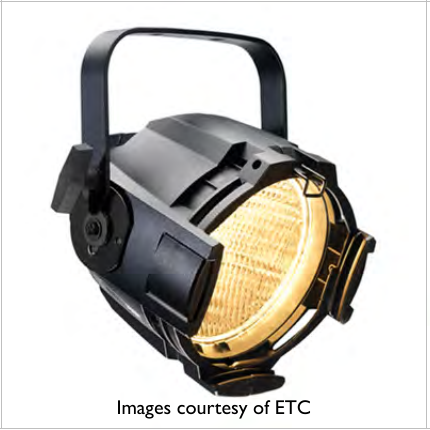


The ETC Source Four PAR EA is a 750 W maximum tungsten PAR with an HPL source, faceted enhanced-aluminum reflector and interchangeable VNSP, NSP, MFL and WFL lenses.
Use it for a defined pool or a shaped wash when you want tungsten light but need more beam options than a fixed-lamp PAR can. This is a PAR, not the Source Four profile: it does not project a sharply cut shutter or gobo pattern.
- Fixture TypeTungsten HPL PAR with an enhanced-aluminum reflector.
- Power RequirementUp to 750 W on units rated for it; use the HPL lamp approved for the particular fixture and supply voltage.
- Colour Temperature3,250 K Nominal for the HPL 750/115 test lamp. Other lamp codes vary.
- Weight and Mount3.4 kg fixture; steel yoke. Clamp weight is additional.
- Beam ControlInterchangeable VNSP, NSP, MFL and WFL lenses; optional XWFL.
- IP RatingIP20 Indoor, dry locations. IP Rating Guide.
The tungsten Source Four PAR EA uses an HPL lamp and interchangeable PAR lenses. Choose it for a pool, accent or wash rather than the shutter cuts or pattern projection of a Source Four profile.
Source Four PAR Specifications
| Specification | Details |
|---|---|
| Electrical | 115–240 V, 50/60 Hz fixture family |
| Lamp rating | 750 W maximum HPL lamp |
| Lens options | Standard VNSP, NSP, MFL and WFL lenses; optional XWFL |
| Standard package | Source Four PAR EA ships with an MFL lens, colour frame and 3 ft lead |
| Ingress protection | Dry-location IP20 fixture |
Output Calculator
Select the published setup and a manufacturer distance, or enter a custom throw where supported. The results describe centre-beam output, not the brightness across the whole beam.
Camera Settings
If the calculator does not load, use the published photometric table or source on this page. JavaScript is required.
F-stop is a planning estimate, not a meter reading. It uses direct, on-axis illuminance and includes only the optics and diffusion named in the selected setup. Meter on set to account for lens transmission, filters, added diffusion, bounce, dimming and ambient light.
How the exposure estimate works
N = √(E × ISO × t / C), where E is illuminance in lux and t = shutter angle ÷ (360 × fps). The default C = 340 is a dome reference; C = 250 is a flat reference. These are calibration constants, not a measured T-stop. A small nonzero digit is tenths of a stop above the displayed full stop.
Distance estimates and comparisons
Published points are used as given. Between published points the calculator fits a curve through the two nearest readings. Outside those points it uses the inverse-square law only when the fixture’s dataset permits it. Distances outside a configuration’s supported range are reported separately. Comparisons use one shared distance and camera setup; equal lux does not imply equal coverage.
View published readings for the selected configuration
Strengths and Limitations
Strengths: One body takes four common spread lenses. The round spot options give a small pool; the oblong medium and wide lenses let you choose a field that covers more of a wall or stage.
Limitations: Lens changes are discrete rather than a focus sweep. The tungsten lamp draws its rated power and produces substantial heat; this is a dry-location fixture, and a used PAR EA may not be labelled for 750 W.
Practical Uses
For a narrow accent, start with the VNSP or NSP and check both the centre and the field boundary. For a backdrop wash or a longer strip across scenery, try the MFL or WFL. Orient the oblong beam to the surface and recheck spill after aiming.
If you need to dim on cue, confirm the existing dimmer and circuit suit the fitted tungsten lamp. For camera work, check the colour at the working dimmer level rather than assuming it matches the full-output lamp rating.
Output and Colour
ETC measured the following data with a calibrated HPL 750/115, 300-hour lamp at rated voltage, normalized under IES LM-73-04. The four configurations preserve every documented distance reading for the standard lenses, using ETC’s rounded metric distances. Interpolation is restricted to each lens’s published range: VNSP 9.1–25.9 m, NSP 7.6–24.4 m, MFL 4.6–15.2 m and WFL 2.4–9.1 m.
| Lens | Distances | Foot-candles | Lux |
|---|---|---|---|
| VNSP | 30 / 50 / 70 / 85 ft | 425 / 153 / 78 / 53 fc | 4,570 / 1,645 / 839 / 569 lux |
| NSP | 25 / 45 / 65 / 80 ft | 539 / 166 / 80 / 53 fc | 5,799 / 1,790 / 858 / 566 lux |
| MFL | 15 / 25 / 40 / 50 ft | 601 / 216 / 85 / 54 fc | 6,467 / 2,329 / 910 / 582 lux |
| WFL | 8 / 16 / 24 / 30 ft | 739 / 185 / 82 / 53 fc | 7,950 / 1,987 / 883 / 565 lux |
Power and Batteries
ETC’s lamp table includes 375 W, 550 W, 575 W and 750 W HPL variants at several voltages. Output conversion requires the optic-specific candela multiplier, not a simple wattage ratio. Use the exact lamp code and supply voltage. The 2020 datasheet specifies 750 W maximum for a PAR EA rated to accept that lamp.
Older units: ETC says PAR EA units shipped after October 31, 1999 are listed for up to 750 W and have a 750 mark on the burner cap. Check the fixture marking before fitting a 750 W lamp. This rating does not apply to the PAR MCM. See ETC’s PAR EA rating notice.
Control, Cooling and Camera Operation
The lamp is dimmed externally on a suitable tungsten circuit. Check exposure and colour at the level used on camera. The housing and lens become hot; disconnect power and let the head cool before servicing it.
Modifiers, Rigging and the Working Package
| Lens / Reference | Beam Angle | Field Angle | Peak Candela |
|---|---|---|---|
| VNSP · 400-VNSP | 9° | 16° | 382,145 |
| NSP · 400-NSP | 9° | 17° | 336,740 |
| MFL · 400-MFL | 13° V × 18° H | 23° V × 31° H | 135,225 |
| WFL · 400-WFL | 20° V × 31° H | 37° V × 51° H | 47,270 |
VNSP and NSP produce round beams; MFL and WFL are oblong. The 400-LS4 set contains these four lenses. The optional 400-XWFL is listed separately, without a corresponding chart in this sheet. The included 407CF colour frame is 7.5 inches. Fixture weight is 3.4 kg; ETC lists an additional 2.3 lb for a C-clamp. Source: ETC PAR EA datasheet, Rev. J (December 2020), pages 1–5.
Alternatives and Related Fixtures
For a shutter cut or a gobo, use the ETC Source Four tungsten profile. Compare the PAR when you need a bright field rather than a projected edge.
What People Are Saying
Field Feedback at a Glance
What worked
- Low, warm light on windows and backgrounds. The cinematographer quoted below uses tungsten Source Four PARs for uplight and low-angle illumination. That is an example, not a measured comparison.
- Several beam shapes from one body. The EA takes interchangeable PAR lenses and HPL lamps rather than requiring a separate can for every beam. See the fixture documentation.
- 575 W is a real stage-package choice. Kingston Grand Theatre’s inventory below lists 38 ETC Source Four PARs with 575 W HPL lamps. The calculator uses a separate 750 W test, not the theatre’s setup.
Drawbacks to plan for
- Some early heads are not rated for 750 W. Check the fixture label, supply voltage and approved HPL before ordering. ETC’s rating reference.
- Read the markings on the lenses. ETC documented a production change to the lens set. Do not assume a rental includes the original set or the optional wide lens. ETC’s lens-change notice.
- Fixed colour depends on the lamp and dimmer level. This is not the ColorSource LED PAR or the PARNel. Meter at the actual dim level and use CTO or CTB where required; the 750 W test does not include those filters.
In a cinematography discussion about replacements for a PAR 64, one operator described using tungsten Source Four PARs for an uplight on backgrounds and to suggest low, warm sunlight through windows. Their practical point was the combination of standard HPL lamps and interchangeable lenses in one head.
The Kingston Grand Theatre’s 2018 inventory lists 38 ETC Source Four PARs with 575 W HPL lamps, separately from its Source Four profiles and LED PARs.
Videos
The ETC Source Four PAR user manual illustrates how to identify the four standard lens patterns and check their seating in the rotating lens ring. ETC’s original and revised lens photos help identify a mixed used set. The guide is for the tungsten PAR, not the PARNel or ColorSource PAR.
Rental and Used-Fixture Checks
Check the nameplate and burner-cap marking, voltage and exact HPL code. Confirm the lenses you need are present, undamaged and retained securely. Check the yoke, clamp, safety attachment, colour frame and power connector before the fixture goes on the rig.
Documentation and Specifications
ETC Source Four profile · search for ETC fixtures · lamp code lookup