
Last Updated 5 days ago
LA200D Overview
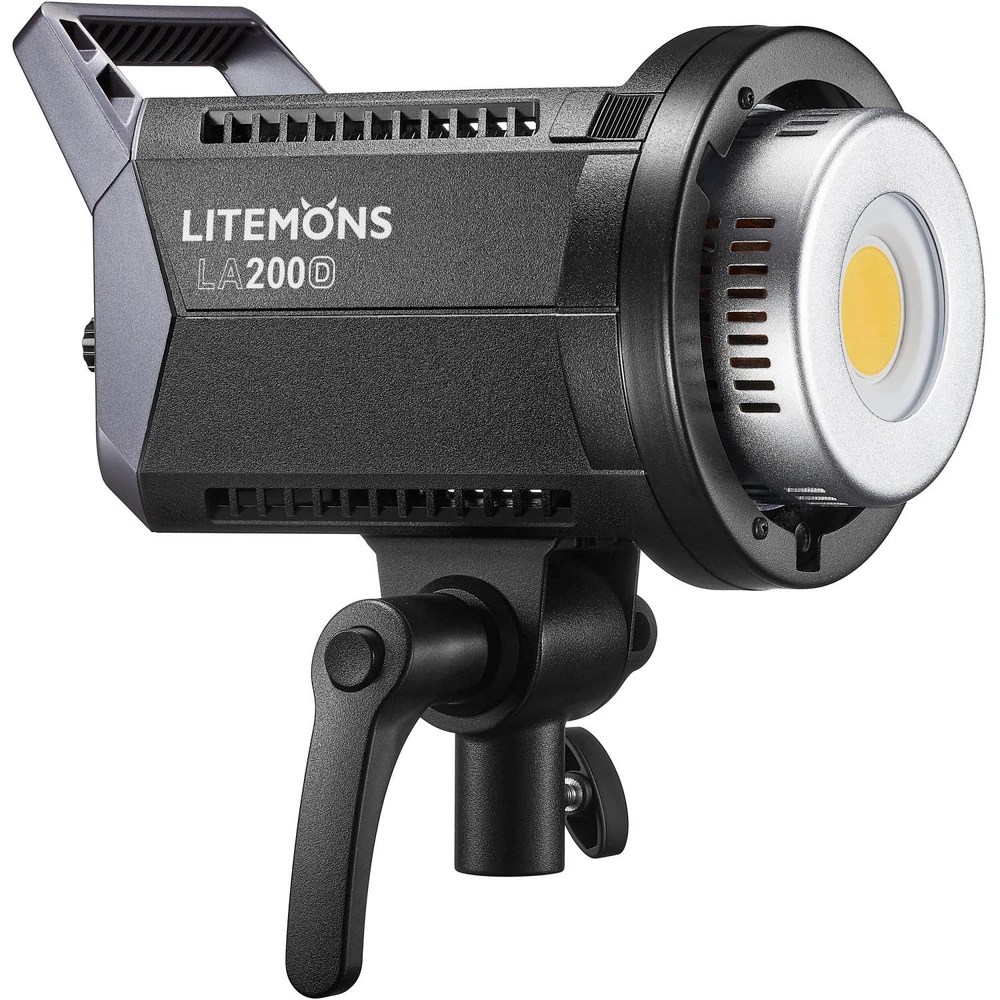
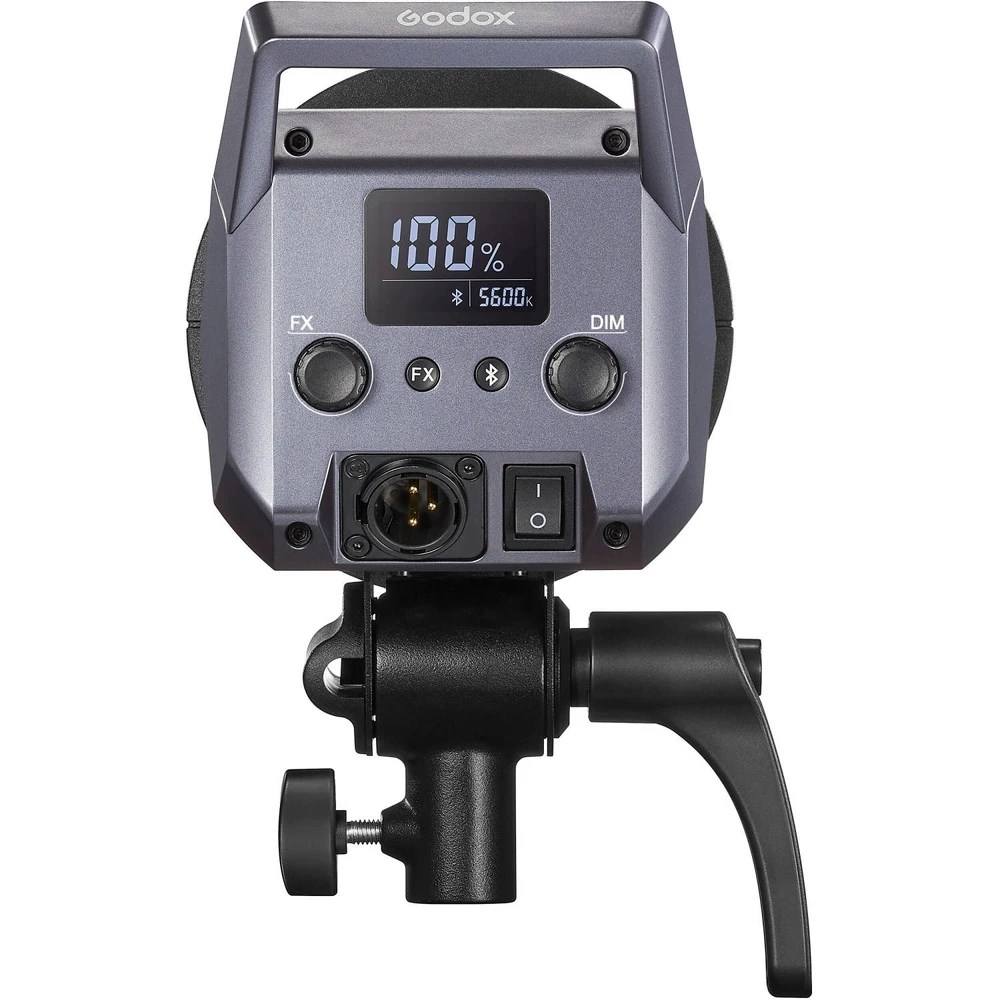
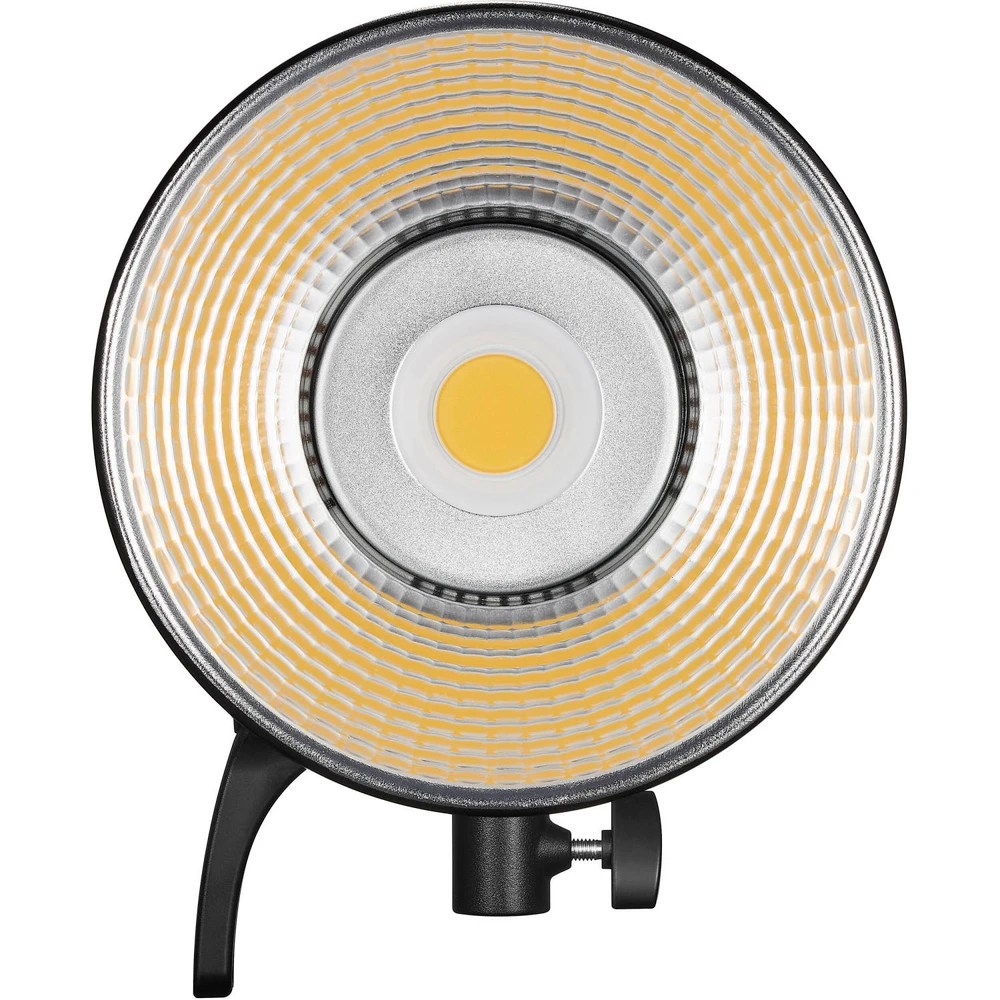
The Godox Litemons LA200D is a fixed-daylight COB with a Bowens mount, rear dimmer and external power brick. Its fixed 5,600 K output suits a daylight-balanced interview or tabletop setup that doesn’t need a warmer key.
At 3 m Godox measures 1,050 lux bare and 8,670 lux with the reflector. The often-quoted 101,000 lux is a 1 m reflector reading.
- Light Source Daylight COB LED with Bowens S mount.
- 230 W Max + External AC Adapter The adapter supplies 48 V DC to the head.
- Colour Temperature5,600 K Fixed daylight.
- Weight Approx. 1.4 kg / 3.1 lb for the head only.
- Beam Angle Not specified in the Godox manual. Bare head and supplied reflector have separate output readings.
- IP RatingNot documented Read the IP Rating Guide.
LA200D Specifications
| Specification | Details |
|---|---|
| Fixture | Daylight COB, Bowens S mount |
| Colour temperature | 5,600 K |
| Maximum power | 230 W (Godox manual) |
| Power connection | 48 V DC at the head via the external mains adapter |
| Colour rendering | CRI approx. 96, TLCI approx. 97 |
| Dimming and effects | 0–100%, 8 built-in effects |
| Control | Rear controls and Godox Light app over Bluetooth |
| Dimensions | 205 × 145 × 215 mm |
| Weight | Approx. 1.4 kg, fixture only |
Godox measured the centre of the beam at 1, 2 and 3 m. Values at other distances are estimates. A softbox, diffusion or a different reflector will change the result.
Output Calculator
Select the published setup and a manufacturer distance, or enter a custom throw where supported. The results describe centre-beam output, not the brightness across the whole beam.
Camera Settings
If the calculator does not load, use the published photometric table or source on this page. JavaScript is required.
F-stop is a planning estimate, not a meter reading. It uses direct, on-axis illuminance and includes only the optics and diffusion named in the selected setup. Meter on set to account for lens transmission, filters, added diffusion, bounce, dimming and ambient light.
How the exposure estimate works
N = √(E × ISO × t / C), where E is illuminance in lux and t = shutter angle ÷ (360 × fps). The default C = 340 is a dome reference; C = 250 is a flat reference. These are calibration constants, not a measured T-stop. A small nonzero digit is tenths of a stop above the displayed full stop.
Distance estimates and comparisons
Published points are used as given. Between published points the calculator fits a curve through the two nearest readings. Outside those points it uses the inverse-square law only when the fixture’s dataset permits it. Distances outside a configuration’s supported range are reported separately. Comparisons use one shared distance and camera setup; equal lux does not imply equal coverage.
View published readings for the selected configuration
Strengths and Limitations
- Strength. The daylight head gives more centre light than the LA200Bi at 5,600 K with either published configuration. Only intensity needs resetting between takes.
- Limitation. To bring the LA200D’s 5,600 K light close to a 3,200 K tungsten practical, start with Rosco 3411 three-quarter CTO. Check colour and exposure after adding the gel, especially if the practical uses a warmer household bulb. The strong hotspot with the stock reflector can show on an evenly painted wall.
Practical Uses
| Setup | Placement |
|---|---|
| Daylight talking head | Bounce into white or fit a Bowens softbox close to the subject. Check for window-level changes as the interview progresses and trim from the rear dial or app. |
| Background accent | Use the reflector to put a pool of light on set dressing. Walk the edge of the beam across the background while watching camera, especially on smooth surfaces. |
Output and Colour
Godox measured the following configurations at full brightness. Each cell gives lux followed by the equivalent foot-candles, rounded to the nearest whole foot-candle.
| Configuration | 1 m lux / fc | 2 m lux / fc | 3 m lux / fc |
|---|---|---|---|
| 5,600 K · bare head | 8,670 / 805 | 2,170 / 202 | 1,050 / 98 |
| 5,600 K · supplied reflector | 101,000 / 9,383 | 20,800 / 1,932 | 8,670 / 805 |
At 2 m Godox gives 20,800 lux with the reflector, versus 2,170 lux bare. The reflector puts a lot of that difference into its central hotspot. For an evenly lit background, take readings at the frame edges as well as on the beam axis.
Power Requirements
Godox specifies 48 V DC input at the head and a 230 W maximum in the operating manual. The standard mains setup includes an external adapter. On a mobile cart, support the brick and leave slack at the head so the lead does not pull as the stand turns.
Control, Cooling and Camera Operation
The rear controls and the Godox Light app handle intensity. The fixture has 8 effects and an internal cooling fan. Check a dim fade and any effects through the production camera at its actual frame rate and shutter angle. For a quiet take, listen after the head has warmed up with the adapter in its working position.
Modifiers, Rigging and the Working Package
A Bowens speed ring replaces the supplied reflector when a conventional softbox is fitted. The swivel sits below the lamp body. Fit the actual softbox before setting the stand distance, especially when trying to aim steeply down at a tabletop.
Alternatives and Related Fixtures
If you need adjustable colour temperature rather than a fixed daylight setting, compare the Godox Litemons LA150Bi.
| Related fixture | When to compare it |
|---|---|
| amaran 200d S | A fixed-daylight alternative with the same Bowens modifier format. |
| Godox KNOWLED M200D | A Godox daylight option with control electronics separate from the head. |
What People Are Saying
Field Feedback at a Glance
Matthew Allard’s Newsshooter review tests the LA200D separately from the LA150D.
What worked
- The LA200D’s measured colour temperature varied only 48 K from full power down to 10% in the review, useful when trimming an established key.
- Allard liked the compact head and built-in controls for quick setup and pack-down; the swivel folds against the body.
- He found the onboard menus and Bluetooth app straightforward to operate.
What to watch for
- The stock reflector creates a noticeable hotspot, so a centre reading can overstate how evenly a larger subject will be lit.
- The kit does not take a camera battery directly. Allard considered the lack of direct V-mount or Gold-mount operation a drawback for location work.
- Allard heard the fan at full power but found it quiet enough for most setups. Check it at the intended mic position in a quiet room.
Videos
TLDR Filmmaker compares the daylight LA200D with the LA200Bi, including a fan recording at 2:37.
Rental and Used-Fixture Checks
Confirm the D suffix and a fixed 5,600 K display. Test the adapter under load, check the fan from the boom position and inspect the reflector for dents that change its beam.
Before You Book
- Confirm the LA200D nameplate and matching 48 V supply. The LA200Bi is a different fixture.
- Measure the chosen reflector or modifier across the subject; the centre reading alone will not reveal a hotspot.
- Run a sound check at the microphone position. Pair the app at prep if you plan to rely on it.
Documentation and Specifications
- Godox operating manual and illuminance tables (PDF)
- Godox series specifications
- Godox USA product photographs and kit listing
Browse Godox lights · COB lights · all equipment.