
Last Updated 1 day ago
SL150III Overview
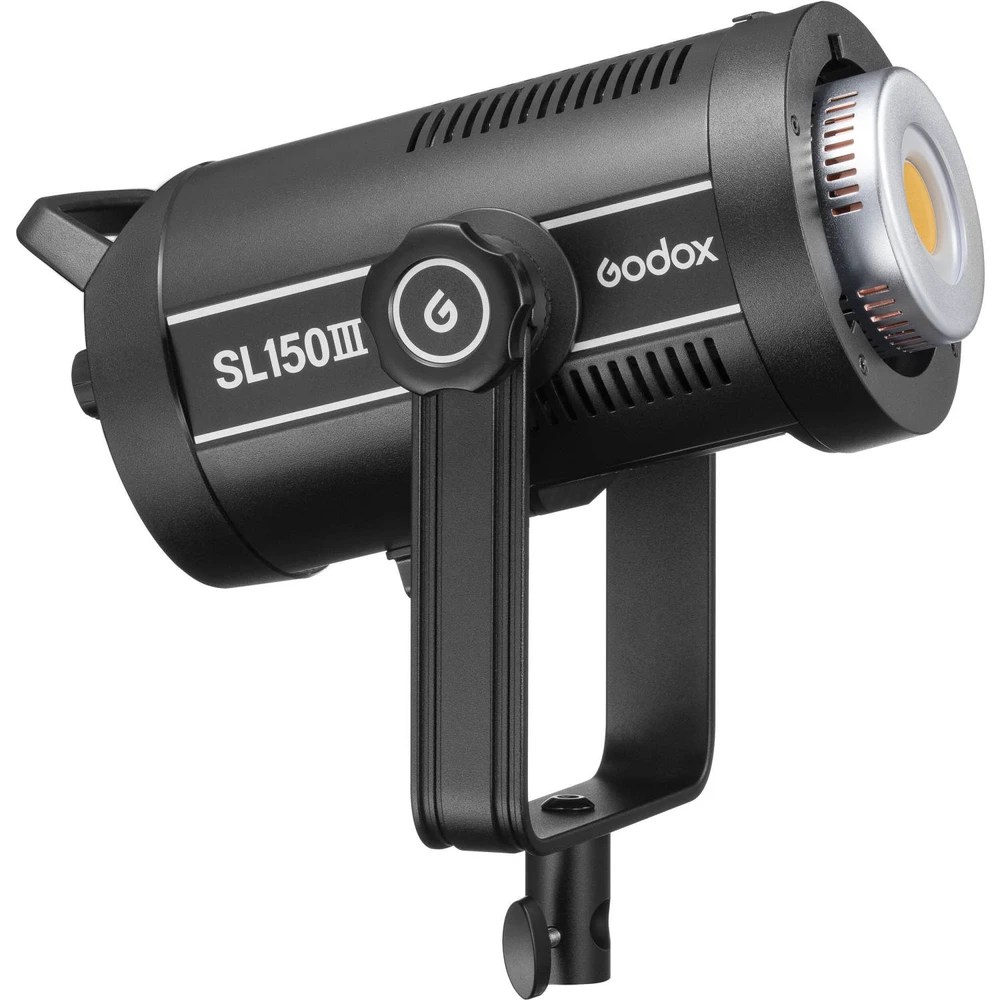
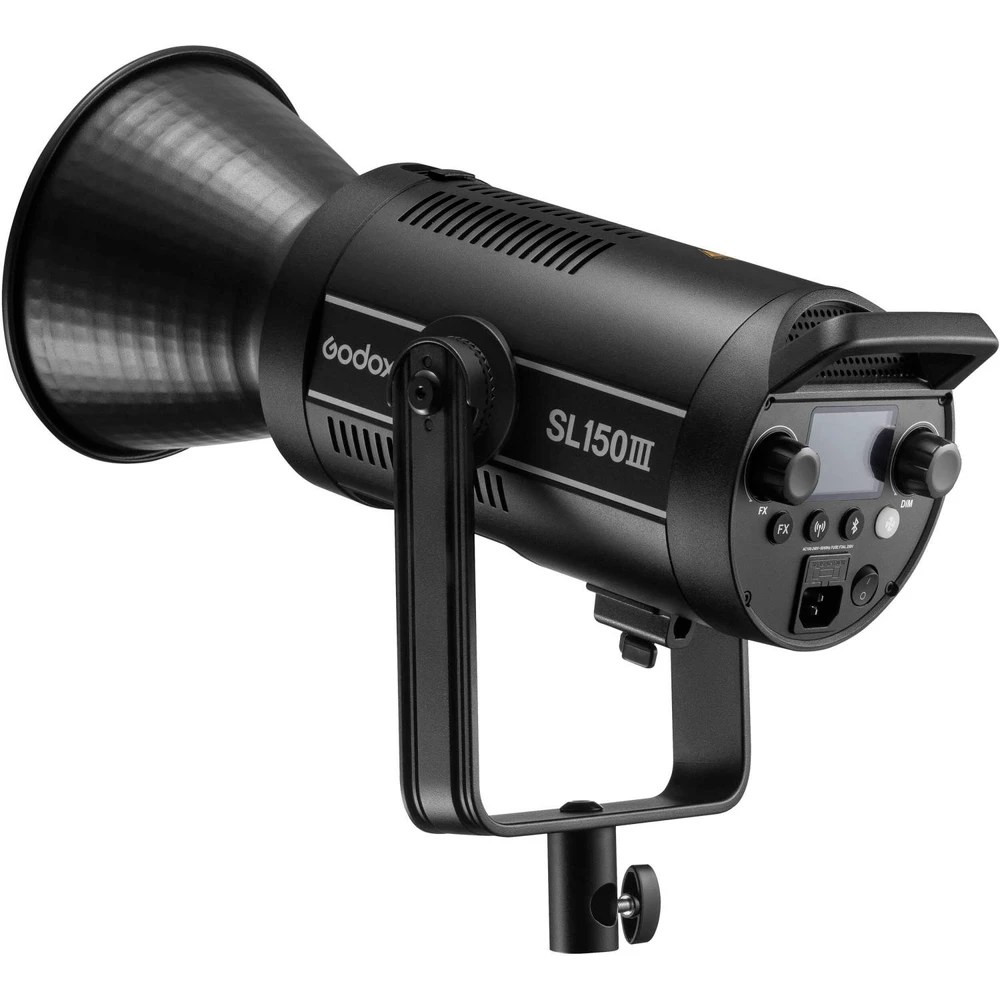
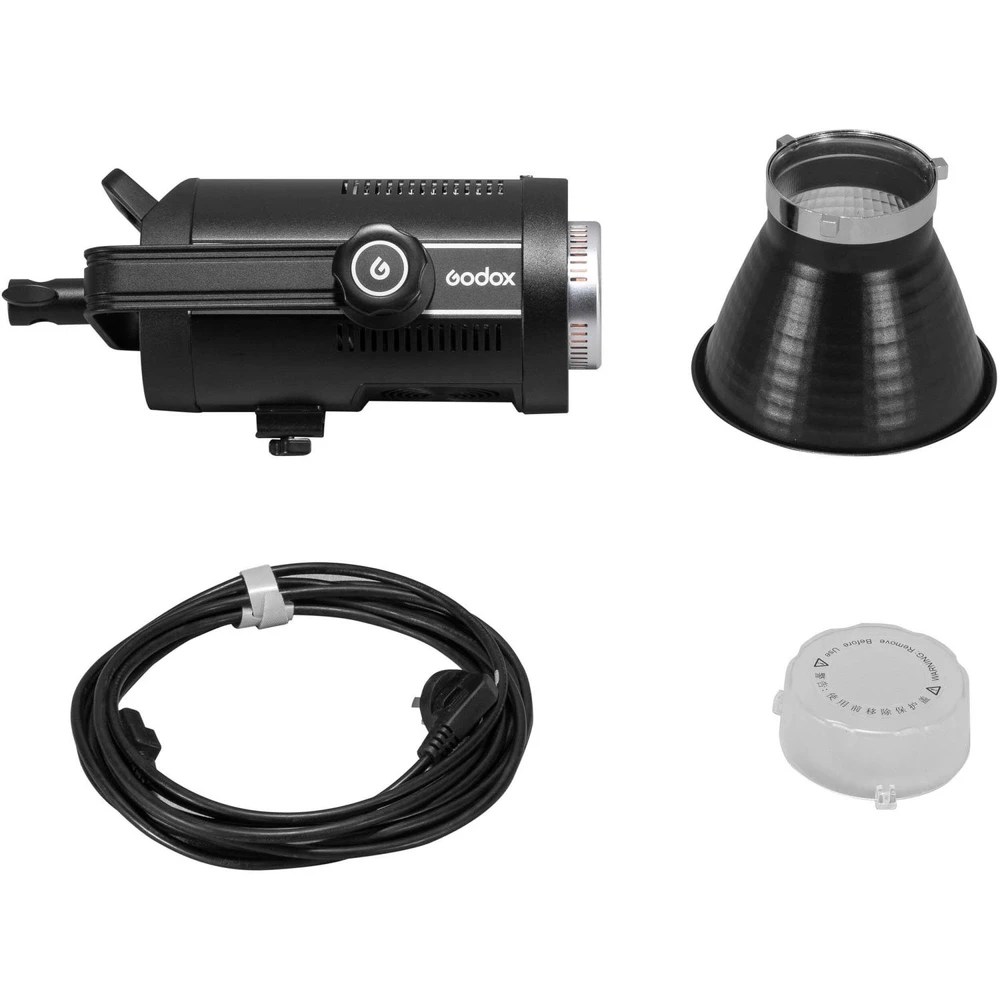
The Godox SL150III is the fixed-daylight, third-generation SL150. Mains power goes straight into the lamp and the controls sit on the back. That makes it a straightforward interview or product-studio head when an outlet is close and the lighting package needs a fan-off setting.
- TypeFixed-daylight COB with Bowens S mount
- Power160 W maximum; mains power connects directly to the head.
- Colour Temperature5,600 K ±200 K Fixed. Use CTO to warm the light or CTB to cool it.
- WeightApprox. 2.8 kg Fixture only; separate support and modifier.
- Beam AngleThe manual tabulates bare head and supplied reflector separately but does not identify an angle for those readings.
- IP RatingNot documented The linked manual does not specify a numeric IP rating. IP rating guide.
SL150III Specifications
| Specification | Details |
|---|---|
| Fixture | Daylight COB, Bowens S mount |
| Colour temperature | 5,600 K ±200 K |
| Maximum power | 160 W (Godox manual) |
| Power connection | 100–240 V AC, 50/60 Hz, 1.6 A |
| Colour rendering | CRI approx. 96, TLCI approx. 97 |
| Dimming and effects | 0–100%, 8 built-in effects |
| Control | Local controls, 2.4 GHz wireless remote and Bluetooth app |
| Dimensions | 340 × 200 × 160 mm |
| Weight | Approx. 2.8 kg |
Output Calculator
Select the published setup and a manufacturer distance, or enter a custom throw where supported. The results describe centre-beam output, not the brightness across the whole beam.
Camera Settings
If the calculator does not load, use the published photometric table or source on this page. JavaScript is required.
F-stop is a planning estimate, not a meter reading. It uses direct, on-axis illuminance and includes only the optics and diffusion named in the selected setup. Meter on set to account for lens transmission, filters, added diffusion, bounce, dimming and ambient light.
How the exposure estimate works
N = √(E × ISO × t / C), where E is illuminance in lux and t = shutter angle ÷ (360 × fps). The default C = 340 is a dome reference; C = 250 is a flat reference. These are calibration constants, not a measured T-stop. A small nonzero digit is tenths of a stop above the displayed full stop.
Distance estimates and comparisons
Published points are used as given. Between published points the calculator fits a curve through the two nearest readings. Outside those points it uses the inverse-square law only when the fixture’s dataset permits it. Distances outside a configuration’s supported range are reported separately. Comparisons use one shared distance and camera setup; equal lux does not imply equal coverage.
View published readings for the selected configuration
Strengths and Limitations
- Strength. Direct AC power removes the loose controller and brick from a small studio floor. The fan can be switched off from the fixture for a sound-sensitive take.
- Limitation. The key is fixed at daylight, and the brightest measurements assume the lamp can run at full output. Recheck exposure when using silent mode.
Practical Uses
| Setup | Placement |
|---|---|
| Quiet dialogue close-up | Build the soft key, select the fan setting, then set exposure. Give sound a chance to listen with the actual mic distance before committing to that mode. |
| Product turntable | Feather a diffused beam across the sweep. The reflector can make a separate bright patch behind a product when the background needs some shape. |
Output and Colour
Godox measured the following configurations at full brightness. Each cell gives lux followed by the equivalent foot-candles, rounded to the nearest whole foot-candle.
| Configuration | 1 m lux / fc | 2 m lux / fc | 3 m lux / fc |
|---|---|---|---|
| 5,600 K · bare head | 5,900 / 548 | 1,570 / 146 | 740 / 69 |
| 5,600 K · supplied reflector | 73,600 / 6,838 | 16,300 / 1,514 | 6,770 / 629 |
The 1 m reflector reading is 73,600 lux. At 3 m the same reflector produces 6,770 lux. If a larger shot needs a softbox, use the bare-head row as the starting reference and meter with the diffusion in place.
Power and Batteries
The fixture accepts 100–240 V AC at 50/60 Hz. Godox lists 160 W maximum and a 1.6 A input rating. There is no external control box to mount. Route the mains lead with enough slack to let the head tilt without pulling the connector.
Control, Cooling and Camera Operation
The rear panel offers dimming and eight effects. The optional RC-A6 uses the 2.4 GHz receiver, and the Godox Light app connects over Bluetooth. For silent mode the manual provides two displayed ranges, 0–33% or 0–100%. Fan-on strong-power mode is the full-power reference. Check exposure and the finish of a fade in the mode you intend to shoot.
Modifiers, Rigging and the Working Package
The U-yoke holds the head on either side. Fit the Bowens modifier and check rear-panel clearance before raising the lamp. A shallow ceiling may allow a compact reflector at an angle that a deep softbox cannot reach.
Alternatives and Related Fixtures
| Related fixture | When to compare it |
|---|---|
| Godox KNOWLED M200D | A Godox daylight fixture with a separate control unit. |
| amaran 200d S | Another studio daylight head that accepts Bowens accessories. |
What People Are Saying
Field Feedback at a Glance
These notes apply to the fixed-daylight SL150III. The SL150III Bi has a different colour range, photometrics and silent-mode settings.
What worked
- Product photographer Shin-chan uses two SL150III heads, one for the main light and one to lift shadows, while assigning the background and edge lighting to a separate fixture.
- Lynn Barsigian Photography’s portrait test describes putting a third-party Bowens optical snoot on the SL150III to place a circular accent on a subject’s shoulder. This is a modifier-use example, not a comparison of the fixture’s reflector output.
- Godox’s daylight SL III manual shows that one short press of the fan button selects silent mode. That allows the fan to be stopped for a take without turning off the fixture. Check the selected brightness range before metering.
Drawbacks to plan for
- The daylight SL150III has selectable 0–33% and 0–100% brightness ranges in mute mode according to Godox’s daylight SL III manual. Verify which is selected on the unit instead of assuming either range applies to every head or treating the dial percentage as a lux measurement.
- The head takes 100–240 V AC directly. Godox’s daylight SL III manual does not show a native V-mount input, so a bare battery plate cannot replace a mains feed on a location without outlets.
- Fixed 5600 K is useful if you are matching daylight, but Godox’s daylight SL III manual shows no colour temperature control on this model. Use CTO gel for a warmer match or specify the separately documented Bi model, rather than borrowing Bi settings for the daylight head.
VIDEO SALON’s launch comparison lists the daylight and bi-colour heads separately.
Videos
Godox demonstrates the SL III controls across its daylight and bi-colour models. The colour-temperature adjustment shown applies to the Bi versions.
Rental and Used-Fixture Checks
Check that the case contains the daylight SL150III, then select fan-off and verify the saved dimmer range. Listen and meter at the intended setting before fitting the rest of the studio package.
Before You Book
- Confirm that the rating plate says SL150III, not SL150IIIBi or SL150II.
- Bring the intended modifier and check the output at the working distance with the fan mode you plan to use.
- Test the AC lead, local dial, and any remote you need before the head goes out of reach.
Documentation and Specifications
- Godox operating manual and illuminance tables (PDF)
- Godox series specifications
- Godox USA product photographs and kit listing
Browse Godox lights · COB lights · all equipment.