
Last Updated 7 hours ago
VL150II Overview
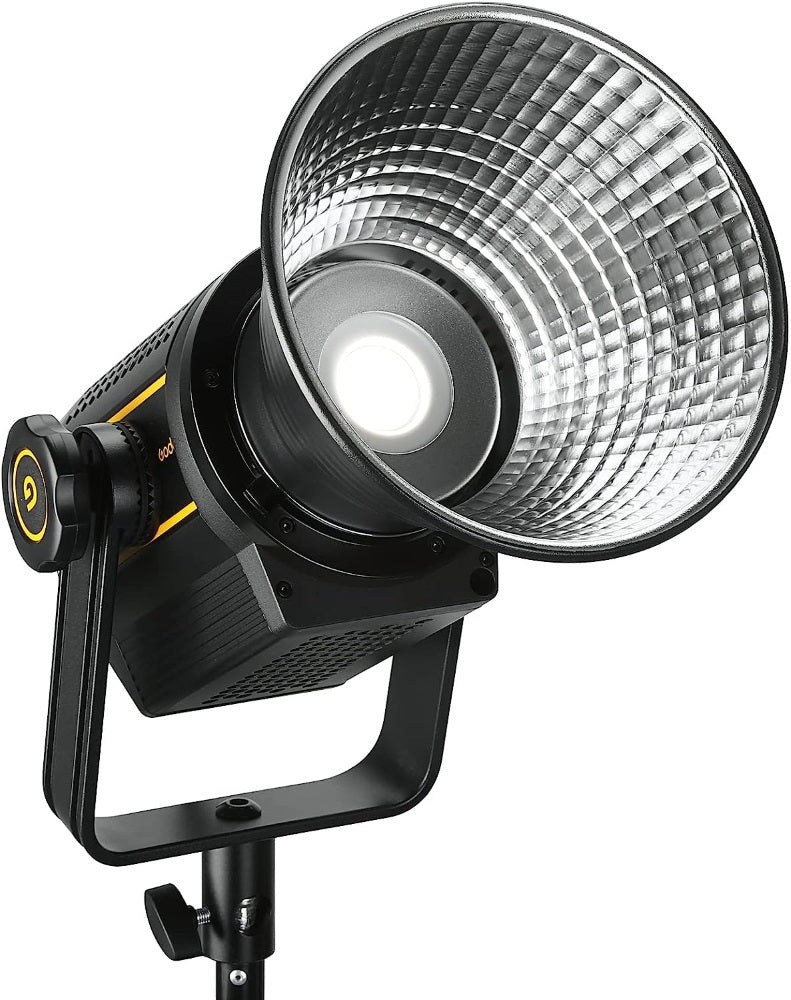
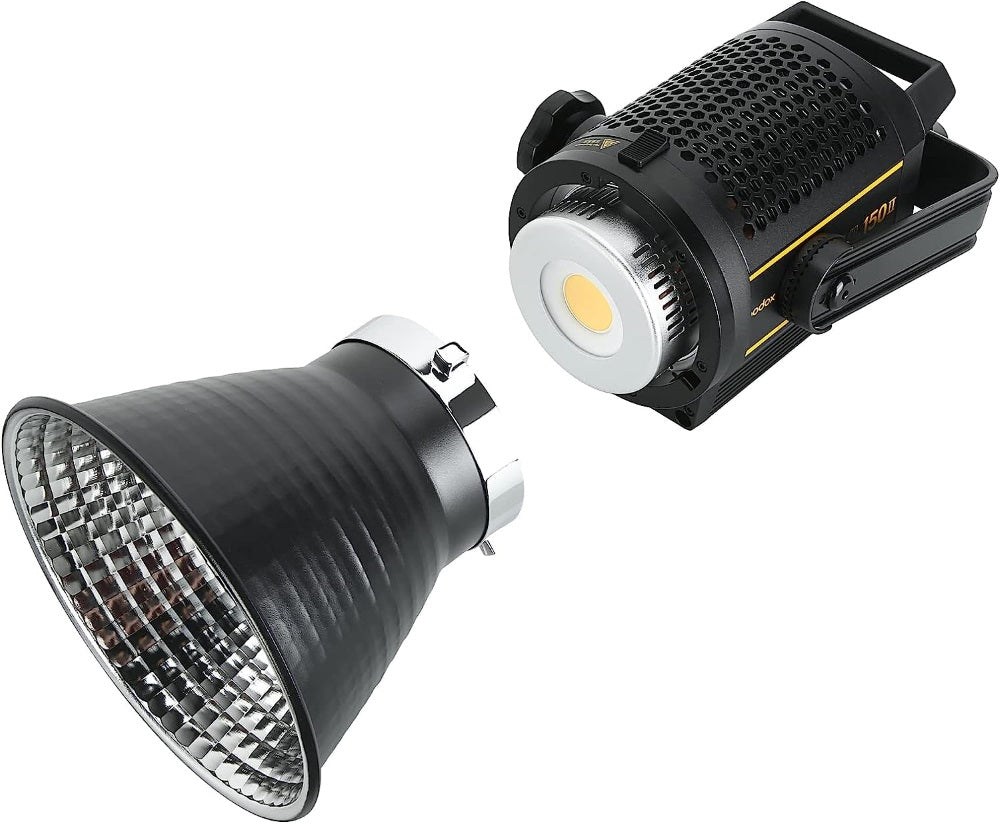
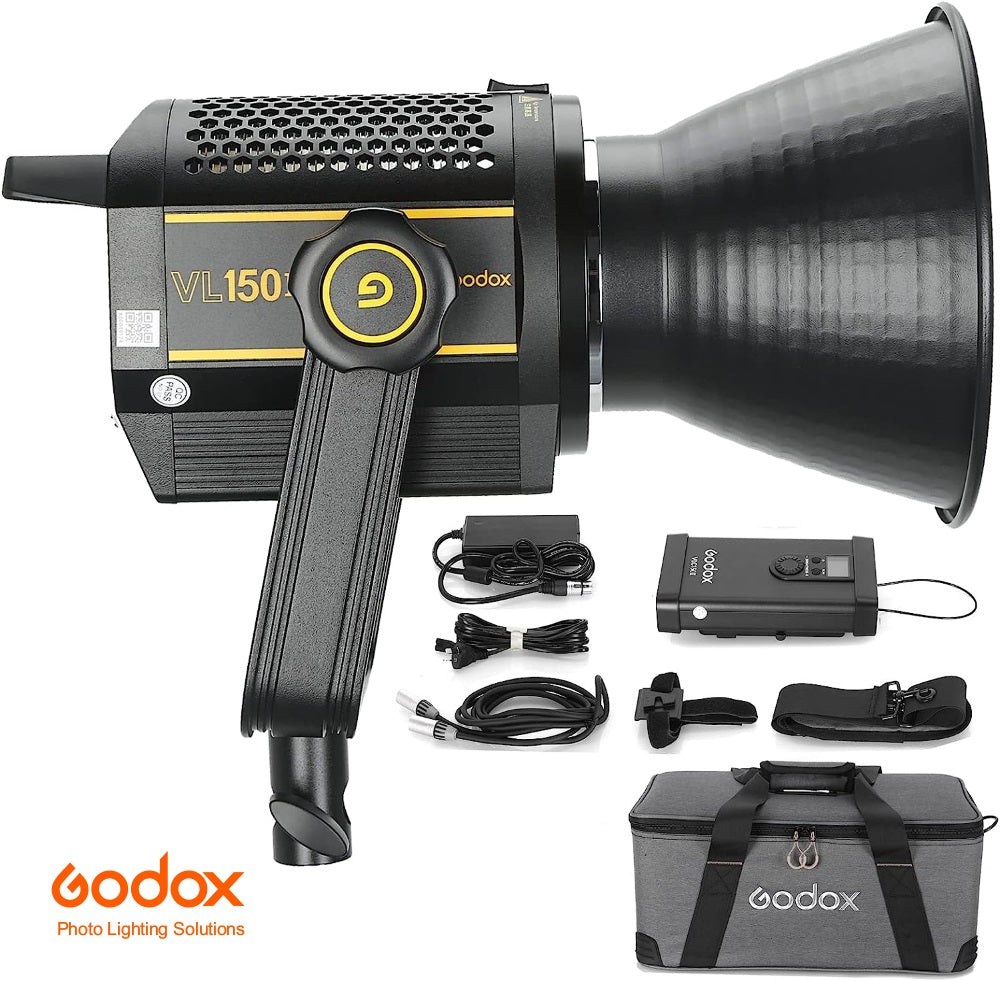
The Godox VL150II is a daylight Bowens-mount head with a separate controller. The head weighs 1.72 kg, which keeps the part sitting behind an interview softbox relatively light. Its advantage in a small room is that the dimmer can stay within reach even when the head is backed into a corner.
The supplied reflector concentrates the beam. Select the matching bare-head or reflector setting in the calculator before choosing where the stand goes. The Output Calculator starts with Godox’s published 1–3 m measurements.
- Daylight COB LED Fixed-white Bowens S-mount head with a separate controller.
- 165 W Maximum Power 100–240 V AC adapter or suitable 14.8 V V-mount batteries at the controller.
- Colour Temperature 5,600 K Fixed daylight; Godox specifies ±200 K.
- Weight 1.72 kg head and 0.70 kg controller, before the power adapter and modifiers.
- Beam Control The supplied reflector concentrates the bare beam. The Bowens mount accepts other compatible modifiers; the manual does not give a beam angle.
- IP Rating No numerical IP rating listed in the cited manual. Keep the head and controller dry. IP rating guide.
VL150II Specifications
| Specification | Details |
|---|---|
| Fixture | Daylight COB, Bowens S mount |
| Colour temperature | 5,600 K ±200 K |
| Maximum power | 165 W (Godox manual) |
| Power connection | 100–240 V AC adapter, 50/60 Hz, or compatible 14.8 V V-mount power |
| Head input | 35 V DC, 4.3 A |
| Colour rendering | CRI ≥96, TLCI ≥96 |
| Dimming and effects | 0–100%, 8 built-in effects |
| Control | Local controls, 2.4 GHz wireless remote and Bluetooth app |
| Dimensions | 270 × 175 × 212 mm |
| Weight | 1.72 kg head, 0.70 kg controller |
Output Calculator
Select the published setup and a manufacturer distance, or enter a custom throw where supported. The results describe centre-beam output, not the brightness across the whole beam.
Camera Settings
If the calculator does not load, use the published photometric table or source on this page. JavaScript is required.
F-stop is a planning estimate, not a meter reading. It uses direct, on-axis illuminance and includes only the optics and diffusion named in the selected setup. Meter on set to account for lens transmission, filters, added diffusion, bounce, dimming and ambient light.
How the exposure estimate works
N = √(E × ISO × t / C), where E is illuminance in lux and t = shutter angle ÷ (360 × fps). The default C = 340 is a dome reference; C = 250 is a flat reference. These are calibration constants, not a measured T-stop. A small nonzero digit is tenths of a stop above the displayed full stop.
Distance estimates and comparisons
Published points are used as given. Between published points the calculator fits a curve through the two nearest readings. Outside those points it uses the inverse-square law only when the fixture’s dataset permits it. Distances outside a configuration’s supported range are reported separately. Comparisons use one shared distance and camera setup; equal lux does not imply equal coverage.
View published readings for the selected configuration
Model and Family Fit
Choose the 150 II when the lighter head and controller matter more than throw. Compare it with the 200 II and 300 II using the matching bare or reflector conditions rather than mixing the two table rows.
Strengths and Limitations
- Strength. A small head and remote controller suit a one-stand interview key. A 14.8 V V-mount option allows the same fixture to move to a location without an AC outlet.
- Limitation. The color temperature is fixed at daylight. Use CTO gel to match tungsten. Both gel and dense diffusion reduce output from the 810 lux measured bare at 3 m.
Practical Uses
| Setup | Placement |
|---|---|
| Single-person interview | Bring a softbox just outside the frame and feather the bright side past the subject. The controller lets you trim exposure without stepping into the eyeline. |
| Tabletop insert | Send the bare head through a small diffusion frame. Look at the reflection in the product while moving the frame, then dim at the controller. |
Output and Colour
Godox measured the following configurations at full brightness. Each cell gives lux followed by the equivalent foot-candles, rounded to the nearest whole foot-candle.
| Configuration | 1 m lux / fc | 2 m lux / fc | 3 m lux / fc |
|---|---|---|---|
| 5,600 K · bare head | 6,100 / 567 | 1,700 / 158 | 810 / 75 |
| 5,600 K · supplied reflector | 76,000 / 7,061 | 16,000 / 1,486 | 5,400 / 502 |
At 2 m the reflector raises the centre reading from 1,700 to 16,000 lux. Neither reading predicts softbox output. For a Bowens softbox, meter with the actual fabric and baffle fitted, using the working distance from the front of the box.
Power and Batteries
Godox pairs this head with the VLC150II controller. The AC adapter takes 100–240 V, 50/60 Hz, with a 2 A input rating. The manual specifies a 14.8 V V-mount battery option. Check the pack’s continuous discharge rating and test a full interview-length run with the selected modifier.
Control, Cooling and Camera Operation
Brightness and eight effects are adjusted at the controller. The Godox Light app adds Bluetooth control. The optional 2.4 GHz remote uses a channel, group and fixture ID. On a multi-light interview, confirm that each group responds separately before raising the heads. For a dialogue scene, run the fan at working temperature and listen from the intended mic position.
Modifiers, Rigging and the Working Package
Fit the Bowens speed ring and set the tilt before parking the stand behind furniture. The lamp, controller and AC adapter are three separate pieces. Leave enough lead for the controller to sit within reach without its weight hanging from the head connection.
Choosing the Optic or Modifier
Start with the stock reflector for a concentrated beam or fit a Bowens softbox when the apparent size of the source matters more. Check whether the next model up gives useful headroom with your actual modifier.
Alternatives and Related Fixtures
| Related fixture | When to compare it |
|---|---|
| amaran 200d S | A daylight Bowens fixture to compare for small interview and product setups. |
| Godox KNOWLED M200D | A higher-power daylight option in the Godox system. |
What People Are Saying
Field Feedback at a Glance
The original VL150 and the VL150 II use different controller hardware. These notes separate an exact-model operator report from features documented for the II.
What worked
- Hypop’s studio-lighting guide points to keeping the VL II controller low when the head is raised above an interview or product table. This is dealer guidance, not an independent output test.
- Godox’s VL II manual shows the VL150 II’s single 14.8 V V-mount slot on the controller. That makes a battery-powered setup possible without attaching the pack to the head.
- HL Studio’s VL II lineup walkthrough includes the VL150 II. The native Bowens mount confirmed in the manual allows a Bowens reflector or softbox to go straight on without an adapter.
Drawbacks to plan for
- A VL150 II operator on r/videography reported that it was not quite enough for their interviews against windows. That is one setup, not a metered output limit: check the competing daylight with the intended softbox in place.
- The separate controller is handy low on a stand, but the AC adapter is a third piece to place and secure. Godox’s VL II manual shows both the adapter-to-controller and controller-to-head connections; a spare mains lead alone cannot replace the head cable.
- The daylight head is fixed at 5600 K. Godox’s VL II manual lists brightness and effects control, not electronic colour temperature adjustment. Use CTO gel when you need to match warmer tungsten practicals, or choose an adjustable fixture if the match changes between setups.
Videos
Godox’s Light App 4.0 overview shows the wireless control interface. It covers the app across the Godox range.
Rental and Used-Fixture Checks
Match the VLC150II to the head and check the AC adapter, head cable, reflector and battery latch. Listen from the microphone position after the lamp has warmed up.
Before You Book
Set the stand position with the chosen modifier, test the wireless group and try one working-length battery run before sending the kit out.
Documentation and Specifications
- Godox operating manual and illuminance tables (PDF)
- Godox series specifications
- GodoxOnline product photographs and kit listing
Browse Godox lights · COB lights · all equipment.