
Last Updated 12 hours ago
Overview
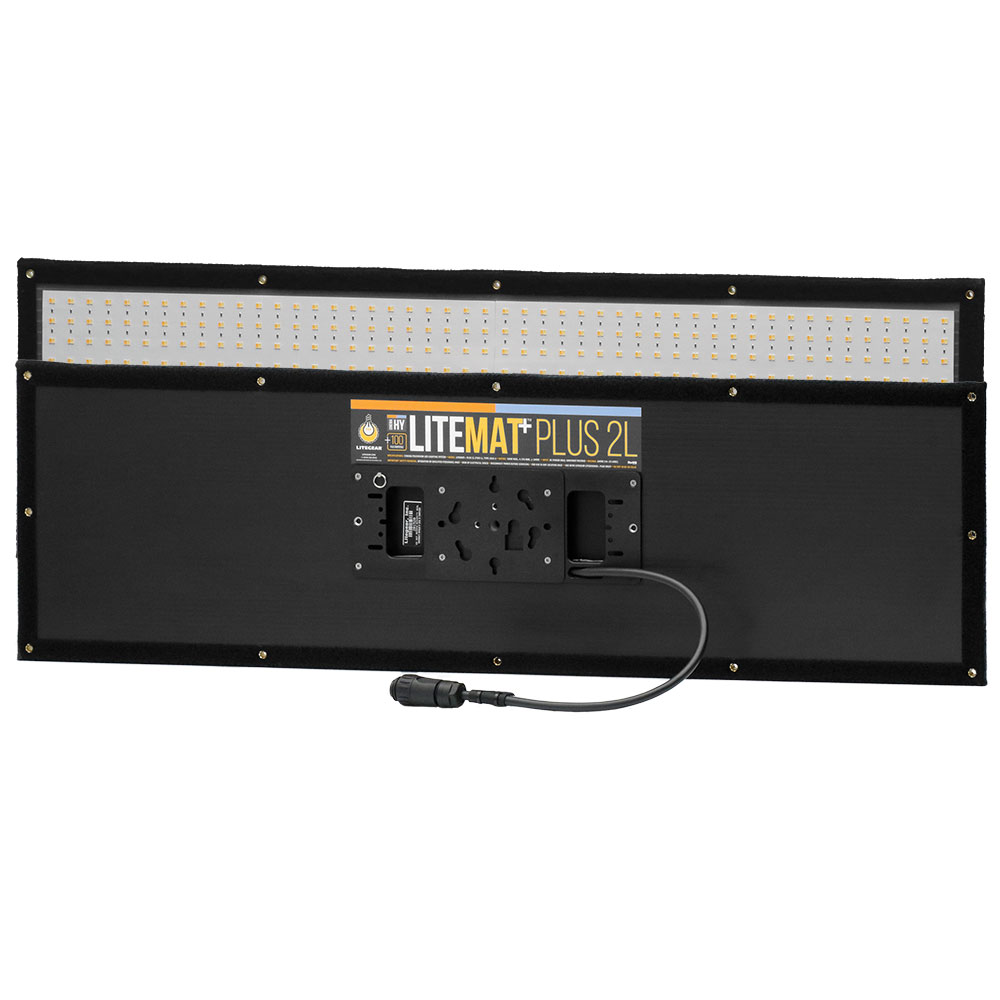
The LiteGear LiteMat Plus 2L is a long, thin variable-white LED head rated at 100 W. Its 40 × 11.5 inch format is useful for strip-shaped soft keys, narrow overhead sources, vehicle work and long reflected highlights.
The “L” means the long two-tile arrangement, rather than the squarer Plus 2. This is the Plus generation with a PL7 connection, not an original LiteMat 2L or a full-colour Spectrum 2L. Its 1.72 kg figure describes the head; controller, supply, cable and mount are additional.
Key specifications
| Specification | Details |
|---|---|
| Fixture class | Thin variable-white LED head, LiteMat Plus generation |
| Head model | LM-PLUS-TWO-LONG-HY-MAT |
| Nominal head power | 100 W |
| Head input | 24 V DC through the matching Plus system |
| Specified current | 4.17 A at 24 V DC |
| LED quantity | 1,152 |
| Head dimensions | 292 × 1016 × 23 mm / 11.5 × 40 × 0.9 in |
| Head mass | 1.72 kg / 3.8 lb, head only |
| White range reference | 2600–6200 K in the family catalogue; archival photometry at 2600 / 4300 / 6000 K |
| Colour rendering | CRI / TLCI 95+ in the identified white-light data |
| Connection | PL7 locking head connection |
| Mounting | Compatible removable LiteMount / centre-mount arrangement for the long head |
| Control | Through compatible LiteDimmer; DMX/radio depend on controller and accessories |
Strengths and limitations
Strengths
- A thin emitting head fits low-profile soft-light rigs.
- Separate power and controls allow accessible placement.
Limitations
- Head-only mass excludes support, diffusion, controller and cables.
- Use the matching dimmer, connector system and approved battery arrangement.
Practical uses
The long source can create a horizontal eye light, a top reflection along a tabletop or a controlled side direction beside a seated subject. Rotate it vertically for a different wrap and catchlight. Its geometry is the reason to choose the 2L over a square head of comparable electrical power.
The 23 mm bare profile is helpful under a low ceiling or along a vehicle roof, while the metre-long body still needs a safe transport and mounting route. Avoid treating a long, light panel as something that can be bent or squeezed into position. Position and support the complete skirt/diffusion assembly before cabling.
| Setup | Working approach |
|---|---|
| Low-profile overhead | Support the mat and controller separately with the correct frame and retention. |
| Soft key | Build diffusion before metering and use a skirt or grid for spill. |
Output and colour
The following lux values are from LiteGear’s 2019 model-specific data sheet. The distances are the sheet’s nominal 48 and 72 inch positions, labelled 122 and 183 cm. These are manufacturer laboratory figures for the named head, not a new comparison test against a modern colour mat.
The sheet identifies measurements from sample heads under laboratory conditions with no diffusion. Added diffusion, a louver or grid changes the usable output and spill; these bare-head figures should not be presented as a complete softbox setup.
Photometric results in a general family catalogue may use another test arrangement or controller/output approach. The named sheet is kept separate here so that a reader can trace the numbers rather than combining incompatible rows from several revisions.
| CCT in the sheet | 122 cm, lux | 183 cm, lux |
|---|---|---|
| 2600 K | 1,970 | 875 |
| 4300 K | 2,368 | 1,052 |
| 6000 K | 2,045 | 909 |
Power and batteries
The head is specified at 24 V DC, 4.17 A and 100 W. The archived sheet lists the LiteDimmer Plus Duo DC200 and approved 12 V / 24 V supply options as system components. Lower-voltage battery operation depends on the actual compatible controller, supply and cable; the raw head’s specification remains 24 V.
PL7 is the Plus system’s locking head connection. It is not interchangeable with a Spectrum PDX connection, and an adapter should never be improvised from a similar-looking connector. Identify the head, controller, supply, battery-mount option and extension cable as one compatible system.
The nominal head load is not the complete AC draw or the weight of a ready-to-use kit. Circuit and battery planning must include the specified controller/supply arrangement and adequate cable capacity. Support the power/control unit separately and provide slack for aiming without loading the head connector.
Control, cooling and camera operation
LiteGear’s Plus family catalogue describes CineMitter variable white from 2600 to 6200 K. The archival model tables test the daylight setting at 6000 K. State the document and controller revision when comparing a kit; a 6000 K test row should not be rewritten as a measurement at 6200 K.
The model sheets publish CRI/TLCI of at least 95 for the listed white settings, with some individual rows higher. The Plus engine mixes warm and cool white emitters; it does not provide the Spectrum family’s independent saturated RGB colour or its pixel-mapping feature set.
Dimming, CCT handling, DMX resolution, curves and any radio feature depend on the installed LiteDimmer. The current smaller-head kit pages identify Duo DMX packages, while non-DMX Plus kits and different AC400 versions also exist. A bare head is not itself a wireless-DMX receiver: verify the exact controller and any added receiver.
Modifiers, rigging and the working package
Use the Plus 2L PolySkirt and the matching quarter, half or full diffuser. The manufacturer also lists the corresponding louver, PolyGrid angles and 40° Snapgrid. A Plus 2 square skirt is not the long 2L accessory, even though the two heads share a nominal wattage class.
The distributed emitters make a broad source, but visible point reflections or multiple shadows can still matter on a close or glossy subject. Choose the diffuser while looking through the camera. More diffusion can improve the appearance of the face at the cost of working level.
A grid or louver controls off-axis emission; it does not produce the hard optical cut of a spotlight projector. Record the exact diffuser and grid along with CCT and intensity when a setup must be recreated.
Treat the thin head as a supported panel, not a flexible fabric. Use the specified removable mount, engage it fully and match the stand or overhead support to the complete load and leverage. Elevated placement needs appropriate secondary retention. Protect the face and connector during transport and store the head without bending it.
Inspect the clear protective layer, hook-and-loop border, emitter uniformity, rear mounting hardware and PL7 lead. Check that every warm and cool section responds evenly, that the controller fades cleanly and that the intended DMX/battery arrangement works. A cheap head without its proper controller, cable, mount or skirt can be an incomplete working package.
The checked archival specifications do not establish unrestricted weather protection. Keep the head and power electronics within the matching instructions, protect them from moisture and provide ventilation. Claims for a weatherproof LiteTile or newer Spectrum product do not transfer to this Plus head.
Alternatives and related fixtures
The Plus 2 provides a squarer source at the same nominal 100 W class. The Plus 3 and LiteMat 4 Plus provide larger faces. Choose the 2L for the long narrow source geometry; equal watts do not establish equal reflection shape or usable level in every placement.
| Fixture | Choose it for |
|---|---|
| LiteMat Spectrum | A full-colour LiteMat family; verify generation and controller. |
| LiteMat Plus | A variable-white family with a different power and connector system. |
What people are saying
Alan Steinheimer: LiteMat Plus
Alan Steinheimer discusses the LiteMat 4 Plus’s strengths and compromises. The comparison concerns a related size in the Plus family. View the discussion.
Videos
Meet the Gaffer: LiteMat 4 Plus
Related-model discussion; output and weight remain size-specific.
Rental and used-fixture checks
Check the exact model, matching power components and control leads. Inspect the emitting surface, protective parts, mounts and connectors. Test the intended operating mode, low-level control and camera settings before rigging.
Documentation and specifications
current manufacturer model information, 2019 model-specific data sheet and LiteMat Plus family catalogue.
September 2026: LiteGear product lines join the Kino Flo portfolio
Product photograph: LiteGear product photograph, hosted by Kino Flo.
Browse Litegear lights · LED mats · all equipment.