
Last Updated 2 days ago
Overview
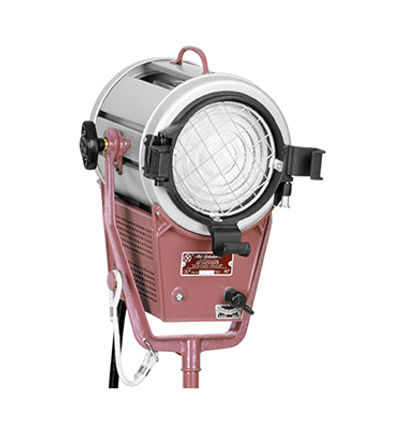
The Mole-Richardson Baby Junior Solarspot, Type 4131, is a compact 2,000 W tungsten Fresnel with a six-inch lens. It provides more level than a 1 kW Baby while retaining a comparatively small body for a traditional 2 kW head. Typical uses include hard keys, backlight, bounced light and illumination through a diffusion frame.
Identify the 4131 Baby Junior specifically. It is not the larger eight- or ten-inch Junior, and published 4131 material itself contains mount and socket discrepancies. The vintage sheet, current web page and dealer listing contain incompatible mount and socket details; check the actual head and its matching documentation.
Key specifications
| Specification | Details |
|---|---|
| Head / maximum power | Type 4131 Baby Junior; 2,000 W tungsten-halogen |
| Lamp base, archival sheet | Mogul bipost, spring-loaded contacts; verify actual socket |
| Lamp examples | CYX 2,000 W 120 V; CXZ 1,500 W 120 V; CYV 1,000 W 120 V; FKK 2,000 W 240 V |
| Light-centre length / burning position | 5 inches; listed globes base-down to horizontal |
| Lens / stated field angle | 6-inch Fresnel; 27–55° with standard configuration |
| Alternative optical configuration | Type 55 hot lens has a separate higher-intensity, narrower-coverage chart |
| Focus | Front and rear Molecool paddle handles |
| Mount identification | Archival PDF specifies 5/8-inch baby hardware; current web page describes a removable junior pin |
| Head weight with cable | 16½ lb / approximately 7.5 kg in the archival sheet |
| Dimensions, manufacturer order | 11¾ × 9¾ × 13¼ inches |
| Accessory family | 9-inch scrims and frames listed |
| Nominal full-power current | 16.7 A at 120 V; approximately 8.3 A with a correct 2,000 W 240 V globe |
| Safety screen | Specified in original manufacturer literature |
Strengths and limitations
Strengths
- A continuous tungsten source gives direct, visible control of the lighting effect.
- Lamp and accessory choices adapt the source to its job.
Limitations
- Heat and electrical load remain central to placement and circuit planning.
- Dimming changes colour; lamp code, voltage and fixture limits must match.
Practical uses
Use the Baby Junior when a small Fresnel is not delivering enough level after diffusion or when a hard key needs more throw. It can provide a pronounced edge through a doorway, light a bounce from further back or cover a wider acting area than a lower-wattage head at a comparable focus setting.
Its compact six-inch lens distinguishes it from the larger traditional Junior models. That matters for beam character, mechanical dimensions and accessories. A rental order should name ‘Baby Junior 4131’ and the required lens or accessory package, rather than relying solely on the phrase ‘Mole 2K’.
| Setup | Working approach |
|---|---|
| Controlled key or accent | Choose focus or diffusion for the intended shadow and trim spill with compatible accessories. |
| Warm practical motivation | Meter at the chosen dimmer setting and balance colour through the camera. |
Output and colour
The Type 4131 sheet publishes two optical configurations with a 2,000 W, 120 V, 3200 K globe. A higher spot reading is accompanied by a different beam size; it does not mean that one head creates more total light simply because a different lens is fitted.
| Distance | Standard Type 4131 lens: flood / spot | Type 55 hot lens: flood / spot |
|---|---|---|
| 10 ft / 3.05 m | 400 / 1,500 fc | 525 / 2,470 fc |
| 20 ft / 6.10 m | 100 / 375 fc | 140 / 630 fc |
| 30 ft / 9.14 m | 45 / 165 fc | 60 / 280 fc |
Power and batteries
A 2,000 W lamp at 120 V draws about 16.7 A, so it exceeds a 15 A supply’s rating on nominal lamp load alone. Use distribution, cable, connectors and a tungsten dimmer rated for the actual load. A head fitted with a 240 V globe has different supply requirements; changing a plug does not change the globe’s voltage rating.
Mole’s lamp table includes approved lower-wattage options. Use only the listed geometry and rating, and disconnect and cool the head before relamping. For on-set level changes, wire scrims avoid the intentional warming of electrical dimming. A dimmer can provide a useful warm fade, but it is not fixed-colour output control.
Control, cooling and camera operation
Use the documented control arrangement for this exact lamphead and power system. Check dimming behaviour, camera settings and thermal conditions at the intended working level.
Modifiers, rigging and the working package
There is a meaningful conflict in the manufacturer’s published material. The archival PDF describes a mogul bipost socket and a yoke fitting 5/8-inch hardware. The current web page describes a medium bipost socket and a removable 1⅛-inch junior pin. The documents should not be read as proof that every 4131 simultaneously has both assemblies.
Inspect the actual socket, lamp plate and yoke before ordering globes or support equipment. A supplied adapter or altered yoke can change how a rental example is mounted. Ask the rental house to confirm the exact configuration. For this model, the written revision distinction is more useful than an apparently precise specification copied from a single reseller.
The listed accessory family is nine inches, including full and half scrims, diffuser frames, snoots and barn doors. Six-inch lens diameter is not the accessory-holder diameter, and the six-inch Baby 1K uses a different accessory system. Check both fit and retention before adding weight to the front of the head.
The original sheet gives 16½ lb with cable, excluding a complete working modifier package. Choose support for the identified mount and total assembly, keep cable pull off the tilt lock, and use appropriate secondary suspension for a hung lamp. Maintain ventilation and the clearances required by the fixture and lamp instructions. Do not handle the lens, socket or globe while hot.
Alternatives and related fixtures
Inspect the lens identity and condition, front-door latch, safety screen, scrim retainers, focus carriage and yoke. Check for overheated socket contacts, unreliable spring pressure, brittle insulation, a damaged switch and improvised cable repairs. An appropriate service inspection should resolve electrical or component doubts before a lighting test.
A larger Junior may provide a different field and handling experience at the same 2 kW lamp class. The ARRI T2 is another traditional Fresnel option with its own lens, mount and accessory dimensions. Modern LED spotlights can reduce heat and simplify colour matching, but their suitability should be assessed at the required beam size and after the same diffusion losses.
| Fixture | Choose it for |
|---|---|
| ARRI LED L-Series | A colour-adjustable Fresnel with different operating and control hardware. |
| A supported soft-light system | A larger diffused emitting area when a hard source is not required. |
What people are saying
Neil Oseman: tungsten Fresnel roles
Neil Oseman’s tungsten-lighting guide uses a Mole-Richardson 1K Baby as a Fresnel example and explains the role of focusable hard sources. It is family context rather than a measured test of every Baby size. View the source.
Videos
Mole-Richardson Baby Junior 2K (Type 4131): family guide
Related-model review: the smaller Tweenie 650 W. Its lamp, power and photometry differ from the Baby models.
Rental and used-fixture checks
Check the exact type plate, lamp code, input voltage, mounting hardware and complete power package. Inspect protective glass, lamp holders, connectors and all retaining parts. Test the intended control and camera settings with the actual supplied unit.
Documentation and specifications
Manufacturer product page, original specification and performance chart and a working rental inventory containing traditional Mole fixtures. The rental listing is context for continued availability, not the source of the numerical specifications.
Product photograph: Mole-Richardson, official product photograph.
Browse Mole-Richardson lights · tungsten lights · all equipment.