
Last Updated 2 days ago
Overview
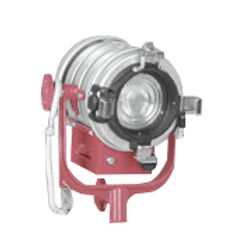
The Mole-Richardson Betweenie, Type 3131, is a compact 300 W tungsten Fresnel for accents, small keys, backlight and controlled background illumination. Its three-inch glass Fresnel, ventilated channel body and front/rear focus controls make it a familiar small hard-light tool in traditional location kits.
Identify the 300 W Betweenie rather than the smaller InBetweenie or the 650 W Tweenie II. Their similar names are not specifications. This is the replaceable-lamp tungsten 3131, with the correct prefocus globe and mechanical beam control, rather than an LED conversion.
Key specifications
| Specification | Details |
|---|---|
| Head / maximum lamp power | Type 3131; 300 W tungsten-halogen |
| Socket / globe geometry | Two-pin prefocus; 1.83-inch light-centre length |
| 120 V lamp | FKW 300 W, 3200 K; 200-hour listed life |
| 240 V lamp | FSK 300 W, 3200 K; 150-hour listed life |
| Lamp position | Coil horizontal, per manufacturer’s globe table |
| Lens / field angle | 3-inch heat-resistant glass Fresnel; 12–58° stated field angle |
| Reflector / focus | Alzak aluminium; front and rear focus knobs |
| Mount | 5/8-inch baby receiver; curved yoke |
| Dimensions | 6⅛ × 7 × 9 inches, manufacturer order |
| Head weight with cable | 6¾ lb / approximately 3.1 kg in the cited sheet |
| Historical cable / switch | 25 ft three-conductor #18 AWG cable; inline switch |
| Accessory family | 5⅛-inch scrims, diffuser frames and related light controls |
| Nominal lamp current | 2.5 A at 120 V; 1.25 A by calculation at 240 V with the correct lamp |
| Dimming | Suitable external tungsten dimmer; colour becomes warmer at reduced voltage |
Strengths and limitations
Strengths
- A continuous tungsten source gives direct, visible control of the lighting effect.
- Lamp and accessory choices adapt the source to its job.
Limitations
- Heat and electrical load remain central to placement and circuit planning.
- Dimming changes colour; lamp code, voltage and fixture limits must match.
Practical uses
The Betweenie can create a controlled background highlight, a modest shoulder edge or a small directional key where a larger tungsten head would add unwanted size and heat. Its curved yoke improves mechanical access to steeper positions, while the front and rear knobs help focus when one end is difficult to reach.
Use flood when even coverage matters and spot when the illuminated area can be smaller. A higher spot reading comes from concentration, not a change in lamp power. Barn doors reduce spill but do not make the lamp a sharp pattern projector. A flag placed for the receiving surface or a dedicated imaging fixture is more suitable for a very crisp cut.
| Setup | Working approach |
|---|---|
| Controlled key or accent | Choose focus or diffusion for the intended shadow and trim spill with compatible accessories. |
| Warm practical motivation | Meter at the chosen dimmer setting and balance colour through the camera. |
Output and colour
The manufacturer’s performance chart uses an FKW 300 W, 120 V, 3200 K quartz globe. The listed beam dimensions define approximately 50% of centre intensity, which is a different boundary from a general field-angle specification.
| Distance | Flood | Spot | Flood / spot beam diameter |
|---|---|---|---|
| 5 ft / 1.52 m | 180 fc | 990 fc | 4.4 / 0.7 ft |
| 10 ft / 3.05 m | 45 fc | 248 fc | 8.8 / 1.5 ft |
| 15 ft / 4.57 m | 20 fc | 110 fc | 13.2 / 2.2 ft |
Power and batteries
The sheet lists FKW at 120 V and FSK at 240 V, both 300 W and 3200 K. Their voltage and rated life differ. Match the actual lamp code, prefocus base, 1.83-inch light-centre length and fixture instructions rather than installing a globe solely because its pins enter the socket.
A 300 W lamp at 120 V draws a nominal 2.5 A. With the correct 240 V globe the simple P/V calculation is 1.25 A, consistent with the manufacturer’s rounded 1.2 A entry. The fixture is not an automatic voltage converter; a head carrying an FKW lamp must not simply be connected to 240 V through an adapter.
Control, cooling and camera operation
A compatible external tungsten dimmer provides fades with a warmer colour at lower voltage. For an output adjustment that avoids that deliberate colour shift, use appropriate wire scrims, distance or another suitable fixture. The nominal 3200 K lamp figure describes rated operation, not every dimmer setting.
The manufacturer lists a 5⅛-inch accessory family, including full and half single/double scrims, diffuser frames, snoots and barn doors. The three-inch lens diameter is not the same as the accessory-holder size. Some related Mole fixtures share specified accessories, but the family nickname alone is not a reliable buying guide. Check the actual holder, retention and part number.
Modifiers, rigging and the working package
Keep the specified filament coil horizontal and follow the head and globe instructions for operating position and clearance. The curved yoke’s mechanical range does not override lamp restrictions. Preserve ventilation, keep hot components away from delicate or flammable materials and allow cooling before packing or relamping.
The 6¾ lb figure includes the historical cable, not a stand or every front accessory. Choose support for the complete working arrangement, manage cable pull and secure overhead equipment appropriately. Use heat-rated modifiers and avoid placing a fabric enclosure intended only for LED use around the hot front of the head.
Alternatives and related fixtures
The InBetweenie is the smaller 100/200 W family member; the Tweenie II moves up to 650 W. An ARRI 300 Plus is another 300 W tungsten Fresnel with different optical, mechanical and accessory specifications. A compact LED spotlight is usually simpler for batteries, low heat and fast colour matching. The Betweenie is useful when its small traditional Fresnel beam fits the scene and the complete head remains serviceable.
| Fixture | Choose it for |
|---|---|
| ARRI LED L-Series | A colour-adjustable Fresnel with different operating and control hardware. |
| A supported soft-light system | A larger diffused emitting area when a hard source is not required. |
What people are saying
Joseph Brain: the 300 W Betweenie
Joseph Brain’s Betweenie presentation demonstrates the 300 W tungsten fixture as a compact classic source. It provides a view of the working head alongside the manufacturer’s lamp, support and clearance specifications. View the source.
Videos
Mole-Richardson Betweenie 300W (Type 3131): family guide
A demonstration of the named tungsten family; confirm the actual type plate and lamp.
Rental and used-fixture checks
Check the three-inch Fresnel, front door, safety components, accessory retainers, focus travel, curved yoke and stand lock. Inspect the socket contacts, inline switch, cable insulation, strain relief, plug and protective earth. Signs of overheating or improvised electrical repairs warrant service before operation.
Confirm that a used sale includes the correct lamp, barn doors and any scrims needed for the intended job. A missing lens or damaged socket can make a cheap head a poor purchase. Test the beam with a known approved globe after its electrical condition is established, and assess any unusual camera frame-rate or shutter setup with the actual lamp and supply.
Documentation and specifications
Official Type 3131 product page, original specifications, lamp table and photometrics and a rental inventory listing traditional Mole sizes, including the Betweenie.
Product photograph: Mole-Richardson official product photograph.
Browse Mole-Richardson lights · tungsten lights · all equipment.