
Last Updated 2 days ago
Overview
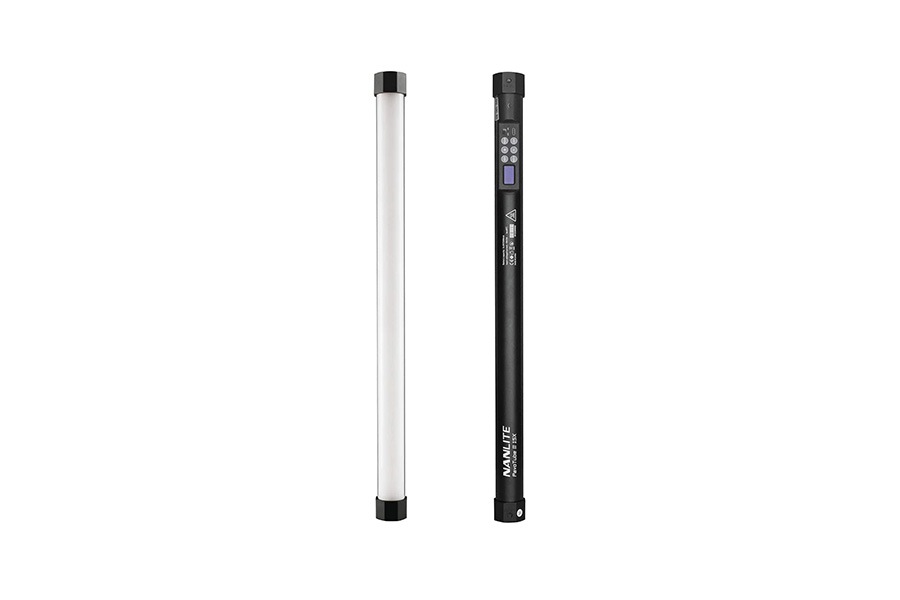
The Nanlite PavoTube II 15X is a compact, battery-powered RGBWW pixel tube in the nominal two-foot class. Its 600 mm body is useful in vehicles, shelves, set recesses and small practical-light arrangements, while eight controllable sections allow animated patterns along the tube.
The original 15X has no built-in CRMX receiver. The later 15XR adds built-in LumenRadio CRMX; that radio must not be assigned to an original X unit. The 15X is also distinct from the non-pixel PavoTube II C series and from the earlier PavoTube 15C.
Key specifications
| Specification | Details |
|---|---|
| Fixture class | Battery-powered RGBWW LED pixel tube |
| Nominal / physical size | 43 mm diameter × 600 mm long; nominal 2 ft class |
| Weight | Tube 0.82 kg; 15 V / 2 A adapter 0.20 kg |
| Rated power | 35 W manufacturer rating |
| White range | 2700–12000 K; green/magenta adjustment ±100 |
| Colour metrics | Average CRI 97; TLCI 98 |
| Dimming | 0–100% |
| Pixel sections | 8 |
| Internal battery | 14.8 V / 2200 mAh internal lithium battery |
| External supply | 15 V DC / 2 A maximum, using the specified adapter |
| Radio control | Bluetooth/NANLINK and Nanlite 2.4 GHz; no native CRMX on the original X model |
| Wired control | DMX/RDM via compatible adapter cable |
| Temperature limit | Maximum ambient 45°C in the corresponding family instructions |
Strengths and limitations
Strengths
- An internal battery removes the power lead for mobile accents and visible practicals.
- The 600 mm tube and eight sections fit compact set details.
- Wired DMX/RDM and NANLINK support remote control.
Limitations
- Charging, battery condition and colour-specific power draw affect usable runtime.
- The narrow emitting width gives a different shadow and reflection from a broad panel.
- The original X has no built-in CRMX; that feature belongs to XR.
Practical uses
The short tube fits where a four-foot unit cannot, such as a car cabin or a shallow shelf. It can provide a coloured practical element in frame, an edge behind a subject or a close fill. A narrow tube is soft along its length but remains narrow across its diameter; it does not automatically replace a broad diffused panel.
Pixel control is useful for passing colour, running reflections and visible graphic accents. If the light itself appears in frame, check the actual camera exposure, diffusion uniformity and the visibility of transitions between sections. A cue that looks smooth to the eye can read differently on a sensor at a short shutter.
For close work on reflective objects, the tube creates a long narrow highlight. Rotate and position it while watching the reflection, then control the surrounding spill. A compatible eggcrate/barndoor accessory can restrict off-axis light, but it changes output and should not be confused with a focusing lens.
| Setup | Working approach |
|---|---|
| Visible practical | Plan framing and exposure with the tube in shot so it retains the intended colour and surface detail. |
| Reflected highlight | Rotate and position the tube while watching its reflection; source length and distance determine the highlight shape. |
| Pixel interaction | Set the direction, timing and repeatability of the animation, then test at the actual camera frame rate and shutter. |
Output and colour
The table reproduces Nanlite’s bare-tube centre-illuminance values for the named X/XR size, in lux. White settings and saturated colours are listed separately because equal dimmer percentages do not produce equal illuminance. The measurements are manufacturer figures rather than a site retest.
A tube has meaningful physical length, especially at close distances. Its output should not be compared with a narrowly focused spotlight using only one headline lux number. Check the coverage, intended orientation and actual reflected or incident level at the subject.
| Setting | 1 m, lux | 2 m, lux | 3 m, lux |
|---|---|---|---|
| 2700 K | 343 | 86 | 38 |
| 3200 K | 350 | 87 | 39 |
| 5600 K | 377 | 94 | 42 |
| 6500 K | 386 | 97 | 43 |
| Red | 150 | 39 | 17 |
| Blue | 63 | 15 | 7 |
The RGBWW engine provides 2700–12000 K white light with green/magenta adjustment, plus hue/saturation and built-in effects. Nanlite lists average CRI 97 and TLCI 98. Those averages do not describe every saturated colour or establish a perfect spectral match with another tube at the same Kelvin value.
The 8 physical pixel sections can be grouped according to the selected mode and firmware. Match the console’s personality, pixel count, bit depth and colour mode to the tube. A whole-fixture dimmer/colour profile is not the same thing as independently addressing all sections.
Save the white/tint setting or colour values, pixel arrangement, effect speed and level for a repeatable cue. Where a visible effect must synchronize with other fixtures, verify the behaviour through the intended control path instead of relying on two independently started local effects.
Power and batteries
The original model’s manual lists a 14.8 V / 2200 mAh internal battery and the 15 V / 2 A external adapter. The rated 35 W figure and adapter specification are separate published quantities, not a measured mains-power report. Use the designated adapter for powering/charging and do not assume the USB-C firmware port accepts a generic USB power source.
An internal battery removes a cable at the light position, but its useful duration depends on level, white/colour mix, pixel activity, temperature and battery condition. Plan the operating period and recharge schedule around the actual tube rather than transferring a runtime from the longer 30X/60X or a different generation. Used packs may deliver less than a new unit.
Route and support the adapter lead when using external power. A powered tube is still a mounted load, and a cable tug must not pull it from a clip. Protect the display, connectors and internal battery from impact or excessive heat; a dented body or swollen battery calls for qualified inspection.
Control, cooling and camera operation
Bluetooth/NANLINK and Nanlite 2.4 GHz; no native CRMX on the original X model. An external CRMX receiver can feed a suitable wired DMX connection, but that is additional equipment; it does not turn the original 15X into a native XR radio fixture.
Wired DMX/RDM uses the correct Nanlite CB-DMX-ACP adapter arrangement at the tube’s control connector. Include the necessary adapter and cables in a hire, set the address and terminate the final fixture in a wired run. The USB-C port is identified for firmware updates, not as a general-purpose DMX or charging socket.
The locking local controls help protect a set level. Test low fades, blackout, app reconnection and radio or wired signal loss in the selected mode. Check firmware on mixed used/rental tubes, because available effects and DMX handling can differ by revision.
Modifiers, rigging and the working package
The 600 mm tube is short enough for confined sets but still needs a positive retained mount. Use the appropriate T12 clip, threaded mounting point or specified accessory. Keep clips clear of the controls and cable connection, and arrange secondary retention for an elevated installation.
The body provides 1/4-20 mounting receivers for approved accessories. Use the correct thread engagement and mounting hardware without crushing the tube or drilling into its battery housing. An elevated fixture needs appropriate secondary retention and a support rated for the full arrangement.
Nanlite lists separate model-specific IP68 waterproof housings. That rating belongs to the accessory system when properly assembled, not to the naked tube, adapter or unsealed connection. The corresponding instructions call for protection from wet conditions and specify an ambient limit for each size.
On a used unit, inspect diffusion, body straightness, clips, threads and connectors, then test battery health, every colour, pixel transitions and both local and remote control. Uneven sections or unexpected shutdowns warrant diagnosis before relying on the tube in a time-sensitive setup.
Alternatives and related fixtures
The PavoTube II 30C is a longer non-pixel variable-white/colour tube with a different design. An Astera Helios Tube uses Astera’s control and mounting ecosystem. Choose the original 15X when its short pixel-capable format fits and native CRMX is not required.
| Fixture | Choose it for |
|---|---|
| PavoTube II 15XR | The corresponding XR model adds integrated CRMX. |
| Astera Titan Tube | A separate battery-tube control and accessory ecosystem; compare source length, output and the complete working kit. |
| PavoSlim 120C | A broader rectangular source when a tube’s narrow face is not the required reflection or shadow shape. |
What people are saying
Graham Sheldon: stronger controls and a useful upgrade
Sheldon’s field review of the 15X and 30X likes the reorganised buttons, extra mounting points, Bluetooth control and pixel functions. He found NANLINK quicker for effects than the tube menus. His reservations include first-party accessories and the firmware-update process on the review samples.
Videos
Andrew Murphy: 15X and 30X lighting setup
A two-tube setup using the original X models.
Rental and used-fixture checks
Check the 15X label, battery runtime at the intended setting, supplied adapter and DC cable. Inspect the diffuser, end caps, buttons, mounting threads and clamps. Verify every required pixel mode and control channel; include the correct DMX adapter and independent retention for an overhead rig.
Documentation and specifications
official family specifications and photometry, manufacturer operating manual.
Product photograph: STAR Online product photograph; identification checked against Nanlite.
Browse Nanlite lights · LED tubes · all equipment.