
Last Updated 14 hours ago
Overview
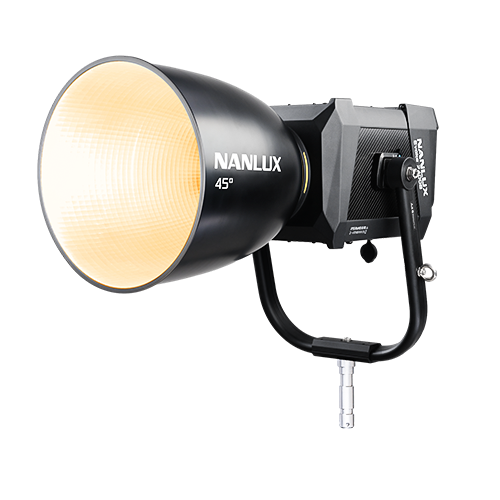
The Nanlux Evoke 2400B is a 2,400W bi-colour point-source LED with green/magenta correction, an NL accessory mount and a separate power supply. It is aimed at substantial window light, long throws, large bounces and diffusion setups that need more output than a smaller location COB.
Its strengths are output and control, but the complete package includes a heavy power supply, high electrical demand and modifier-specific limits. The fixture’s nominal power does not tell you what it can do in a quiet fan mode or through an accessory that limits output.
Key specifications
| Specification | Details |
|---|---|
| Rated power | 2,400W |
| CCT / tint | 2,700–6,500K; G/M ±80 |
| CRI / TLCI | 96 / 97 averages |
| SSI | 84 at 3,200K; 74 at 5,600K |
| TM-30 | Rf 95; Rg 100 averages |
| AC input | 100–240V, 50/60Hz; 26A maximum specification |
| DC input | 48V / 26A × 2, specified system |
| Mount | NL with electronic modifier recognition |
| Dimming | 0–100%, 0.1% increments |
| Head / power supply | 15kg / 11.58kg, published component figures |
| Head dimensions | 427.3 × 316.4 × 265.1mm; stated fixture configuration |
| Weather rating | IP55 for head and power supply |
| Control | Onboard, wired controller, NANLINK, DMX/RDM, CRMX, Art-Net/sACN |
Strengths and limitations
Strengths
- High-output variable white and tint support substantial location lighting.
- Input-current management provides operational flexibility.
Limitations
- The heavy supply, cabling and modifiers are part of the rigging load.
- Reduced circuit settings also reduce available output.
Practical uses
The 2400B is useful when a smaller tunable-white source loses too much light through diffusion or cannot reach the required distance. It can make a controlled daylight push practical without repeated correction-gel changes, while still allowing a warmer setup from the same head.
Compare it with the Evoke 1200B for a lighter-output package and the Evoke 900C when full colour matters. Select by the required beam, colour capability, power and handling rather than a manufacturer’s broad HMI-equivalence claim.
| Setup | Working approach |
|---|---|
| Window light | Choose throw and coverage, then confirm the circuit setting and modifier. |
| Large bounce | Check the full useful bounce area and remaining exposure reserve. |
Output and colour
Selected 5,600K readings from the Nanlux photometric table show the difference between the bare source and reflectors. Do not present the 15° reflector reading as the output of the wider standard reflector.
| Distance | Bare | 15° reflector | 45° reflector |
|---|---|---|---|
| 3m | 9,584 lux | 116,900 lux | 41,910 lux |
| 5m | 3,801 lux | 61,000 lux | 14,070 lux |
| 10m | 1,039 lux | 17,450 lux | 3,607 lux |
CCT and G/M correction let the 2400B adjust white-light temperature and tint. It is not a full-colour fixture for saturated RGB looks. The tint scale is a manufacturer control range; it should not be assumed equivalent to another brand’s percentage or a particular physical gel.
Match through the production camera and viewing transform. A Kelvin number, especially in mixed LED and daylight environments, does not fully describe the spectrum. Use a grey reference and real scene materials when the match matters.
Power and batteries
The rated input is a production-scale load. The broad AC voltage range is not permission to connect the fixture to any domestic circuit without checking that circuit’s capacity, connection and other loads. Confirm the actual regional cable and operating arrangement during prep.
The separate supply weighs 11.58kg before cables or mounting hardware. Place and support it deliberately; do not let a head cable carry its weight. Keeping the supply accessible can simplify operation and troubleshooting, but the cable route must allow safe aiming and movement of the head.
Control, cooling and camera operation
The manufacturer documents Smart, Full Speed, Low Speed and Off modes. Its product information limits maximum output to 50% in Low Speed and 15% in Off. Those are significant exposure differences, not merely changes in fan noise.
If sound requires a quieter setting, agree on it before setting exposure. A fixture metered at full output during setup can no longer provide the same lighting level after a switch to a restricted mode. Test with the actual microphone placement and ambient temperature; the sound of the complete power-and-head system matters.
The head provides wired DMX/RDM and Ethernet-based Art-Net/sACN, with NANLINK and CRMX options. Its two LAN ports and DMX connections are useful in a networked production package, while the wired controller offers a simpler way to reach a high or awkward head.
Use the current DMX reference for the chosen operating mode. Record dimming curve, profile, fan mode and signal-loss behaviour. A successful link only proves communication; it does not prove the console’s fixture personality matches the light’s selected channel map.
Modifiers, rigging and the working package
The electronic contacts allow supported modifier recognition and power management. Mechanical fit does not mean that every NL accessory supports unrestricted 2,400W operation. In particular, Nanlux lists the older FL-28 at a 50% limit on this fixture.
The newer FL-35E has its own compatibility and operating information. Use the appropriate documentation for the exact lens; do not infer its limits from the FL-28 or from a smaller Evoke. The product page retains some older launch-era wording, so a current accessory page is more useful for an accessory decision.
For a large soft source, choose a supported softbox or frame arrangement and check how evenly the beam fills it. For throw, a narrow reflector can provide stronger centre illumination but less useful coverage. The biggest lux number is not a complete lighting plan.
The 15kg head figure is not the complete working load. Include reflector or Fresnel, yoke configuration, cable pull and any other mounted accessory in the support plan. Large soft modifiers also create wind area, regardless of the head’s weather rating.
IP55 covers the manufacturer-rated head and supply under the specified conditions. Close unused ports with the correct caps and follow the manual’s weather instructions. Third-party cables, connectors or distribution equipment retain their own limitations.
Alternatives and related fixtures
| Fixture | Choose it for |
|---|---|
| Evoke 5000B | A larger integrated-supply source with different input demands. |
| Evoke 1200B | A lower-load NL fixture with different output and accessory limits. |
What people are saying
Graham Sheldon: useful circuit flexibility
Sheldon values the 2400B’s selectable input-current arrangement, tint adjustment and broad connectivity. His field review sees it as a useful long-term large-source investment, while keeping the supply and electrical setup central to the package. Read or watch the full account.
Videos
Gaffer & Gear 255: Evoke 2400B
A model-specific walkthrough or review.
Rental and used-fixture checks
Verify the exact model, power components and control profile. Inspect mounts, optics or diffusion, connector locks and cables. Test a slow fade, colour matching and the complete intended remote-control path before rigging.
Documentation and specifications
Nanlux Evoke 2400B product page · English user manual · DMX reference · Official firmware and downloads.
Product photograph: Nanlux.
Browse Nanlux lights · COB lights · all equipment.