
Last Updated 5 hours ago
TK-450 Overview
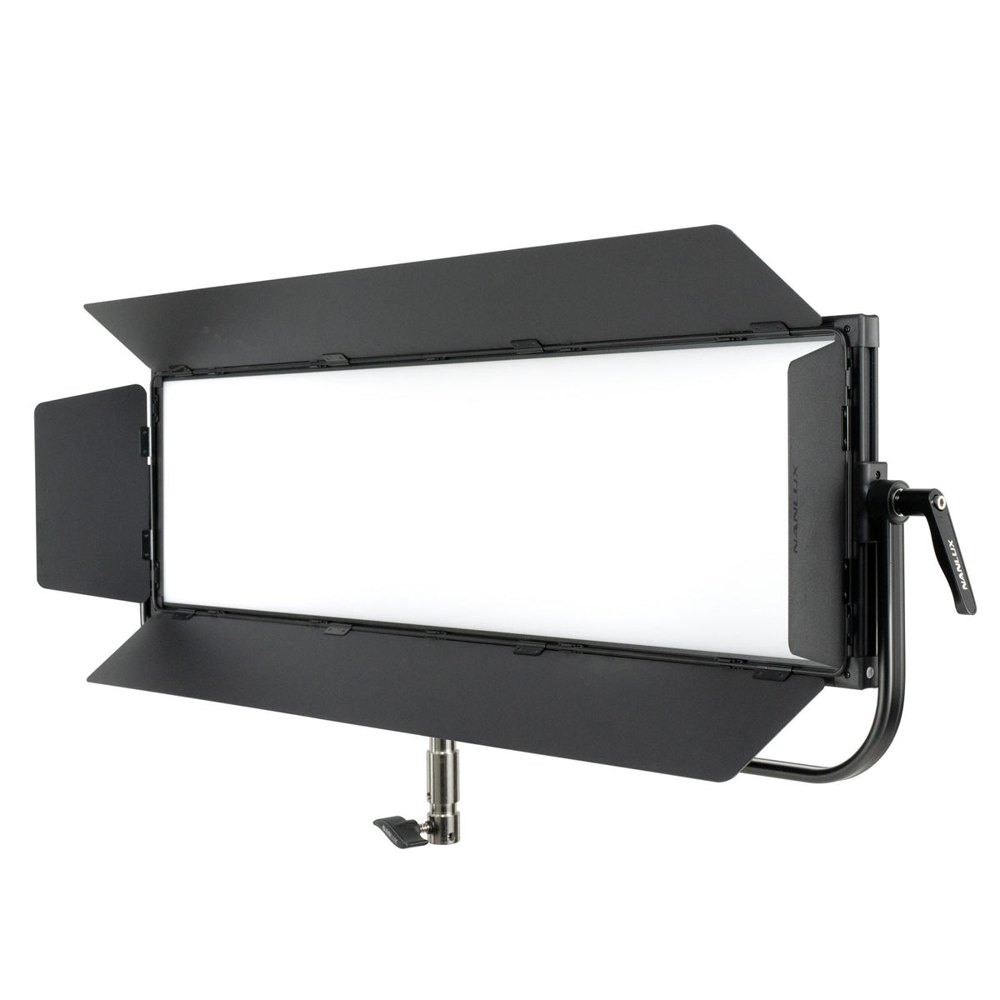
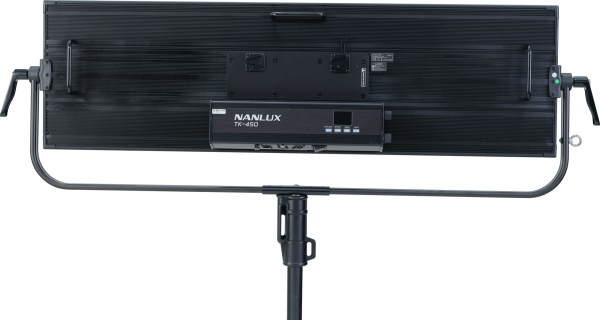
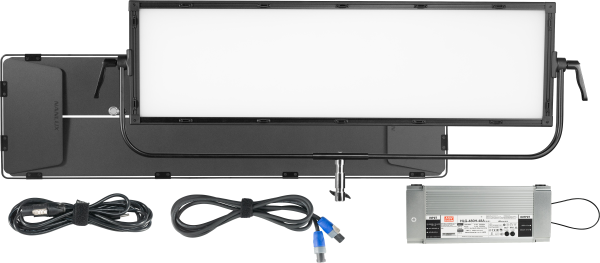
The TK-450 is a large fixed-daylight soft panel for a broadcast desk, standing interview or window-side fill. Its 455 W rating and 48 V head supply identify it in the shared TK-200 and TK-450 manual.
The TK-450’s colour temperature is fixed at 5,600 K. Use CTO to warm it when you need it to match tungsten; a dimmer or an FX preset does not give it adjustable white light. Test the filter and level together before committing to a match.
- Fixed-Daylight LED Panel Wide soft panel for studio and broadcast.
- 455 W Rated The external power supply feeds the head at 48 V DC.
- Colour Temperature5,600 K fixed daylight. Use CTO to warm it or CTB to raise its colour temperature.
- Weight8.58 kg / 18.9 lb head only; 1.68 kg / 3.7 lb yoke. Barndoors and supply are separate weights.
- Beam Control Broad diffused output; use barndoors, grids or flags for spill control.
- IP RatingNot stated No numeric IP rating appears in the published specifications; do not assume weather protection.
TK-450 Specifications
| Specification | Details |
|---|---|
| Manufacturer and model | Nanlux TK-450 |
| Source or rated power | 455 W rated power |
| Optics, colour or format | Fixed 5,600 K soft panel |
| Head or system detail | 48 V DC / 10 A maximum at the head, CRI 96 and TLCI 98 |
Output Calculator
Select the published setup and a manufacturer distance, or enter a custom throw where supported. The results describe centre-beam output, not the brightness across the whole beam.
Camera Settings
If the calculator does not load, use the published photometric table or source on this page. JavaScript is required.
F-stop is a planning estimate, not a meter reading. It uses direct, on-axis illuminance and includes only the optics and diffusion named in the selected setup. Meter on set to account for lens transmission, filters, added diffusion, bounce, dimming and ambient light.
How the exposure estimate works
N = √(E × ISO × t / C), where E is illuminance in lux and t = shutter angle ÷ (360 × fps). The default C = 340 is a dome reference; C = 250 is a flat reference. These are calibration constants, not a measured T-stop. A small nonzero digit is tenths of a stop above the displayed full stop.
Distance estimates and comparisons
Published points are used as given. Between published points the calculator fits a curve through the two nearest readings. Outside those points it uses the inverse-square law only when the fixture’s dataset permits it. Distances outside a configuration’s supported range are reported separately. Comparisons use one shared distance and camera setup; equal lux does not imply equal coverage.
View published readings for the selected configuration
Model and Family Fit
The TK-450 and smaller TK-200 are the original daylight TK panels; use the exact TK-450 manual and supply rather than assuming the two kits share a voltage.
Strengths and Limitations
- A large daylight face can cover a desk with fewer hard shadows.
- The panel is fixed at 5,600 K. Start with Rosco 3411 three-quarter CTO for 3,200 K tungsten; for practicals that look warmer, compare on camera before choosing a stronger gel.
Practical Uses
Use a pair across a desk when broad coverage is more important than a hard shadow. Shape the edge with a grid or flags and check the level at each chair.
Output and Colour
| Configuration | Distance | Lux | Foot-candles |
|---|---|---|---|
| 5,600 K · daylight panel | 1 m | 12,480 | 1,159 |
| 5,600 K · daylight panel | 3 m | 1,776 | 165 |
| 5,600 K · daylight panel | 5 m | 736 | 68.4 |
| 5,600 K · daylight panel | 7 m | 405 | 37.6 |
Photometric source and test conditions.
The regional product table publishes all four readings at 5,600 K. The calculator retains them unchanged and limits estimates to 1–7 m. The table does not state a separate louvre or modifier test; no accessory transmission or other-CCT curve is inferred.
Power and Batteries
The manufacturer’s TK-200/TK-450 manual specifies the TK-450 at 455 W, DC 48 V / 10 A maximum, with AC 100–240 V, 50/60 Hz input through its power supply. It lists DMX, RDM, 2.4 GHz, Bluetooth and LumenRadio control. The Japanese regional product page instead prints DC 24 V / 10 A; this differs from the exact-model manufacturer manual. Use the TK-450 manual and the supplied unit’s labels, not the regional 24 V line, when checking the power supply.
Control, Cooling and Camera Operation
If the fixture is being patched with other lights, match the desk profile to the actual wired or wireless mode and verify the power supply label before testing cues.
Modifiers, Rigging and the Working Package
The wide panel face suits a multi-person setup. Doors and a correctly sized grid help limit spill on walls and set pieces.
Choosing the Optic or Modifier
The wide face is the starting point. Choose the grid for spill control and verify the coverage at the working throw instead of treating the grid as a narrower reflector.
Alternatives and Related Fixtures
For a full-colour Nanlux soft-panel alternative, see Nanlux Dyno 650C.
What People Are Saying
Field Feedback at a Glance
The studio inventory names exact fixtures. The other notes come from Nanlux documentation, not an independent owner test.
What worked
- MediaMaking lists two TK-450s in its green-screen stage package without assigning them a specific role. Studio inventory.
- The long soft panel covers a broad area without an external bounce; Nanlux lists doors and optional honeycomb and eggcrate. Nanlux flyer.
- Passive cooling is useful for dialogue, and Nanlux lists DMX/RDM and built-in LumenRadio CRMX for console control. Nanlux flyer.
Drawbacks to plan for
- The 5,600 K output is fixed. Use suitable CTO and budget for light loss when matching a warmer source, or choose the separate adjustable-white TK-280B. Nanlux user manual.
- The 455 W fixture uses a 48 V DC/10 A maximum head supply, not the TK-200’s 24 V arrangement. Nanlux user manual.
- The factory reading drops from 12,480 lux at 1 m to 405 lux at 7 m. Use the intended distance and meter after adding diffusion or a grid. Nanlux flyer.
MediaMaking, green-screen studio
The studio lists two TK-450s in its green-screen stage package alongside other Nanlux fixtures. The list documents how the panel fits into a working studio inventory; it does not report an output test or assign the TK-450s a specific job.
Videos
Westbuy’s TK-series walkthrough identifies the TK-450 and TK-140B. Use it for shared menu concepts, not as an isolated TK-450 output test. The Nanlux manual identifies the rear-panel connections for the exact model.
Rental and Used-Fixture Checks
Check the TK-450 model label and the correct supply. The TK-450’s manual lists wired DMX/RDM and wireless control, while the smaller TK-200 uses a different DC voltage.
Before You Book
Match the power supply to the head and manual, pack the grid or doors the plot calls for, then test a low-level fade on the intended control path.
Documentation and Specifications
Back to contents · Browse Nanlux lights · Browse all lighting equipment