
Last Updated 3 days ago
Overview
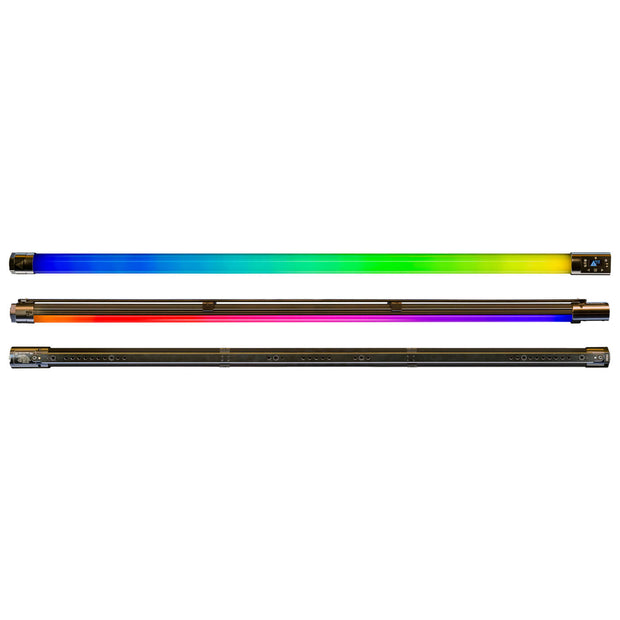
The Quasar Science Rainbow 2 Q50R2 is the nominal four-foot, single-row Rainbow 2 linear LED fixture. It provides 24 controllable pixel sections, full colour and integrated production control in a relatively narrow 50 W maximum package.
The exact model matters: the two-foot Rainbow 2 is Q25R2 and the larger Q100R2 is a different length. Q50R2 is also separate from an original Rainbow and from the two-row Double Rainbow RR100. The R2 is a powered fixture with AC/DC inputs, not an internally battery-powered tube.
Key specifications
| Specification | Details |
|---|---|
| Exact model / part | Q50R2 / part 924-2302 |
| Fixture class | RGBX Spectral Science linear LED fixture |
| Maximum rated wattage | 50 W maximum |
| Pixel layout | 24 sections in one row |
| White range in checked manual | 1750–10000 K; green/magenta adjustment |
| Body size | 46.9 × 1.75 in in the product table; nominal 4 ft class |
| Fixture weight | 1.50 kg / 3.30 lb |
| Listed AC current examples | 120 V AC / 0.45 A; 240 V AC / 0.25 A |
| Listed DC examples | Listed examples: 12 V DC / 4.50 A; 24 V DC / 2.30 A |
| Battery | External source required; no internal operating battery specified |
| Mounting | Integrated Ossium rail with matching slider / baby-pin hardware |
| Network distinction | Ethernet node; the manual distinguishes R2 port behaviour from the RR network switch |
Strengths and limitations
Strengths
- A linear source gives distinctive visible lines and product highlights.
- Professional remote control supports programmed effects.
Limitations
- Pixel layout and source length determine the look and control patch.
- Power and network accessories remain part of the working kit.
Practical uses
The narrow four-foot format is useful for a long product reflection, an overhead strip, a close edge or a visible practical-light element. Its length creates a different source shape from a square panel, while its small width leaves a fairly narrow highlight on glossy surfaces.
Twenty-four sections allow gradients, passing light and pixel effects along the line. Choose the degree of segmentation for the cue rather than assuming every effect needs a maximum-channel profile. If the fixture appears in frame, check pixel boundaries and diffusion at the camera’s exposure and shutter settings.
An array can be used for image-based lighting or pixel animation when properly mapped and fed. It is still a lighting array rather than a high-resolution video screen. The number and spacing of physical sections determine what movement and reflected detail can be reproduced.
| Setup | Working approach |
|---|---|
| Visible practical | Expose through the camera to retain colour and face detail. |
| Interactive effect | Test direction, timing and repeatability at the actual shutter and frame rate. |
Output and colour
The current Rainbow 2 page links to an archival brightness chart whose plotted curves are explicitly RR50 and RR100. Those Double Rainbow numbers cannot be relabelled as Q50R2 measurements. A traceable Q50R2 lux test with its CCT, distance and accessory state is therefore preferable to quoting an unsupported “equivalent” value here.
Quasar also publishes an identified September 2021 R2/RR colour report. It gives different scores at different white settings: the 3200 K page reports CRI Ra 89 and TLCI 91, while the approximately 5600 K page reports Ra 95 and TLCI 97. These are archival report values, not a claim that every mode, current firmware or saturated colour has the same score.
The RGBX Spectral Science engine and its colour controls are useful working tools, but a maximum gamut or colour-count statement does not establish the output available in a particular saturated cue. Check the chosen white/tint or colour setting on the production camera and meter the intended working distance.
Power and batteries
The manufacturer lists 50 W maximum, 0.45 A at 120 V AC and 0.25 A at 240 V AC. Its DC examples are 4.50 A at 12 V and 2.30 A at 24 V. The family manual describes a 2.1 mm locking DC barrel input and generic 10–30 V DC operation; use the correct approved lead and a source with adequate current capacity.
The manual identifies direct AC through a True1-type connection and an AC operating description of 110–240 V. Match the actual regional unit, retained cable and electrical label. Digital control provides dimming; a phase-cut mains dimmer is not the normal control path to plan for this fixture.
There is no internal operating battery specified. A battery setup needs the correct external source, retained cable, discharge capacity and support. Watt-hours alone do not prove that a small camera pack can supply the required current. Include total cable load and battery support in the physical installation.
Control, cooling and camera operation
The checked family manual provides a 1750–10000 K white range with green/magenta adjustment, plus colour and effects controls. Record firmware, colour mode, calibration setting, intensity and white/tint or colour values for matching. An older profile or firmware can expose different parameters from a current app interface.
Pixel grouping and 8/16-bit profile choices change the DMX footprint and control resolution. Match the personality and grouping at the console and fixture, then verify the orientation of a simple chase before sending complex content. A whole-fixture colour profile does not expose every physical pixel independently.
Test low fades and the intended camera frame rate/shutter at the actual level and effect speed. Smooth visual operation on one camera setting does not establish an unlimited high-speed performance specification.
The fixture supports local control, wired DMX, Ethernet Art-Net/sACN, wireless DMX through its LumenRadio system, and firmware-dependent Wi-Fi/Bluetooth app routes. The manual’s protocol and priority settings matter: a live wired data route can take priority over manual or wireless commands.
DMX uses the RJ45 ports with a suitable five-pin-XLR-to-RJ45 adapter when joining a conventional DMX chain. These same physical port types can serve different configured functions. Do not assume that an RJ45 connector always carries Ethernet, or connect a DMX output to network equipment without checking its mode and wiring.
Ethernet node; the manual distinguishes R2 port behaviour from the RR network switch. The family manual explains that LAN2 can output converted DMX in node mode; with that function disabled the RR’s LAN2 can act as a switch port, while the R2’s corresponding behaviour differs. Configure the intended role, universes, addressing and signal-loss response before a multi-light setup.
The current product pages promote starCTRL app control, while archival manuals also describe older app workflows. Verify compatibility with the installed firmware and device rather than treating every historical app example as the only current method.
Modifiers, rigging and the working package
Use accessories approved for the exact head and support their complete working load. Confirm retention, clearances and cable routing before raising or hanging the fixture.
Alternatives and related fixtures
The Quasar Crossfade tubes are a different variable-white design and control workflow. Double Rainbow RR100 provides a two-row 48-section face with twice the listed maximum wattage. Choose the Q50R2 for its narrow line, pixel capability and complete compatible control package.
| Fixture | Choose it for |
|---|---|
| Quasar Double Rainbow RR100 | A different row and pixel layout in the RGBX family. |
| Astera Titan Tube | An internal-battery tube and a different control ecosystem. |
What people are saying
Blackout: connecting and controlling the tubes
Blackout Lighting Console’s paired review examines hardware, connection routes, node modes and colour science. It gives practical control-system context for the Rainbow 2 and Double Rainbow without treating their pixel layouts as identical. View the source.
Videos
Quasar Science Rainbow 2 Q50R2: family guide
Paired Rainbow 2 / Double Rainbow review; identify the exact length and pixel layout.
Rental and used-fixture checks
The Ossium rail and matching slider/baby-pin hardware support positioning along the body. Use the correct retained slider, accessory and stand or array support, and follow the current rigging guide for the complete load. Include any battery, diffusion, grid and cable tension in the installation.
A tube/linear-light label does not make the housing compatible with every fluorescent clip or improvised clamp. Keep support away from optics, control interfaces and connector strain. Use appropriate secondary retention for elevated installations and keep heat-dissipation surfaces clear.
Inspect the diffuser, rail, slider locks, end caps, AC/DC connections and every pixel section. Test whites, colours, local controls, wired data, radio and network functions. Protect the fixture and power connections from conditions outside the matching instructions; neither a robust rail nor a retained mains connector alone establishes unrestricted weather use.
Documentation and specifications
official product page, manufacturer operating manual, Rainbow rigging guide, identified RR brightness chart and 2021 R2/RR colour report.
Product photograph: Quasar Science official product photograph.
Browse Quasar Science lights · LED tubes · all equipment.