
Last Updated 3 days ago
Overview
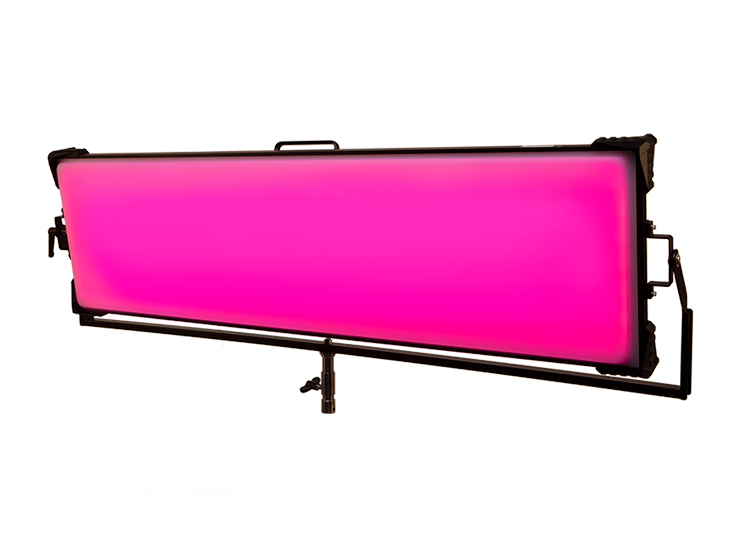
The Rosco DMG MAXI MIX is a larger full-colour LED soft-light fixture using Rosco’s six-colour MIX engine. Its roughly 1.2 m long face provides a broader source than SL1 MIX for larger keys, overhead arrangements, group coverage and extended product reflections.
The current Rosco page names it DMG MAXI; the operating manual identifies the MIX model. It is rated at 360 W maximum and listed at 8 kg for the fixture. The MAXI integrates its control system but still requires the specified separate power supply; the head figure is not a complete ready-to-rig package.
Key specifications
| Specification | Details |
|---|---|
| Fixture class | Six-colour MIX-engine LED soft light |
| Model identification | Current DMG MAXI product number 29822400K001 |
| Maximum power | 360 W maximum |
| White range | 1700–10000 K |
| Emitter colours | Red, green, blue, lime, amber and white (4000 K) |
| Fixture dimensions | 1200 × 360 × 85 mm / approximately 47 × 14 × 3.3 in |
| Listed fixture mass | 8.0 kg / 17.6 lb, fixture |
| AC power system | 100–240 V AC via the specified supply |
| Battery system | 24–35 V DC through the specified power arrangement |
| Package requirement | Integrated control system; separate specified PSU |
| Control via matching system | myMIX/Bluetooth, DMX/RDM, CRMX Timo FX, Art-Net LAN/Wi-Fi; verify driver and firmware |
| Published high-speed claim | Flicker-free up to 4000 fps; test the intended camera mode |
Strengths and limitations
Strengths
- A broad emitting face suits soft keys and controlled reflections.
- Model-specific controls allow repeatable white or colour settings.
Limitations
- Diffusion and grids change both the exposure and the useful coverage.
- The controller, supply and rigging are part of the complete package.
Practical uses
The broader rectangular face can provide more apparent source area than a narrow strip at the same working distance. It suits a larger interview key, a soft side direction across several objects or a substantial reflected highlight on vehicles and furniture.
Multiple MAXI fixtures can be joined using model-specific LINK accessories or supported in the documented multi-head yoke arrangements. These are separate rigging configurations with their own loads, not permission to join arbitrary housings or use the single-head mounting assumptions for an array.
A large soft source can illuminate the background as well as the intended subject. Use matching grids, diffusion and external flags for spill control. Choose placement and modifier density while viewing the camera rather than using the bare-head lux number as the final exposure promise.
| Setup | Working approach |
|---|---|
| Interview key | Set source size and distance for the required wrap, then add a grid or flags. |
| Product reflection | Watch the actual reflection while adjusting orientation and diffusion. |
Output and colour
The current Rosco data sheet gives the following centre illuminance without a diffuser. The white settings and distances are retained exactly as published. These are not output figures through an added softbox, dense diffusion or a saturated colour setting.
A broad panel’s coverage and apparent size matter as much as the centre value. For the final setup, fit the intended diffusion and spill control, place the fixture at its working distance and meter across the subject area. Do not compare a bare soft-light figure with a spotlight’s narrow-focus peak as though the beams were the same.
| Setting / modifier | 1 m, lux | 3 m, lux |
|---|---|---|
| 3200 K, no diffuser | 7,377 | 1,034 |
| 5600 K, no diffuser | 7,550 | 1,045 |
Rosco’s MIX engine uses red, green, blue, lime, amber and white emitters, with the white component identified at 4000 K. The documented tunable-white range is 1700–10000 K. The additional emitter colours are part of the spectral-mixing system rather than six separately interchangeable conventional lamps.
WHITE, GEL, HSI/xy colour, effects and SOURCE MATCH functions address different tasks. The current sheet describes more than 130 True Rosco Color gel matches and Rec.709/Rec.2020 overlays. A matching gel name does not establish identical spectra or equal brightness to a physical gel on another source.
Record the chosen mode, colour-space setting, white/tint or colour values and intensity for a repeatable cue. Check skin, fabrics and products on the production camera. The manufacturer’s up-to-4000-fps flicker-free statement should still be tested at the actual frame rate, shutter, dimming level and effect mode.
Power and batteries
The manufacturer lists a 100–240 V AC system and a required separate power supply, with 24–35 V DC battery operation. The PSU, proper head lead and approved battery arrangement are part of the package. Do not assume the SL1’s 12 V lower-limit specification applies to MAXI or that a single ordinary 14.4 V camera battery is a direct head supply.
Confirm every power component and its regional rating before a hire or used purchase. A product listing that includes only the luminous head may omit a costly or hard-to-source driver, PSU, battery interface or head cable. Weight and dimensions in this article describe the fixture rather than a packed case.
Support the power electronics and cable runs separately, provide strain relief and allow ventilation. For battery work, check voltage, continuous discharge, connector rating and expected duration at the actual operating mode. Stored energy is only one of those limits.
Control, cooling and camera operation
The MAXI system integrates the control interface and lists Bluetooth/myMIX, five-pin DMX/RDM, LumenRadio CRMX Timo FX and Art-Net through LAN/Wi-Fi. Match the installed firmware, network settings and profile. Radio and app control are separate routes, even when both appear in the same product feature list.
Set the DMX address and profile, pair the correct radio system and test low fades, blackout and signal loss. For a wired DMX run use the correct five-pin cables and final termination. For Art-Net, confirm the actual interface, universe and network settings; a LAN connector and a DMX connector are different electrical/data paths.
The app is useful for remote colour adjustment and setup, while a console can coordinate timed cues across multiple fixtures. Test the route that will be used during a take, especially when mixing older MIX drivers with newer app or firmware versions.
Modifiers, rigging and the working package
Use the correct MAXI mount and the documented LINK or multi-head yoke hardware for an array. Calculate the full fixture, PSU, modifier and cable load, including leverage and elevated placement. Fold, assemble and secure any model-specific mechanism only as shown in the MAXI manual; provide appropriate secondary retention.
Match diffusion, grids, lightbanks and mounting accessories to the exact model and version. A grid restricts spill while diffusion changes the appearance of the luminous face and the available level. Keep those modifier states in camera and lighting notes.
Inspect the emitting surface, colour uniformity, rear mount, driver connections and supply leads. Test warm/daylight whites, saturated colours, low fades and the intended radio/wired/network route. Check that all required interconnects and accessories are present and that the housing or mount has not been bent during transport.
Use the weather, ambient and ventilation guidance in the matching manual; this article does not assign an unverified outdoor IP rating to the complete older MIX package. The condition and protection of a separate driver or PSU matter as well as the head.
Alternatives and related fixtures
The SL1 MIX is a lower-load, narrower head with a separate driver. A Creamsource Vortex8 has a different optical, weather and power design. Compare the actual source area, modifier output and full package rather than treating two colour panels as equivalent because both can produce an RGB cue.
| Fixture | Choose it for |
|---|---|
| DMG SL1 MIX | A different emitting area in the MIX system. |
| PavoSlim 240C | A different full-colour panel, mounting and power arrangement. |
What people are saying
Nicolas Goerg: MIX-controller operation
Rosco’s Nicolas Goerg demonstrates the MIX controller’s features and menus. His walkthrough is intended to accompany the MIX user guide, making it useful for checking a complete head-and-controller package. View the source.
Videos
Rosco DMG MAXI MIX: family guide
Manufacturer MIX-controller walkthrough; confirm driver and firmware compatibility for the actual head.
Rosco: DMG MAXI SNAPBAG
A manufacturer guide to the model’s softbox and diffusion.
Rental and used-fixture checks
Check the exact model and revision, complete power package, mounting hardware and control leads. Inspect emitting surface, connectors and support points. Test the intended operating level, fade and camera settings before rigging.
Documentation and specifications
official current model information, Rosco technical sheet and MIX assembly and operating guide.
Product photograph: Rosco official product photograph.
Browse Rosco / DMG lights · LED panels · all equipment.