
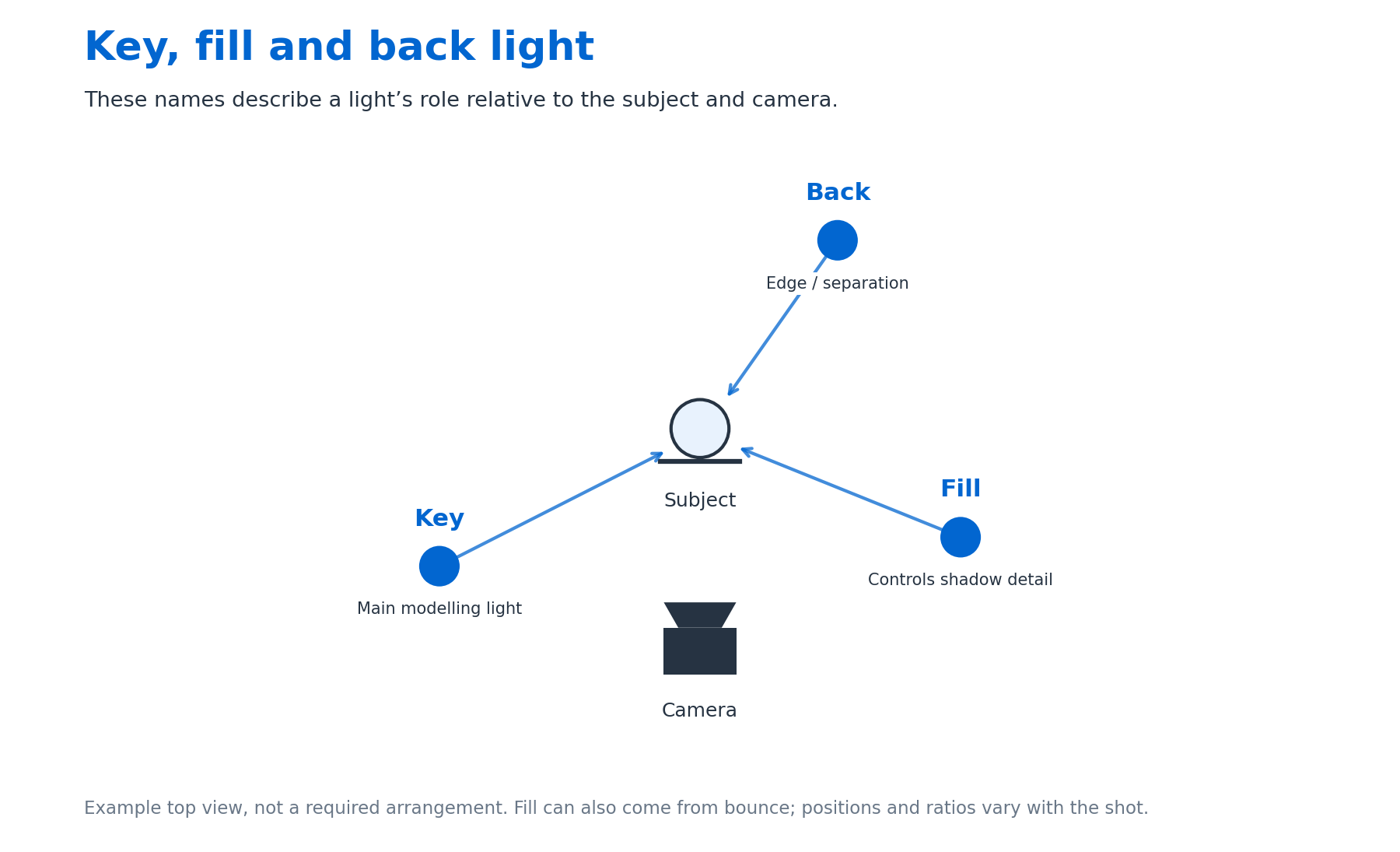
Fill light adds illumination to the shadow areas of a subject. It can come from a separate fixture, a reflector or the room itself, and is used to control the contrast established by the key.
How much fill to use
There is no required fill level. A broad, restrained fill can retain detail while leaving the key’s direction clear. Stronger fill produces a flatter relationship between lit and shadow areas. Watch for a second set of obvious shadows when adding a distinct source.
Fill and negative fill
White surroundings often provide fill without a dedicated light. Negative fill reduces this return using a dark surface. It can be more effective to remove unwanted room bounce than to keep increasing the key.
Practical example
With a soft key from camera left, place a white board on the opposite side and bring it closer until the shadow cheek has the required detail. Compare with the board removed before adding a powered fixture. Record how a quoted lighting ratio was measured; ratios based on source readings and ratios based on lit-versus-shadow readings are not necessarily equivalent.
Related terms
Key Light · Bounce Light · Negative Fill · Lighting Ratio · Incident Light Meter