
Last Updated 5 days ago
Nanlux Dyno 1200C Overview


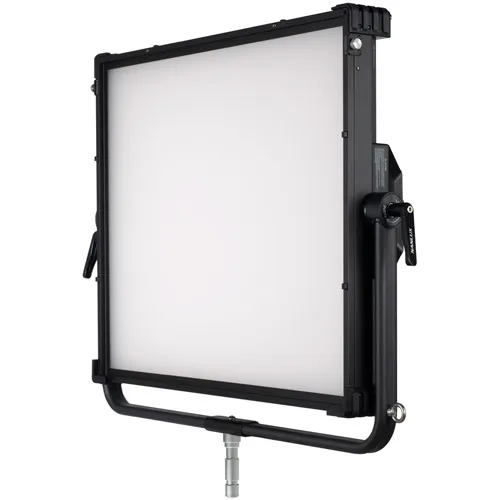
The Nanlux Dyno 1200C is a large-format RGBWW soft panel with a broad native beam and separate power supply. Its square emitting area and substantial working package distinguish it from the rectangular Dyno 650C and hard-light Evoke fixtures.
The Dyno 1200C is a large square soft source for broad keys, overhead light and reflections. Choose it for the required source area and exposure, with a handling plan for the nearly thirty-kilogram fixture-and-diffuser subtotal.
- RGBWW Broad Soft Panel Dyno 1200C with separate power supply and standard diffuser. Learn about RGBWW
- 1200 W Rated Fixture Class 100–240 V AC power system. Head DC rating 48 V, up to 29.2 A; use exact published AC current for circuit planning.
- Colour Temperature2700–20000 K Tunable white with green–magenta and full-colour modes.
- Weight 26.2 kg Head / 7.5 kg Power Supply. Standard diffuser, cabling, mounting and accessories add separate mass.
- Beam Control 160° native beam, with diffuser and matching spill-control accessories. Standard and Boost readings are separate.
- No Published Numeric IP Rating The reviewed model specifications do not establish weather sealing. Keep head and separate power equipment dry. How to Read an IP Rating.
Nanlux Dyno 1200C Specifications
| Specification | Details |
|---|---|
| Engine / beam | RGBWW soft panel; 160° native beam |
| Source format | Large approximately 30-inch-square emitting area |
| White range | 2,700–20,000K with green–magenta adjustment |
| Fixture class | 1,200W rated light |
| Published AC requirements | 100–240V; 12.72A at 110V / 6.36A at 220V / 5.83A at 240V |
| Head input | 48V DC, 29.2A maximum |
| Body dimensions | 1,023 × 173 × 918mm |
| Fixture / diffuser / PSU | 26.2kg / 3kg / 7.5kg |
| Output modes | Standard and Boost with separate photometrics |
| Controls | Onboard, DMX/RDM, internal TimoTwo CRMX and NANLINK Bluetooth/2.4GHz |
Output Calculator
Select the published setup and a manufacturer distance, or enter a custom throw where supported. The results describe centre-beam output, not the brightness across the whole beam.
Camera Settings
If the calculator does not load, use the published photometric table or source on this page. JavaScript is required.
F-stop is a planning estimate, not a meter reading. It uses direct, on-axis illuminance and includes only the optics and diffusion named in the selected setup. Meter on set to account for lens transmission, filters, added diffusion, bounce, dimming and ambient light.
How the exposure estimate works
N = √(E × ISO × t / C), where E is illuminance in lux and t = shutter angle ÷ (360 × fps). The default C = 340 is a dome reference; C = 250 is a flat reference. These are calibration constants, not a measured T-stop. A small nonzero digit is tenths of a stop above the displayed full stop.
Distance estimates and comparisons
Published points are used as given. Between published points the calculator fits a curve through the two nearest readings. Outside those points it uses the inverse-square law only when the fixture’s dataset permits it. Distances outside a configuration’s supported range are reported separately. Comparisons use one shared distance and camera setup; equal lux does not imply equal coverage.
View published readings for the selected configuration
The Nanlux Dyno family documentation identifies this model and its operating modes. Use the exact published Standard or Boost measurements rather than combining them.
Strengths and Limitations
Strengths
- A large square emitting surface provides broad soft coverage and reflections.
- Colour/tint control and internal CRMX support studio and location console operation.
Limitations
- The diffused head and separate supply make a substantial working package.
- Boost and Standard are different references, and the input allocation is greater than the 1,200W class name.
Practical Uses
Use it for a large soft key, broad colour wash or an overhead source on a suitably supported rig. Plan handling, support, power and transport as a complete package, including the yoke and modifiers.
| Setup | How to use this fixture |
|---|---|
| Large soft key | Use the square aperture directly or through the intended additional diffusion. Position for the required shadow and reflection shape before setting intensity. |
| Overhead wash | Plan mounting, cable access and the full assembled load before installation. The separate PSU still needs a supported location. |
| Colour environment | Set the actual hue and saturation for the cue. A 5,600K white reference cannot predict every saturated-colour exposure. |
Output and Colour
The Dyno 1200C is a large square RGBWW soft source with a 160° native beam. At 5,600K/3m the brochure lists 4,718 lux Standard and 5,596 lux Boost; the table keeps those modes separate. Its source shape matters for a square reflection, broad key or overhead wash. A tight hard-panel centre reading is not an equivalent coverage measurement.
Manufacturer Photometrics
| White-light mode / CCT | 3m | 5m |
|---|---|---|
| Standard, 3,200K | 4,403 lux | 1,804 lux |
| Standard, 5,600K | 4,718 lux | 1,934 lux |
| Boost, 3,200K | 5,083 lux | 2,077 lux |
| Boost, 5,600K | 5,596 lux | 2,282 lux |
Sources: Nanlux Dyno 1200C: www.nanlux.com reference; Nanlux Dyno 1200C: www.nanluxamericas.com reference.
At 5,600K/3m the brochure lists 4,718 lux Standard and 5,596 lux Boost, an approximately 19% increase by calculation. The mode belongs with the number. A hard panel’s narrow native beam is a different comparison from this 160° soft source.
The published AC voltage/current pairs give approximately 1,400VA apparent power. Active draw in watts is a separate measurement. Use the supplied PSU’s marked voltage and current requirements for distribution.
Power and Batteries
The fixture’s 1,200W class is separate from the supply requirements. The brochure lists 12.72A at 110V, 6.36A at 220V and 5.83A at 240V AC, with a 48V/29.2A maximum head input. Plan from the supplied PSU’s actual input marking.
The PSU weighs 7.5kg separately. Its support, head cable and required access belong in the rig plan along with the large panel. Establish Standard/Boost and cooling conditions before the final exposure and sound checks.
Control, Cooling and Camera Operation
| Control path | Hardware and operating notes |
|---|---|
| Local | Onboard CCT/tint, colour, gel and effect controls. |
| Console | 5-pin DMX/RDM and built-in TimoTwo CRMX. |
| App / remote | NANLINK Bluetooth/2.4GHz, a separate control route. |
| Cue configuration | Match installed firmware and profile, and retain Standard/Boost mode in the notes. |
A square source creates a different reflection and coverage pattern from a long 2×1. For a glossy subject or wide shot, evaluate the source shape and spill before treating the larger watt class as the deciding advantage.
Test the full cue and low-end fade through the actual light-control accessories. Keep the cooling clearance and fan behaviour under review in a quiet overhead position, where sound and heat conditions can differ from a prep-bench test.
Modifiers, Rigging and the Working Package
Published components are 26.2kg fixture, 3kg removable diffuser and 7.5kg PSU; fixture plus diffuser is 29.2kg before further accessories. The 1,023 × 173 × 918mm body needs substantial clearance and a support plan for its actual mounting version. Add grid/softbox, hardware and cable loads, with the separate PSU supported in its intended position. Plan handling and transport for the square panel's dimensions as well as mass.
| Component | Published reference |
|---|---|
| Fixture | 26.2kg |
| Removable diffuser | 3kg; fixture-plus-diffuser subtotal 29.2kg |
| PSU | 7.5kg separately |
| Body | 1,023 × 173 × 918mm before accessory clearance |
| Working package | Actual yoke/mounting version, grid/softbox and full cable/support hardware |
Allow for doorways, vehicle space and handling of the square body as well as its mass. The diffuser and additional modifiers must be included in the actual supported load; the head-only figure is not a complete rig specification.
Alternatives and Related Fixtures
| Fixture | When to compare it |
|---|---|
| Nanlux Dyno 650C | Choose the smaller rectangular Dyno when a reduced source/package is sufficient. |
| ARRI SkyPanel S120-C | Compare a long Classic panel for elongated reflections and substantially different power and mounting needs. |
| Creamsource Vortex 8 | Compare a directional hard panel if reach or tighter spill control is the primary requirement. |
What People Are Saying
Field Feedback at a Glance
What worked
- Broad overhead fill. On Kalki 2898 AD, cinematographer Djordje Stojiljkovic says the crew hung Dyno 650C and 1200C heads together for soft, sky-like fill. The account verifies both models, not their separate contributions. Read the cinematographer’s account.
- A large key outdoors. Andrew Murphy used the 1200C as a forest key in a Nanlux competition short. The clip shows the lighting setup; Murphy discloses a discount code, so it is not independent testing. See the forest setup.
- Wide colour and coverage from the panel. The 1200C’s broad native RGBWW source works for soft lighting where a hard spot would need extra diffusion; select the exact front and Standard or Boost mode in prep. See the 1200C’s fixture options.
Drawbacks to plan for
- Plan for the complete rig. Nanlux lists 26.2 kg for the 1200C head and 7.5 kg for the separate power supply, before the rest of the working package. Confirm fixture support, cable reach and where the power supply will sit.
- Keep the original 1200C dry. The checked specifications do not establish a numeric IP rating for this unit. Plan protection for the head, controller connections and power supply, not just the panel face. Review the exact Dyno package.
- Check the actual electrical load before booking. The 1,200 W class number describes the fixture, not circuit capacity. Budget from Nanlux’s AC input specifications and the intended mode, not from the 48 V head-side connector alone. See the manufacturer’s electrical specifications.
Andrew Murphy
Murphy is enthusiastic about using the Dyno 1200C as a key on a forest short-film shoot. He says the project was part of Nanlux’s filmmaking competition and supplies a Nanlux discount code, so the commercial context is clear. Watch video.
Glisaz, Rental-supplier Tutorial
Glisaz’s supplier tutorial demonstrates setup and operation in Filipino/Tagalog, with English subtitles available. Watch video.
Videos
In this fixture review, Andrew Murphy explains why he chose the Dyno 1200C as the main key for a night exterior and describes what it lit from more than 30 m away. That’s a report from his shoot, not a measured output test.
Rental and Used-Fixture Checks
- Confirm lifting clearance and the complete fitted head/yoke/modifier load.
- Inspect diffuser retention, yoke locking, PSU connections and cable condition.
- Verify input label, fan mode, Standard/Boost and the chosen control personality.
Documentation and Specifications
- Nanlux Dyno 1200C: www.nanluxamericas.com reference
- Nanlux Dyno 1200C: www.nanlux.com reference
- Nanlux Dyno 1200C operating manual
- Aputure Nova P600c
Browse Nanlux lights · LED panels · all equipment.