
Last Updated 15 hours ago
Overview
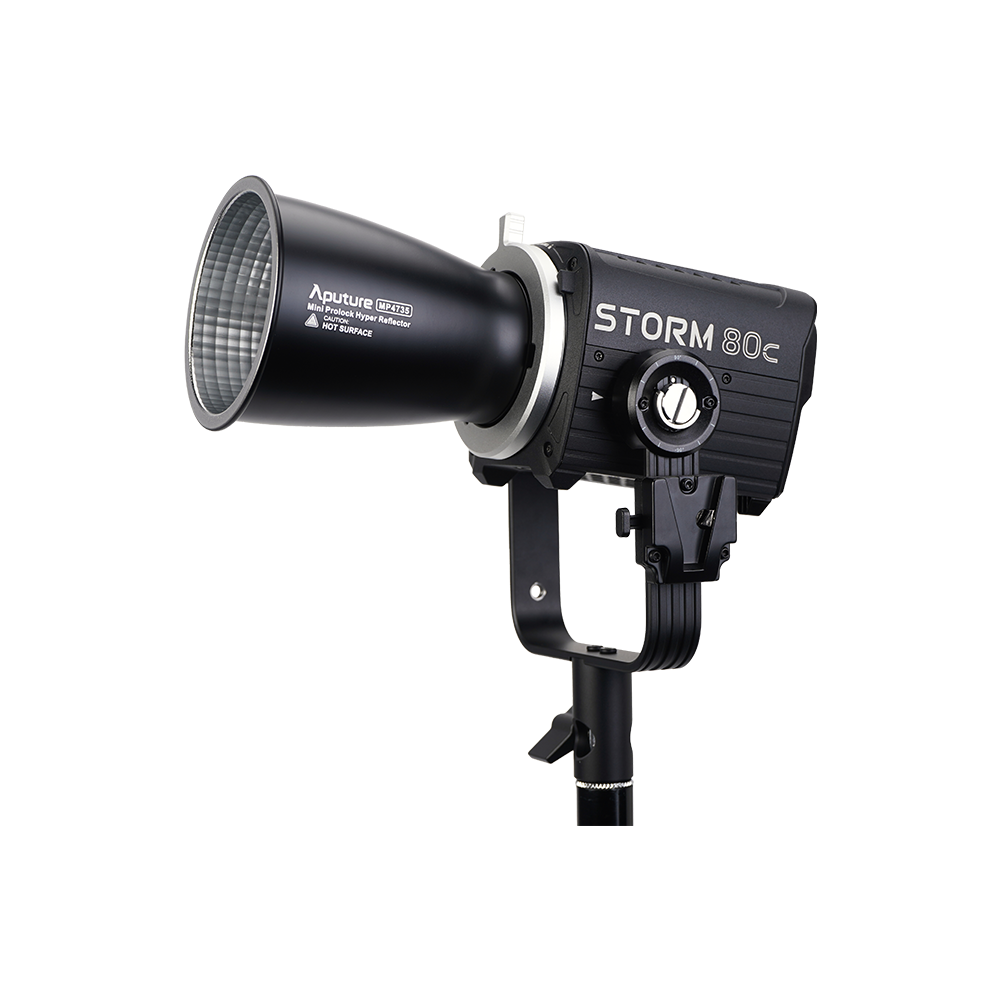
The Aputure STORM 80c is a compact, full-colour point-source LED built around the seven-colour BLAIR-CG engine. It puts a broad white-light range, saturated colour and professional wireless control into a head small enough for a tight location, a travelling interview kit or a carefully rigged accent.
Its main trade-off is straightforward: this is an 80W-class fixture. It can be a useful close key, practical enhancement or controlled pool of light, but its broad colour range does not give it the punch of a large STORM. The modifier and working distance decide what it can actually do.
Key specifications
| Specification | Details |
|---|---|
| Light engine | BLAIR-CG: blue, lime, amber, indigo, red, cyan and green |
| LED output / maximum consumption | 80W / 100W |
| CCT and tint | 1,800–20,000K; ±green adjustment |
| CRI / TLCI | 97 / 99 |
| SSI | 88 against tungsten; 84 against D5600 |
| TM-30 averages | Rf 96; Rg 103 |
| Accessory mount | Mini ProLock; standard Bowens requires an adapter |
| AC / USB-C input | 100–240V adapter; USB-C 20V/5A input |
| Other power | Compatible external DC / V-mount arrangement; no built-in battery |
| Weather rating | IP65 |
| Operating temperature | −20°C to +45°C |
| Head weight | 1.01kg without yoke; 1.35kg with yoke |
| Head with yoke | 16.7 × 22.5 × 14.7cm |
| Control | Onboard, Sidus Link / Link Pro, DMX/RDM and CRMX |
Strengths and limitations
Strengths
- BLAIR-CG provides full-colour control and an 1800–20000 K white range in a compact head.
- USB-C power and an external battery bracket suit travelling and handheld packages.
- CRMX, DMX/RDM and Mini ProLock provide production control and modifier options.
Limitations
- An 80W-class engine is best used close to a subject or for controlled accents.
- There is no internal battery; source, cable and adapter ratings still determine available power.
- Bowens accessories need an adapter; the small head is unsuitable for unsupported heavy modifiers.
Practical uses
Use it where placing a bigger source would cost time or create an awkward rig: a small pool on a background, a close beauty or interview key, a warm accent from furniture height, or a coloured hit in a cramped set. A small softbox can be effective when it stays close enough to look large from the subject’s position.
For a large exterior bounce, a deep diffusion frame or a distant window effect, look at the STORM 1200x class instead. The STORM 1000c is a much larger full-colour source. The 80c earns its place through placement and flexibility rather than brute force.
| Setup | Working approach |
|---|---|
| Close interview key | Use a Light Dome 40 near the subject and control ambient light; check exposure after fitting diffusion. |
| Tight background accent | Use a reflector or CF4 Fresnel where the head can stay close to the target. |
| Handheld moving source | Use the supported grip and battery arrangement, secure the power cable and rehearse the move. |
| Colour matching | Use CCT, tint or a measured colour setting and check the actual wardrobe or product through the camera. |
Output and colour
The official photometric table separates the bare head from the included reflector and optional modifiers. Selected 5,600K readings are below. These are centre readings, not a description of an evenly lit area.
| Distance | Bare head | Included reflector |
|---|---|---|
| 1m | 6,500 lux | 19,850 lux |
| 2m | 1,681 lux | 4,859 lux |
| 3m | 725 lux | 1,987 lux |
BLAIR-CG adds cyan and green to the five-colour BLAIR architecture. Aputure describes a gamut exceeding 90% of Rec.2020 and an indigo component intended to improve how fluorescing materials respond. Those are design claims and gamut coverage figures, not a promise that every camera will render every surface identically.
For wardrobe, paint or a product colour that must be repeatable, test the actual materials through the production camera and viewing transform. A colour value that looks convincing by eye can reproduce differently on another camera. Record the mode, CCT, tint, saturation and intensity rather than a loose note such as “blue, half power.”
Newsshooter’s original STORM 80c review includes measured output, colour and modifier tests. It found that colour-temperature behaviour changed across settings and modifiers. Its readings are separate tests, not replacements for the manufacturer table above. Bare-head measurements do not transfer unchanged through a reflector or softbox.
At 5600 K and 3 m, Aputure’s Help Center lists 1987 lux with the included reflector, while the product page lists 1924 lux. These are two published manufacturer references.
Power and batteries
The fixture supports a 100W USB-C input profile. Use a power source and cable that actually support the required 20V/5A delivery; the presence of a USB-C socket alone says little about available power. A laptop charger or bank with a lower negotiated output can limit the setup.
Battery operation uses external power, not an internal rechargeable pack. The optional handheld bracket combines a grip with a V-mount arrangement. Before rigging the light into a moving setup, account for the battery, cable route and strain relief as well as the lamp itself. An ideal energy calculation of watt-hours divided by watts is only a planning estimate; conversion losses and operating conditions reduce real runtime.
Control, cooling and camera operation
Sidus Bluetooth control and CRMX serve different systems. CRMX receives a compatible wireless DMX signal; it does not require a telephone near the fixture. Wired DMX uses the small locking terminal and an appropriate adapter, sold separately. Do not arrive expecting full-size XLR sockets on the head.
The STORM 80c manual and current DMX chart should travel with the lighting package. Check firmware and the chosen profile before a programmed shoot, particularly where colour modes or fan settings form part of a cue.
Modifiers, rigging and the working package
The smaller mount is an important distinction. A full-size Bowens softbox does not attach directly. Aputure offers a Bowens adapter, but physical attachment does not establish that a large modifier is a sensible load for this small head. Check the manufacturer compatibility tool for the complete combination.
The dedicated CF4 Fresnel is useful for a variable, controlled beam; a Light Dome 40 is a more compact interview option; a Lantern 30 spreads light around a small space. A larger glowing surface close to the subject produces softer shadows, while the reflector concentrates illumination. Choose the distribution first, then check whether enough exposure remains.
Aputure lists active cooling and several fan modes. A silent setting is a cooling/output compromise, not evidence that the fixture can sustain its brightest setting indefinitely without a fan. Listen at the microphone position with the actual lamp placement.
The IP65 rating is weather resistance, not permission to submerge the light or leave unprotected third-party power equipment in rain. Keep the complete power chain within its own ratings. The removable yoke and threaded mounting points help in confined spaces, but the support still has to carry the light, modifier and cable pull.
Alternatives and related fixtures
| Fixture | Choose it for |
|---|---|
| Nanlite Forza 60C | Another compact full-colour point source with its own modifier, power and control system. |
| Aputure STORM 400x | More tunable-white output with a full-size ProLock Bowens mount and limited-gamut colour. |
| Aputure STORM 1200x | A much larger white-light package for throw, bounce and substantial diffusion losses. |
What people are saying
Matthew Allard: useful small kit, especially with the matching dome
Allard’s Newsshooter review liked the compact build, quiet operation, battery options and broad CCT/tint controls. He considered the dome-equipped light useful for interviews in controlled conditions and the three-light kit a practical travel option. His review also shows that measured CCT changes with the optical configuration.
Dapper Gaffer: power and accessories in a working kit
Dapper Gaffer’s review covers USB-C power, the CF4 Fresnel and barn doors, case packing and on-set uses. The discussion treats the light and its accessories as a working package, including the compact form factor and weather sealing.
Videos
Gaffer & Gear 320: STORM 80c
A detailed review of the compact BLAIR-CG fixture.
Dapper Gaffer: STORM 80c and CF4
A practical review covering power, accessories and the small-light package.
Rental and used-fixture checks
Inspect the Mini ProLock latch, yoke and mounting threads, fan vents, locking DC socket, USB-C port and DMX adapter connection. Check that the reflector, AC adapter and any battery grip are present, then test the actual power source and modifier combination at the intended intensity.
Documentation and specifications
Aputure STORM 80c product page · Official support, firmware and DMX documentation · Independent measured review.
Product photograph: Aputure.
Browse Aputure lights · COB lights · all equipment.