
Last Updated 14 hours ago
Overview
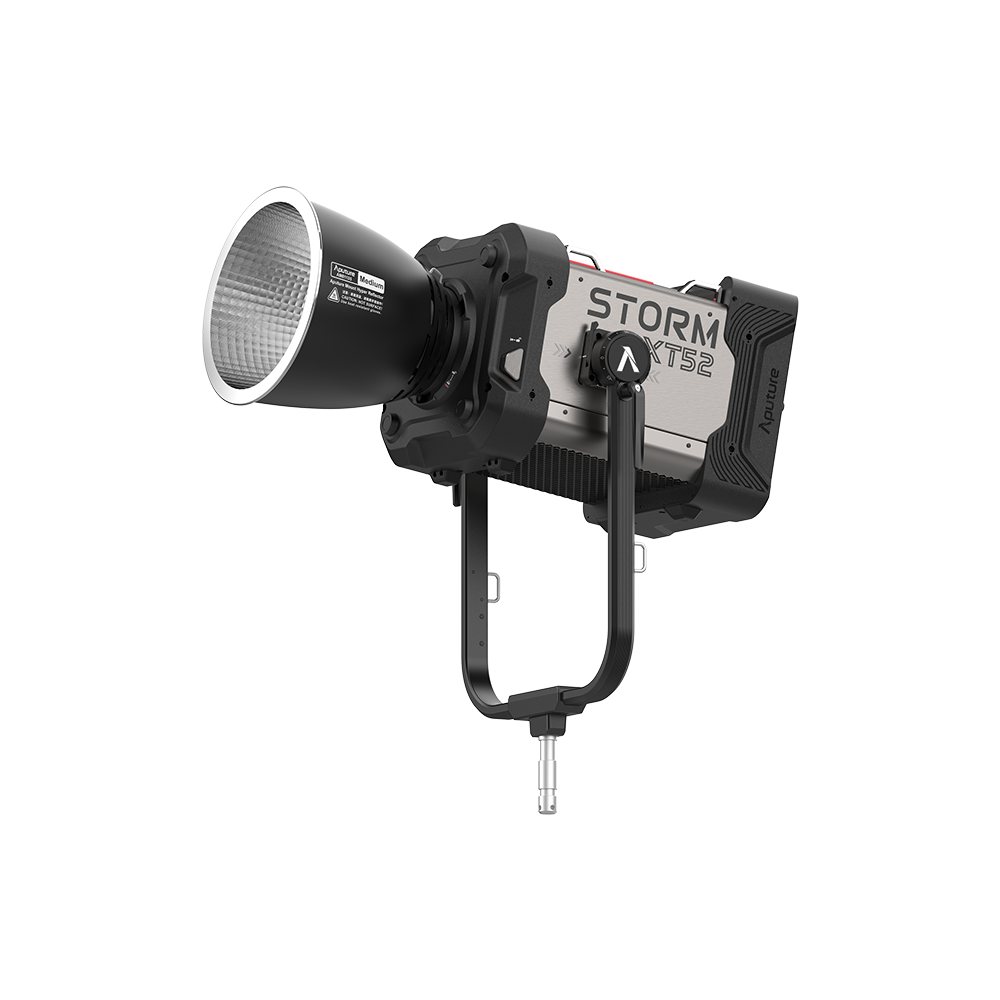
The Aputure STORM XT52 is a large BLAIR-engine point-source LED for jobs that need substantial throw or enough output to work through large diffusion and bounce. It combines tunable white light with limited-gamut colour operation, a separate controller and Aputure’s large accessory mount.
This is a production-scale electrical and rigging package. The important planning figures are its operating voltage, complete head weight, selected cable mode and actual input demand. Treating “XT52” as a simple 5,200W wall-draw label misses several of the details that determine whether it will work on location.
Key specifications
| Specification | Details |
|---|---|
| Engine / CCT | BLAIR; 2,500–10,000K |
| Colour control | CCT/tint, limited HSIC+ and x,y capabilities |
| CRI / TLCI | Above 96, manufacturer listing |
| SSI on current product page | 87 tungsten; 88 D5600; earlier manual differs |
| Maximum lamp-head consumption | 5,200W at the specified high-voltage supply |
| Maximum LED power | 4,800W, current product specification |
| AC input | 100–240V; full-output supply 180–240V |
| 100–179V maximum consumption | 3,200W; reduced-output operation |
| 180–240V maximum consumption | 5,600W standard; 6,000W extended head-cable mode |
| Maximum input current | 32A specification |
| Mount / included reflector | Aputure Mount / 35° medium reflector |
| Head without / with yoke | 27.8kg / 31.3kg |
| Controller | 13.4kg |
| Maximum head-cable chain | 45m, with the specified compatible system |
| Cooling / weather | Liquid plus air cooling / IP65 |
| Operating temperature | −20°C to +50°C |
| Control | Onboard, Sidus, DMX/RDM, CRMX, Art-Net/sACN |
Strengths and limitations
Strengths
- High output and tunable white suit substantial throws, bounce and diffusion.
- A compatible head-cable chain can keep the controller accessible and off the lighting rig.
- Aputure Mount supports dedicated large optics with DMX, CRMX and Ethernet control.
Limitations
- Full output needs 180–240V and a correctly designed distribution package.
- Long-cable operation changes power demand; cable mode and supported components matter.
- The complete head, yoke, modifier and cable load demands substantial support and handling.
Practical uses
The XT52 makes sense for substantial daylight pushes, long throws, large bounces and diffusion setups where a smaller LED runs out of exposure. Its tunability can save changes of correction gel, but matching mixed sources still needs a test through the camera.
For interiors that do not need this scale of output, the STORM 1200x offers a very different power and handling proposition. Select the XT52 because the shot needs its output and beam tools, with the electrical supply and crew support to use them.
| Setup | Working approach |
|---|---|
| Large window source | Choose the reflector for coverage and throw, allowing for the window treatment and diffusion losses. |
| Night exterior moonlight | Use a suitable reflector or Parallel Beam accessory, with the full rig and distribution planned for the location. |
| Large bounce | Cover the useful bounce area and check the resulting level at the actors rather than relying on centre lux alone. |
| Remote high placement | Use the specified head cable and mode, supporting cable weight independently while keeping the controller accessible. |
Output and colour
Aputure publishes 41,900 lux at 5m and 5600 K with the 35° reflector. That is a reflector-dependent centre measurement. It is not the bare-head output or the average illumination over a frame. Consult the full manufacturer table for the required CCT, mode and optic.
For a distant bounce or a source outside a window, the large output budget is useful only if the chosen beam covers the target. Narrow optics concentrate light; diffusion redistributes it and reduces the reading. Plot the geometry before selecting a reflector solely for its maximum lux value.
BLAIR uses blue, lime, amber, indigo and red emitters to create tunable white light, with some colour capability. The XT52’s available HSIC+ or x,y colour range remains limited by that architecture. For a saturated colour specified by an art reference, test the requested chromaticity and exposure rather than assuming a console value is reproducible.
Aputure’s older manual and current product page list different SSI figures. The current product page lists SSI 87 against tungsten and 88 against D5600. Spectral similarity, CRI and TLCI answer different questions; none proves a perfect camera match with every HMI, daylight condition or other LED.
Tests and reviews
Gaffer & Gear 309 includes separate bare-head and reflector tests, DMX/CRMX cue checks, AC draw, dimming and colour measurements. Its chapters keep the supplied 35° reflector separate from the wider and narrower optional optics.
Power and batteries
The current product specification distinguishes LED power, lamp-head consumption and AC consumption. It also distinguishes normal and extended head-cable modes. Those numbers should not be mixed together in a load calculation.
Full output requires the specified 180–240V supply. At 100–179V, the fixture’s stated maximum consumption is 3,200W and operation is reduced. The broad 100–240V input range does not mean full performance from every outlet inside that range. This is particularly important on North American locations.
Electrical distribution must be designed for the actual supply, connection, current and other loads. A marketing example involving a generator is not a guarantee that an arbitrary generator of a similar advertised wattage will suit the package. Confirm continuous capacity and connection requirements with the production electrician.
The supplied head cable is 7.5m, and Aputure documents a compatible chain up to 45m. Moving the controller away from the head can be valuable when the source is high, outside a window or on access equipment, because the operator can keep the controls reachable.
Cable length is part of the electrical configuration, not simply a convenience. Select the appropriate cable mode and use specified components. Dress and support the cable independently so connector strain does not become part of the lamp’s rigging load. Leave enough controlled movement for aiming and focus adjustments.
Control, cooling and camera operation
The XT52 includes DMX/RDM, CRMX and Ethernet lighting protocols alongside Sidus control. Consult the current official support pages for profiles and firmware. Menus and supported controls have changed since launch, so an old printed quick-start sheet may not describe a rental unit’s present behaviour.
The system settings guide makes output mode, fan mode, white-light standard and high-speed behaviour part of operation. Record those settings during prep. Air and liquid cooling do not make this a silent fixture; evaluate its sound where the microphones and scene actually are.
Modifiers, rigging and the working package
The XT52 uses Aputure Mount rather than a standard Bowens interface. The supplied medium reflector, supported large soft modifiers and dedicated optics belong to that system. A modifier that fits a smaller STORM should not be assumed to fit the XT52.
The product page lists accessories including a motorized CF16 Fresnel and the STORM Parallel Beam 70. Their purpose, weight and operational demands differ. A focusing optic provides a different beam tool from a large softbox, even when both attach to the same head. Check the current compatibility list and accessory instructions before assembling a package.
The head’s frequently quoted 27.8kg figure excludes the removable yoke. The current with-yoke listing is 31.3kg, before adding the 1.5kg medium reflector, cable load or any other modifier. That distinction matters when selecting support equipment and planning how a crew will lift and position it.
Use rated support and restraint appropriate to the complete configuration, working height and location conditions. A large modifier also adds wind area. IP65 protection does not remove wind loading, cable management or the need to follow the manual’s wet-weather orientation guidance.
The controller is a separate 13.4kg component. Keep its weight supported and avoid planning transport or shipping from the lamp-head figure alone. Cases and accessory packages can turn a compact-looking product photograph into a much larger practical movement.
Alternatives and related fixtures
| Fixture | Choose it for |
|---|---|
| Aputure STORM 1200x | A much smaller tunable-white power and handling package. |
| High-output HMI package | A different lamp, ballast and optic system; compare actual coverage, source character, power and hot-restrike requirements. |
| Aputure STORM 1000c | Full-colour work at a much lower output and electrical scale. |
What people are saying
Aaron Wayne Hill: XT52 and Parallel Beam on a forest night exterior
Aaron Wayne Hill’s on-set account shows an XT52 with the Parallel Beam reflector used as moonlight for an indie feature in Los Angeles. He describes testing brightness and colour during the setup and shares behind-the-scenes footage of the light working on the forest scene.
Videos
Gaffer & Gear 309: XT52
A review covering the fixture, reflector options, control and measured operation.
Aaron Wayne Hill: XT52 night exterior
An on-set example with the optional Parallel Beam reflector.
Rental and used-fixture checks
Check the complete package list: yoke, correct reflector, head cable, controller, AC connector arrangement, clamps and any dedicated optic. Inspect the liquid-cooling and ventilation system as instructed by the manufacturer, check connector locks and cable condition, and test the planned cable mode and output from the production supply.
Documentation and specifications
Current XT52 product specification · Official operation, firmware and DMX documentation · Original manual PDF.
Product photograph: Aputure.
Browse Aputure lights · COB lights · all equipment.