
Last Updated 13 hours ago
Overview
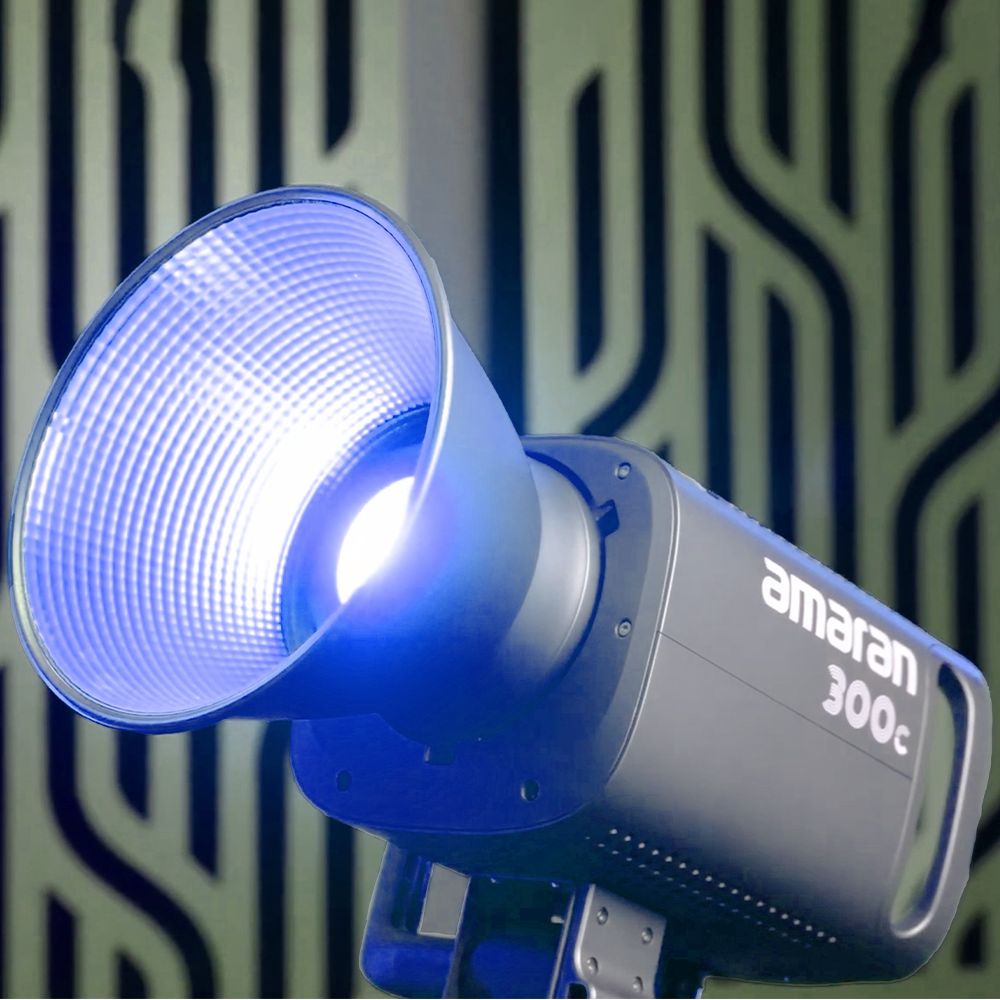
The amaran 300c is a 300W RGBWW point-source LED with a Bowens mount, onboard controls and Bluetooth app operation. It is built for creators and small crews needing one head to handle a white-light key, coloured background, bounce or supported optical effect.
Its limits matter as much as its colour features. This is not a native DMX/CRMX fixture, the supplied adapter is part of the working kit, and the output with a reflector is different from the output through a softbox. Evaluate it as a complete setup rather than a wattage badge.
Key specifications
| Specification | Details |
|---|---|
| Engine | RGBWW full colour |
| LED output / maximum consumption | 300W / 360W |
| CCT | 2,500–7,500K with green/magenta adjustment |
| CRI / TLCI | 95+ / 95+ |
| SSI | 83+ tungsten; 71+ D5600 |
| TM-30 | Rf 92; Rg 101 |
| Accessory mount | Bowens |
| DC input | 48V / 7.5A |
| AC adapter input | 100–240V, 50/60Hz |
| Operating temperature | −10°C to +40°C |
| Fixture weight | 2.633kg |
| Dimensions with bracket | 25.0 × 19.4 × 25.1cm |
| Cooling | Active |
| Control | Onboard; Sidus Link Bluetooth |
| DMX / CRMX / Ethernet | Not listed as built-in controls |
| Internal battery | None |
Strengths and limitations
Strengths
- RGBWW, CCT and tint adjustment let the same head provide white light or a colour effect.
- A Bowens mount and supported Spotlight SE option provide hard, soft and projection roles.
- Integrated controls and Sidus Link suit a small crew.
Limitations
- Saturated-colour brightness differs from the white-light photometrics.
- A fitting bayonet does not establish that every optical accessory is compatible.
- There is no built-in DMX or CRMX, and the separate AC adapter remains part of the kit.
Practical uses
The extra output compared with the 150c is useful when a softbox has to move farther away, a bounce absorbs light or a room contains stronger ambient illumination. It remains a middle-sized source: a large daylight window or a substantial diffusion setup can still demand more output than the 300c can provide.
For a repeatable home studio, mark the stand position, modifier, distance, CCT, tint and intensity. Record the camera exposure as well. A fixture setting is not a reproducible lighting setup until the geometry and exposure are also known.
A reflector directs the light into a smaller angle. Its higher centre reading does not mean the fixture produces the same lux through an Octa Dome, Lantern or a sheet of diffusion. Those setups change coverage and apparent source size, and they introduce losses.
Start with the quality of light the scene needs. A close softbox can give a pleasing key because it is large from the subject’s viewpoint. A distant bare reflector may deliver a higher meter reading while producing a much harder shadow. Choose the modifier and distance together.
| Setup | Working approach |
|---|---|
| Interview key | Bring the diffused source close enough to appear large, then use the grid or flags to keep spill off the background. |
| Background accent | Position the source for the intended field and check the actual subject exposure rather than the brightness of the illuminated panel. |
| Compact location kit | Plan the stand, power source, cable path and access to controls as one package. |
| Colour background | Use HSI or CCT/tint for the intended look and check the colour through the production camera; meter after any modifier. |
Output and colour
These selected white-light readings come from the manufacturer photometric table. Every number below identifies CCT, distance and reflector condition.
| CCT | Bare at 1m | Reflector at 1m | Bare at 3m | Reflector at 3m |
|---|---|---|---|---|
| 3200K | 7520 lux | 21390 lux | 915 lux | 1896 lux |
| 5600K | 9370 lux | 26580 lux | 1140 lux | 2351 lux |
| 7500K | 9180 lux | 26200 lux | 1119 lux | 2321 lux |
RGBWW combines red, green and blue emitters with warm and cool white emitters. It provides full-colour choices as well as ordinary white-light operation. CCT and green/magenta controls are useful for matching a room; hue and saturation are useful for colour effects.
The quoted CRI and SSI values describe white-light tests, not exposure at every saturated hue. Do not use the 5,600K reflector figure as the expected output of deep blue or red. Meter the actual look if it carries the scene. A strong coloured background and a natural face often benefit from being lit as separate areas.
Tests and reviews
Graham Sheldon’s field test measured 5716 K at a 5600 K target and 23,200 lux from 3 ft on the 300c with its supplied 65° reflector. The review keeps the two models’ results separate.
Power and batteries
Maximum consumption is listed as 360W, above the 300W LED output rating. Plan the supply from the input specification. The controls are built into the head, but the AC power adapter is external and needs a secure, accessible position.
The fixture requires the specified 48V DC input. It does not have a built-in rechargeable battery or a native pair of battery plates on the housing. Any portable power arrangement must provide the correct regulated voltage, connector and continuous current. A matching plug alone is not sufficient evidence of compatibility.
Keep the adapter’s weight off the DC connection and protect both sides of the power chain in an exterior setup. Battery energy estimates need an allowance for conversion losses, reserve capacity and the actual output setting.
Control, cooling and camera operation
Onboard controls make the fixture usable without an app, while Sidus Link provides Bluetooth control and supported effects. Neither is interchangeable with a native DMX input or a CRMX receiver. For a console-controlled rental package, confirm whether the available workflow meets the production’s actual needs before selecting the light.
The unit uses active cooling. Marketing descriptions of quiet operation do not establish an inaudible result beside a lavalier or boom. Test with the intended brightness, working distance and microphone position. Leave ventilation paths clear rather than wrapping the housing to reduce noise.
Modifiers, rigging and the working package
The standard package lists the head, protection cover, Hyper Reflector, AC supply, AC cable and carrying case. A softbox, lantern, stand and grid are separate pieces unless a dealer is selling a clearly identified bundle.
The Bowens interface supports a wide selection of accessories, but use the current manufacturer compatibility information for optical and heat-sensitive modifiers. A Fresnel or projector has more constraints than a simple softbox. The manufacturer’s photometric table tests particular accessories; it does not approve every modifier sharing a mount.
Alternatives and related fixtures
The 150c and 300c share the same nominal white-light range and broad control approach. The larger number identifies a different output class, not a different colour gamut by itself. The bi-colour amaran 200x S is another kind of choice: it trades saturated-colour controls for a white-light-focused design.
The dedicated product pages list CRI 95+, TLCI 95+, SSI tungsten 83+ and SSI D5600 71+. Some colour-metric fields in the combined support table are misaligned.
For a larger professional full-colour Bowens package with wired control, compare the LS 600c Pro II class. For the amaran, the useful question is whether its output, control and handling fit the intended job; its output and controls suit close keys and controlled interiors.
| Fixture | Choose it for |
|---|---|
| amaran 150c | The other RGBWW output class in the same range; its power supply is model-specific. |
| amaran 200x S | A white-light-focused alternative when saturated colours are unnecessary. |
| Aputure LS 600c Pro II | A larger full-colour working package with professional wired and wireless control. |
What people are saying
Graham Sheldon: useful indoors, with a control-system trade-off
Sheldon’s review favours the simple controls, quieter cooling and metal yoke. He sees the pair as useful for controlled interiors and creator studios, while identifying the lack of DMX and reliance on plastic components as limits for his larger production work.
New Layer: straightforward colour and useful app control
New Layer’s paired review rates the build, fan noise and colour accuracy positively. It highlights CCT with tint adjustment, full-colour HSI, carrying cases and the additional effects available through Sidus Link.
Videos
Gaffer & Gear 244: amaran 150c and 300c
A review comparing the two RGBWW Bowens fixtures.
New Layer: 150c and 300c review
A paired review of colour, controls, build and cooling.
Rental and used-fixture checks
Check the exact model and power-adapter labels; the 150c and 300c supplies are not interchangeable. Inspect the Bowens latch, metal yoke, locking power connectors, fan and emitter window. Test CCT, saturated colours, a low-level fade and app pairing, then listen after the lamp has warmed up.
Documentation and specifications
Official 300c overview, specifications and downloads · Manufacturer package listing · Official output and support table.
Product photograph: amaran.
Browse amaran lights · COB lights · all equipment.