
Last Updated 14 hours ago
Overview
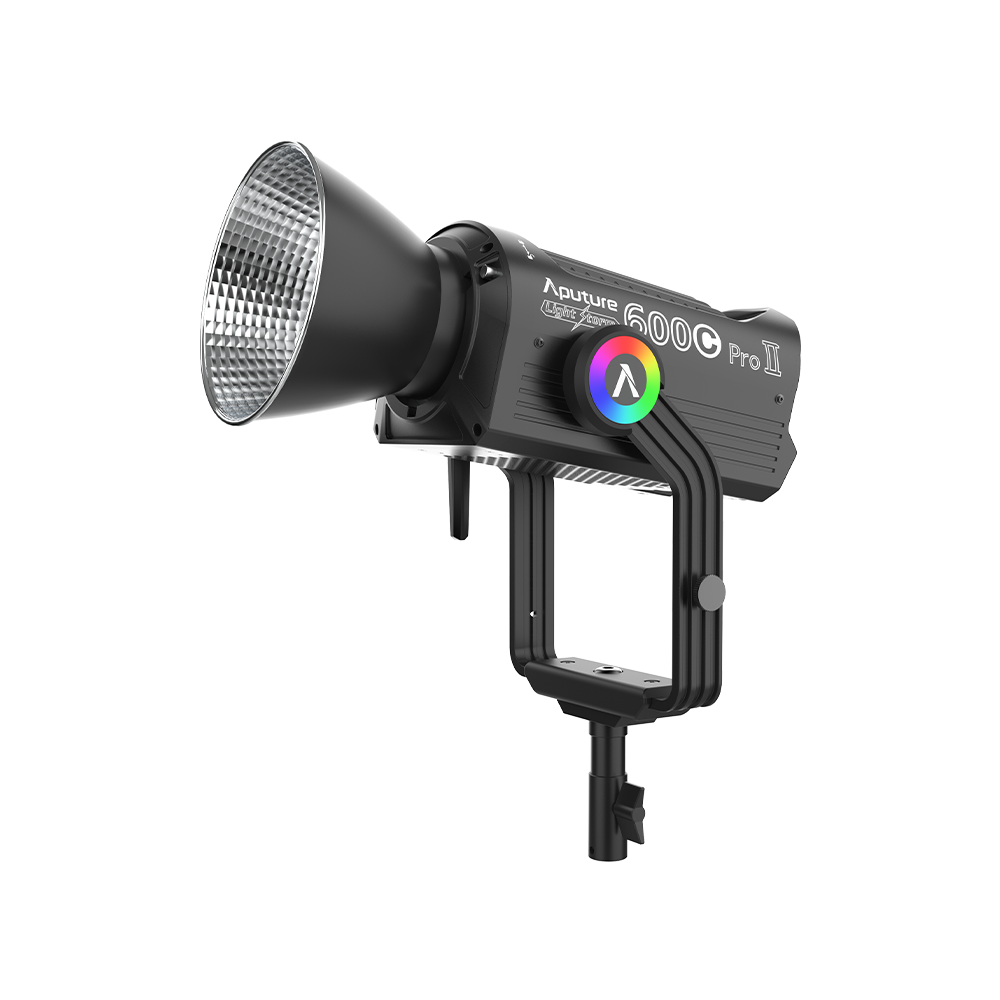
The Aputure LS 600c Pro II is a 600W RGBWW point-source LED with a standard Bowens mount, a separate controller and professional wired and wireless control. It is designed to move between white-light work, coloured effects, softboxes and supported optical modifiers within the Light Storm ecosystem.
The second-generation version concentrates the emitter layout and improves optical efficiency. That makes the modifier part of the upgrade story: the increase through the supplied reflector or F10 Fresnel differs from the increase at the bare head. “Pro II” should not be confused with the original LS 600c Pro.
Key specifications
| Specification | Details |
|---|---|
| LED output / maximum consumption | 600W / 720W |
| Engine | RGBWW |
| CCT | 2,300–10,000K |
| CRI / TLCI | 95+ / 98+ |
| SSI | 85 against tungsten; 74 against D5600 |
| TM-30 averages | Rf 93; Rg 101 |
| Mount / supplied reflector | Bowens / 45° |
| AC input | 100–240V, 50/60Hz |
| External regulated DC | 48V / 15A input specification |
| Battery controller options | V-mount or Gold mount; output depends on source capability |
| Weather rating | IP54 |
| Operating temperature | −20°C to +45°C |
| Head with yoke | Approximately 5.9kg |
| Controller weight | Product page: 5.4kg; support page: 5.21kg |
| Control | Onboard, Sidus, DMX/RDM, CRMX, Art-Net/sACN over Ethernet |
Strengths and limitations
Strengths
- A redesigned RGBWW emitter improves output through supported optics.
- Bowens, F10 and supported Spotlight Max options make the head adaptable.
- CRMX, wired DMX and network control fit console-managed sets.
Limitations
- The gain varies by reflector, Fresnel, CCT and mode; one percentage cannot describe every setup.
- The full package includes a heavy controller, cable and modifier load.
- Firmware and profiles must match; the named Silent mode still has published head and controller noise.
Practical uses
This light suits a crew wanting a full-colour source that can also act as an everyday white key, bounce or optical effect. It is especially relevant to a package already built around Light Storm controls and accessories. The extra colour capability is useful when the same head must change roles during a day.
For a white-only task, compare the LS 600d Pro and LS 600x Pro using the required CCT and modifier. For higher spectral similarity or a wider colour range, compare the newer BLAIR-CG system on its own documented merits. There is no universal winner independent of the scene.
| Setup | Working approach |
|---|---|
| Soft key | Use a supported Light Dome or other compatible softbox and meter after fitting its diffusion. |
| Controlled hard source | Use a reflector or F10 setting for the required coverage, with support for the complete front-heavy package. |
| Colour cue | Choose the correct firmware/profile, output mode, smoothing and dimming curve before recording the cue. |
| Mixed-source interior | Use CCT and tint or source presets as a starting point, then check the camera and actual subject. |
Output and colour
Selected readings from Aputure’s official photometric table appear below. The F10 is an optional accessory. These are white-light readings; they do not describe saturated-colour output.
| CCT and distance | Bare | Supplied reflector | F10 at 45° | F10 at 15° |
|---|---|---|---|---|
| 3,200K at 3m | 2,106 lux | 8,744 lux | 4,444 lux | 9,200 lux |
| 5,600K at 1m | 21,610 lux | 91,500 lux | 48,400 lux | 97,600 lux |
| 5,600K at 3m | 2,401 lux | 10,167 lux | 5,378 lux | 10,844 lux |
Aputure attributes the improvement to a redesigned light engine, a more concentrated COB and revised heat management. Its quoted gains depend on the configuration: a bare source and a reflector are different tests. A single percentage should not be applied to every accessory, CCT or colour.
For an owner, the practical question is whether the revised optical system improves the setup they actually use. A modifier that extracts more useful light can matter more than a modest bare-head increase. Existing rental stock should be labelled clearly so that a plot or prep list specifies which generation is required.
The fixture offers white-light and full-colour operation, including gel and source-style controls. RGB control values describe the interface; the physical LED engine includes white emitters as well. Matching a gel preset to a physical source still calls for a camera test.
Firmware V1.5, released May 15, 2026, replaces the older advanced HSI mode with HSIC+ and adds green/magenta adjustment there. It also adds DMX smoothing options and interface changes. A rental unit running an earlier version may therefore differ from current support instructions. Record firmware and use the corresponding DMX chart.
Tests and reviews
The Granite Gaffer’s data review examines the three claimed upgrades and the revised light quality, with a separate price discussion later in the video. Tyler states that Aputure supplied the review unit, while the content and opinions were not paid for or reviewed by an outside party.
Power and batteries
Plan from the 720W maximum consumption. The 600W LED rating is not the complete electrical load. A remote power source must satisfy both the voltage requirement and the necessary continuous current, with compatible cabling.
The official power guide covers AC, battery-mount and external DC arrangements. Battery operation is not a blanket promise of full output at every voltage. Check the selected pack’s discharge rating and the controller’s battery power option. A battery with enough watt-hours can still have an inadequate current limit.
Route the head cable so the controller’s weight never hangs from the lamp connector. A supported controller also makes the controls accessible and avoids adding unnecessary weight at the top of a stand. The complete transport kit is considerably heavier than the head alone.
When charging batteries while lighting, Aputure specifies output limits of 70% with Linear or Exponential curves, 30% with Logarithmic and 55% with S-Curve. Set the curve and charging state before planning available intensity.
Control, cooling and camera operation
The controller supports DMX/RDM, CRMX and network control through Art-Net/sACN, alongside Sidus operation. Aputure’s configuration guide states that one remote control option is used at a time. Decide which system owns the fixture before troubleshooting an unresponsive cue.
Output mode matters too. Constant Output prioritizes consistency across CCT changes; Max Output prioritizes available brightness. A colour-temperature cue can behave differently when two otherwise identical heads use different output modes. Match dimming curves, smoothing and signal-loss behaviour during prep.
IP54 describes the manufacturer-rated fixture system, including the head and controller. It offers less ingress protection than the IP65 STORM models and is not a submersion rating. Follow the manual’s connection and orientation guidance in weather.
Aputure publishes fan-mode noise figures, including a non-zero figure for the lamp’s Silent setting and noise from the controller. Treat “Silent” as the name of a mode, not a guarantee of an inaudible complete system. Check with sound from the microphone’s actual position.
The product and support pages also give slightly different controller weights. The two references list different weights. For shipping or a weight-critical rig, weigh the actual unit and include every accessory rather than treating a rounded marketing weight as an engineering allowance.
Modifiers, rigging and the working package
The supported ecosystem includes Light Domes, Lanterns, the F10 Fresnel and Spotlight Max. A generic Bowens mount is a mechanical standard; it does not establish thermal or optical compatibility with every Bowens accessory ever made. Confirm the exact light-and-modifier combination in Aputure’s current documentation.
Use a softbox when the apparent size and control of a close source matter, a lantern for distributed ambient light, and a suitable optical modifier for a shaped or focused beam. The existing F10 Fresnel entry explains the accessory separately. Budget for its weight and dimensions as part of the rig.
Alternatives and related fixtures
| Fixture | Choose it for |
|---|---|
| Original Aputure LS 600c Pro | An older RGBWW generation with different optical performance; confirm the label on used and rental packages. |
| Aputure LS 600d Pro | Daylight output when full-colour control is unnecessary. |
| Aputure LS 600x Pro | Bi-colour white-light work in the established Light Storm package. |
What people are saying
Another Camera Channel: more output and useful low-level dimming
In its Pro II review, Another Camera Channel highlights the revised COB and reflector, increased output and dimming below 1%. The description also notes familiar ballast/cabling and a larger rolling case, making the comparison useful for crews considering an upgrade from the original.
Videos
The Granite Gaffer: LS 600c Pro II
An in-depth review covering changes, data and price.
Another Camera Channel: original versus Pro II changes
A review of the revised light engine, output and low-level dimming.
Rental and used-fixture checks
Verify the Pro II identification, correct head cable, supplied reflector, control-box clamp and regional battery-mount version. Test low-level fades as well as full-output white and colour. Check the firmware before patching HSIC+ or smoothing options, and listen to both the head and controller at operating temperature.
Documentation and specifications
LS 600c Pro II product page · Official manual, safety, firmware and control guides · Product manual PDF.
Product photograph: Aputure.
Browse Aputure lights · COB lights · all equipment.