
Last Updated 3 days ago
Astera PlutoFresnel Overview
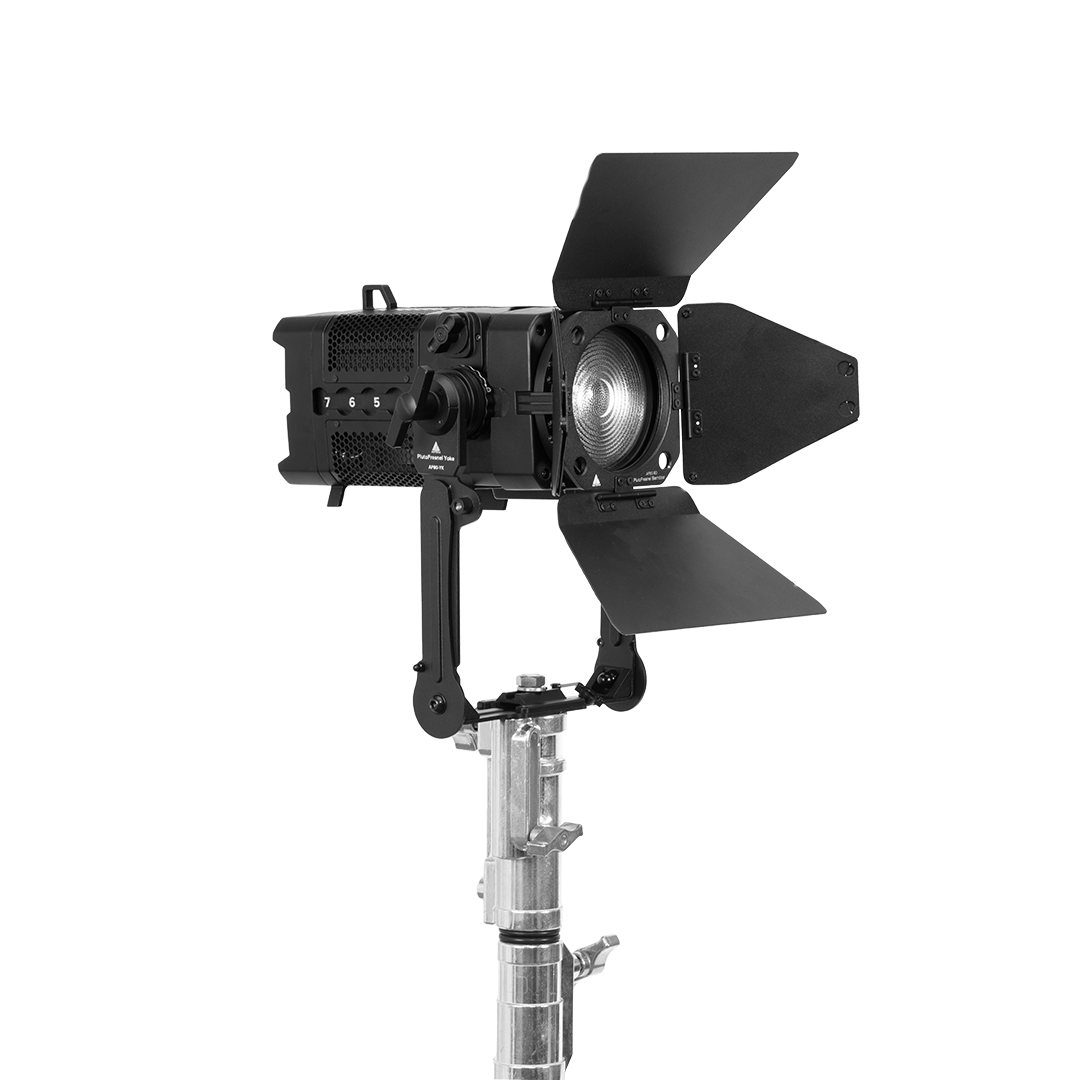


The Astera PlutoFresnel is a battery-powered full-colour Fresnel using the Titan LED engine. Its 15–60° manual focus range and supplied barndoors make it a beam-shaping tool, while onboard colour control lets it move between white-light matching and coloured effects.
Pluto is the smaller, 80W-draw version: useful for portable close lighting, controlled accents and locations where running a cable would slow the setup. The internal battery is part of the design, rather than an external pack that must be attached to a COB.
- Fixture Type Battery-powered RGBMintAmber LED Fresnel, model AF80.
- Power 80 W published LED draw; 24 V DC external power. Three-hour maximum-brightness white runtime reference, not the reduced-output 20-hour setting.
- Colour Temperature Tunable white and full-colour Titan engine; published CRI / TLCI ≥96 at the specified 3,200–6,500 K white settings.
- Weight and Mount 4.637 kg with Fresnel and barndoors; 6.493 kg in the listed yoke/handle configuration. AirlineTrack mounting.
- Beam Control 15–60° manual Fresnel focus with barndoors. Removing the lens changes the optical configuration and requires separate metering.
- IP RatingIP55 Dust-protected and water-jet resistant, not dust-tight or submersible. Unwired use requires PB15-PLG; wired use requires the specified PWB-CAB sealed cables. Read the IP rating guide.
Astera PlutoFresnel Specifications
| Specification | Details |
|---|---|
| Model | AF80 |
| Engine | Titan RGBMintAmber |
| Published LED power draw | 80W |
| Fresnel beam range | 15–60° |
| Luminous flux at 5,500K | 2,847lm |
| CRI / TLCI | 96 or above in the specified 3,200–6,500K range |
| Battery runtime at maximum brightness | 3h, white-light manufacturer figure |
| Managed runtime | Up to 20h with brightness management |
| External power | 24V DC, 80W |
| Wired DMX | Via specified power/data system |
| Wireless control | CRMX, UHF, BluetoothBridge; supported AsteraApp workflow |
| Operating temperature | 0–40°C |
| Weather rating | IP55, subject to the documented connected/unconnected arrangement |
| Lens-and-barndoor configuration | 4.637kg |
| Listed yoke configuration | 6.493kg |
| Dimensions | 281.9 × 244.7 × 323mm with yoke |
Output Calculator
Select the published setup and a manufacturer distance, or enter a custom throw where supported. The results describe centre-beam output, not the brightness across the whole beam.
Camera Settings
If the calculator does not load, use the published photometric table or source on this page. JavaScript is required.
F-stop is a planning estimate, not a meter reading. It uses direct, on-axis illuminance and includes only the optics and diffusion named in the selected setup. Meter on set to account for lens transmission, filters, added diffusion, bounce, dimming and ambient light.
How the exposure estimate works
N = √(E × ISO × t / C), where E is illuminance in lux and t = shutter angle ÷ (360 × fps). The default C = 340 is a dome reference; C = 250 is a flat reference. These are calibration constants, not a measured T-stop. A small nonzero digit is tenths of a stop above the displayed full stop.
Distance estimates and comparisons
Published points are used as given. Between published points the calculator fits a curve through the two nearest readings. Outside those points it uses the inverse-square law only when the fixture’s dataset permits it. Distances outside a configuration’s supported range are reported separately. Comparisons use one shared distance and camera setup; equal lux does not imply equal coverage.
View published readings for the selected configuration
Strengths and Limitations
Strengths
- The focusable Fresnel and barndoors shape a controlled white or coloured beam.
- Internal battery and CRMX reduce cable runs.
Limitations
- Spot and flood settings have different field coverage and centre illuminance.
- Test battery runtime at the brightness you plan to use. For a rigged unit, count the mount, modifier and any external power hardware in the total weight.
Practical Uses
A Fresnel lets the crew adjust the distribution without swapping a set of spreader lenses. Use a broader setting for coverage and a narrower one for a pool, edge or longer throw. The appearance of shadows and the effectiveness of the barndoors depend on the geometry.
The lens assembly can be removed for a broader open-face configuration. That is a different optical setup, not a hidden way to get the same Fresnel beam with more output. Meter and assess it separately. An optional projection accessory also serves a different purpose, particularly when a sharp pattern or defined shutter cut is required.
Pluto is useful for a small shaped key, an accent in a tight location, a portable beam on a moving setup or a fast background adjustment. Its focus and doors are more deliberate light-control tools than the bare face of a general-purpose pocket light.
Compare the optical behaviour as well as brightness with an open-face COB. A lens, doors and internal battery create a different working tool. For a long visible source or reflected line, the Titan Tube remains a different kind of choice.
| Setup | Working approach |
|---|---|
| Shaped key or edge | Focus for the required field and trim spill with the doors. |
| Fast location change | Set battery runtime and remote-control mode before moving the fixture into place. |
Output and Colour
Astera publishes the following 5,500K readings at 1m. The narrow and flood positions cover different areas, so the higher spot reading is not an increase in total light.
| Focus | Illuminance at 1m |
|---|---|
| 15° | 38,167 lux |
| 35° | 10,028 lux |
| 60° | 2,872 lux |
Power and Batteries
The manufacturer gives 3 hours for maximum-brightness white operation. Its longer “up to 20 hours” runtime feature manages output to meet a duration. It should never be presented as 3 hours and 20 hours of the same maximum output.
Set the required duration first, then meter the scene. Record the runtime setting and charge state with the lighting notes, especially for a unit that will be rigged where it is difficult to reach. Battery age, temperature and the actual programmed look affect practical reserves.
Pluto uses the specified 24V DC supply for extended wired operation. A mains power cable does not connect directly to the head as it does on Leo. Confirm whether the chosen individual-light or kit SKU includes the required supply.
The optional RuntimeExtender accepts supported V-mount or Gold-mount battery arrangements. The added pack changes balance and working weight. Use the correct cable and source rather than treating any nominally similar battery as an approved replacement.
Control, Cooling and Camera Operation
The Titan engine provides colour and tunable-white control with the AsteraApp and compatible wireless systems. A CRMX receiver lets the fixture join a suitable console network, while the BluetoothBridge function serves the supported app connection path. These are different control roles.
Use the current DMX profile for the selected mode and firmware. Check dimming, colour and signal-loss behaviour before the source becomes inaccessible. A look that matches by eye still needs evaluation through the camera and the scene’s actual surfaces.
Pluto’s wired data is delivered through the supported power/data cable and injector system. Include those components in the package; the DC socket alone is not a conventional wired-DMX input.
The standard listing includes the Fresnel, barndoors, yoke components, handle and TVMP adapter. Dealer kits may add supplies, cables or a case. Confirm the exact contents instead of assuming every item visible in a demonstration is in the basic box.
Modifiers, Rigging and the Working Package
The stated 4.637kg figure describes the lens-and-barndoor configuration. The manufacturer also lists 6.493kg with its specified yoke arrangement. Include the actual handle, support adapter, cables and external battery when calculating the working load.
The removable yoke components and AirlineTrack mounting system provide options for placement. Use them as documented and add suitable secondary restraint. A removable handle is convenient for carrying and aiming; it does not establish a safe overhead suspension method.
The IP55 claim depends on the documented connections, caps and power/data arrangement. Keep cooling paths clear and test noise at the actual microphone position. A weather-resistant housing does not remove the need to protect other parts of the power chain. The manufacturer manual prohibits immersion and requires disconnection from mains during thunderstorms.
Alternatives and Related Fixtures
| Fixture | Choose it for |
|---|---|
| Astera LeoFresnel | The other battery-Fresnel size, with different output, mass and power connections. |
| Astera QuikSpot | A smaller zoomable accent package. |
What People Are Saying
Gaffer & Gear: Optics and Battery Management
Episode 277 describes the PlutoFresnel’s optics positively and examines the removable Fresnel, battery management, power/data hardware and DMX behaviour, alongside dimming and colour measurements. Read or watch the full account.
The practical points below draw on Astera’s PlutoFresnel manual. Published output and runtime figures are the manufacturer’s, not independent measurements.
What Works
- Shape a small source: Use the 15–60° Fresnel focus and barndoors for a close edge or background pool without putting a separate projector on the stand.
- Built-in battery when a cable is awkward: The AF80’s internal pack and CRMX let you place it outside a window or on a mobile rig without an external pack on the head.
- Multiple optical looks: Gaffer & Gear demonstrates the difference with and without the removable Fresnel. Keep the Fresnel on for a defined adjustable beam; meter separately if you remove it.
What to Watch For
- Three hours is a particular condition: Astera’s maximum-brightness reference is for white light. The managed 20-hour setting trades output for endurance; set it before approving exposure.
- External power differs from Leo: Pluto takes its specified 24 V DC power, not direct mains into the head. Include the appropriate power hardware and the required power/data route for wired control.
- Small output class: The 80 W LED rating and 2,847 lm reference at 5,500 K are not Leo’s output. Check the exact optic and throw before using it as a distant key.
Videos
Gaffer & Gear 277: PlutoFresnel
A model-specific walkthrough or review.
Rental and Used-Fixture Checks
Verify the exact model, power components and control profile. Inspect mounts, optics or diffusion, connector locks and cables. Test a slow fade, colour matching and the complete intended remote-control path before rigging.
Documentation and Specifications
Official product overview · Technical specifications · Manuals, data sheets and DMX profiles.
Product photograph: Astera.
Browse Astera lights · LED Fresnels · all equipment.