
Last Updated 15 hours ago
Overview
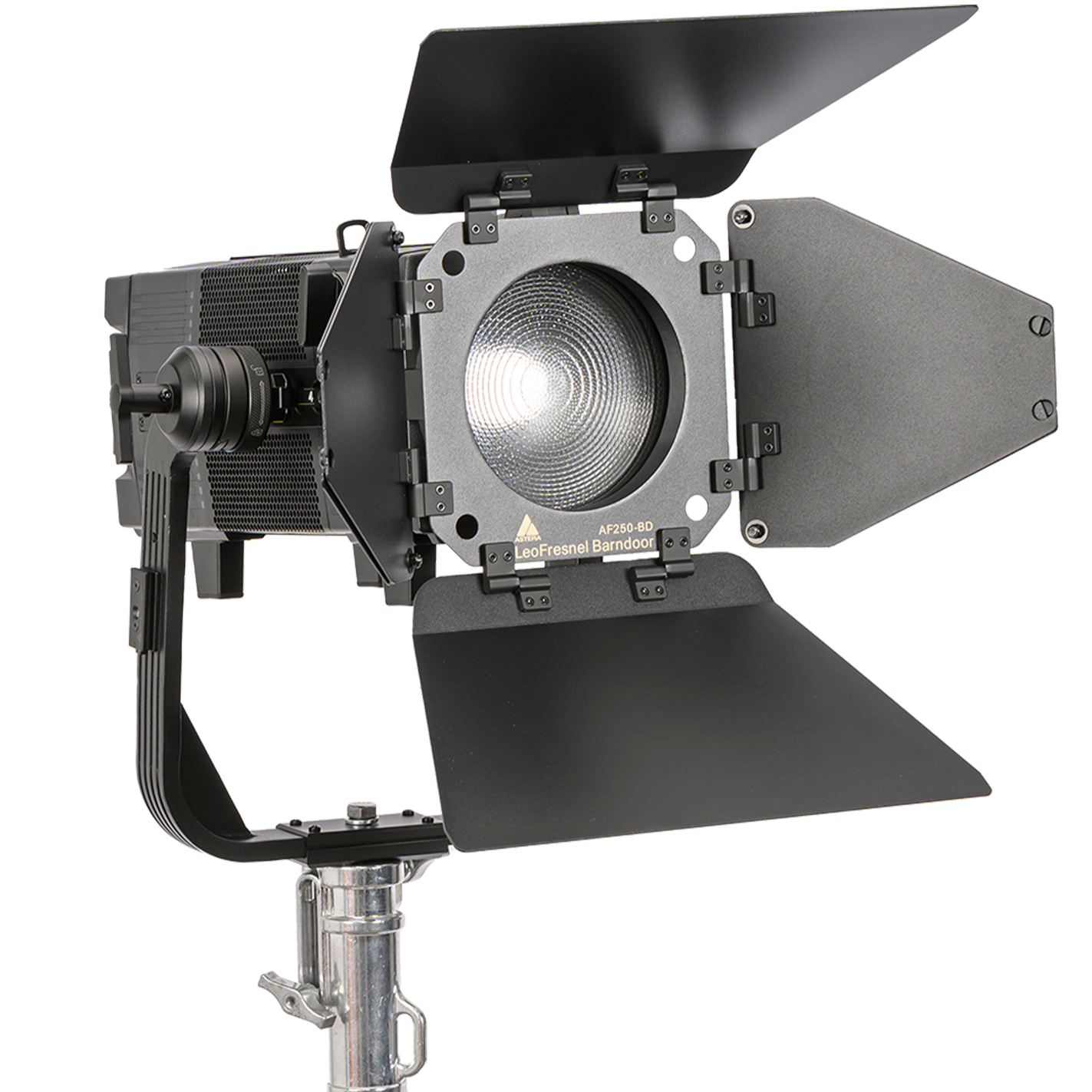


The Astera LeoFresnel is a battery-powered full-colour Fresnel using the Titan LED engine. Its 15–60° manual focus range and supplied barndoors make it a beam-shaping tool, while onboard colour control lets it move between white-light matching and coloured effects.
Leo is the larger, 250W-draw version, offering greater output and direct AC connectivity. It remains a substantial fixture once its Fresnel, doors and yoke are fitted; its nominal power does not describe its handling weight.
- Fixture Type Battery-powered RGBMintAmber LED Fresnel, model AF250.
- Power 250 W published LED draw; 100–240 V AC or 12–48 V DC, maximum 15 A. Internal battery and supported RuntimeExtender arrangements.
- Colour Temperature Tunable white and full-colour Titan engine; published CRI / TLCI ≥96 at the specified 3,200–6,500 K white settings.
- Weight and Mount 13.83 kg with Fresnel and barndoors; 16.32 kg with the listed yoke components. AirlineTracks and yoke mounting.
- Beam Control 15–60° manual Fresnel focus with barndoors. Open-face and projection configurations are different optics, not equivalent Fresnel output.
- IP RatingIP55 Wired or unwired as documented: dust-protected and water-jet resistant, not dust-tight or submersible. Keep the complete power arrangement within its own ratings. Read the IP rating guide.
Key Specifications
| Specification | Details |
|---|---|
| Model | AF250 |
| Engine | Titan RGBMintAmber |
| Published LED power draw | 250W |
| Fresnel beam range | 15–60° |
| Luminous flux at 5,500K | 7,119lm |
| CRI / TLCI | 96 or above in the specified 3,200–6,500K range |
| Battery runtime at maximum brightness | 2h, white-light manufacturer figure |
| Managed runtime | Up to 20h with brightness management |
| External power | 100–240V AC; 12–48V DC, max 15A |
| Wired DMX | Yes |
| Wireless control | CRMX, UHF, BluetoothBridge; supported AsteraApp workflow |
| Operating temperature | 0–40°C |
| Weather rating | IP55, subject to the documented connected/unconnected arrangement |
| Lens-and-barndoor configuration | 13.83kg |
| Listed yoke configuration | 16.32kg |
| Dimensions | 455 × 371 × 545mm with the listed mounting arrangement |
These manufacturer references are for the 15°, 35° and 60° Fresnel positions at 5500 K and 1 m. The calculator uses that measured distance only; open-face and projection optics are not represented. Other distances are not extrapolated. Manufacturer photometric data.
Output Calculator
Select the published setup and a manufacturer distance, or enter a custom throw where supported. The results describe centre-beam output, not the brightness across the whole beam.
Camera Settings
If the calculator does not load, use the published photometric table or source on this page. JavaScript is required.
F-stop is a planning estimate, not a meter reading. It uses direct, on-axis illuminance and includes only the optics and diffusion named in the selected setup. Meter on set to account for lens transmission, filters, added diffusion, bounce, dimming and ambient light.
How the exposure estimate works
N = √(E × ISO × t / C), where E is illuminance in lux and t = shutter angle ÷ (360 × fps). The default C = 340 is a dome reference; C = 250 is a flat reference. These are calibration constants, not a measured T-stop. A small nonzero digit is tenths of a stop above the displayed full stop.
Distance estimates and comparisons
Published points are used as given. Between published points the calculator fits a curve through the two nearest readings. Outside those points it uses the inverse-square law only when the fixture’s dataset permits it. Distances outside a configuration’s supported range are reported separately. Comparisons use one shared distance and camera setup; equal lux does not imply equal coverage.
View published readings for the selected configuration
Strengths and Limitations
Strengths
- The focusable Fresnel and barndoors shape a controlled white or coloured beam.
- Internal battery and CRMX reduce cable runs.
Limitations
- Spot and flood settings have different field coverage and centre illuminance.
- Runtime, complete rigging mass and external-power hardware still need planning.
Practical Uses
A Fresnel lets the crew adjust the distribution without swapping a set of spreader lenses. Use a broader setting for coverage and a narrower one for a pool, edge or longer throw. The appearance of shadows and the effectiveness of the barndoors depend on the geometry.
The lens assembly can be removed for a broader open-face configuration. That is a different optical setup, not a hidden way to get the same Fresnel beam with more output. Meter and assess it separately. An optional projection accessory also serves a different purpose, particularly when a sharp pattern or defined shutter cut is required.
Leo suits crews needing a focusable colour source with a larger output budget, direct mains operation and the flexibility of an internal battery. It can provide a shaped interior key, a controlled background pool or a motivated effect without a separate external-battery rig.
Compare the optical behaviour as well as brightness with an open-face COB. A lens, doors and internal battery create a different working tool. For a long visible source or reflected line, the Titan Tube remains a different kind of choice.
| Setup | Working approach |
|---|---|
| Shaped key or edge | Focus for the required field and trim spill with the doors. |
| Fast location change | Set battery runtime and remote-control mode before moving the fixture into place. |
Output and Colour
Astera publishes the following 5,500K readings at 1m. The narrow and flood positions cover different areas, so the higher spot reading is not an increase in total light.
| Focus | Illuminance at 1m |
|---|---|
| 15° | 57,737 lux |
| 35° | 18,191 lux |
| 60° | 6,639 lux |
Power and Batteries
The manufacturer gives 2 hours for maximum-brightness white operation. Its longer “up to 20 hours” runtime feature manages output to meet a duration. It should never be presented as 2 hours and 20 hours of the same maximum output.
Set the required duration first, then meter the scene. Record the runtime setting and charge state with the lighting notes, especially for a unit that will be rigged where it is difficult to reach. Battery age, temperature and the actual programmed look affect practical reserves.
Leo accepts direct AC through its powerCON TRUE1-compatible arrangement and has a documented DC input. Its optional RuntimeExtender system allows external battery use; the product overview distinguishes reduced output with one 14.4V battery from full-power arrangements using a supported 26V battery or two 14.4V batteries.
That is a voltage-and-current capability issue, not simply a question of watt-hours. Check the exact supported arrangement and do not assume that one large low-voltage pack provides the same result as the prescribed full-output configuration.
Control, Cooling and Camera Operation
The Titan engine provides colour and tunable-white control with the AsteraApp and compatible wireless systems. A CRMX receiver lets the fixture join a suitable console network, while the BluetoothBridge function serves the supported app connection path. These are different control roles.
Use the current DMX profile for the selected mode and firmware. Check dimming, colour and signal-loss behaviour before the source becomes inaccessible. A look that matches by eye still needs evaluation through the camera and the scene’s actual surfaces.
Leo includes wired DMX along with its wireless options. Its direct AC architecture is useful for sustained operation, while the internal battery can simplify placement and movement between setups. Treat the connected operating arrangement according to its own ratings.
The listed package includes the Fresnel, barndoors, yoke components, Rabbit-Rounder adapter, TVMP adapter and handle. Verify dealer bundles for additional accessories and cases. A modifier’s mounting adapter and the modifier itself are separate items.
Modifiers, Rigging and the Working Package
The stated 13.83kg figure describes the lens-and-barndoor configuration. The manufacturer also lists 16.32kg with its specified yoke arrangement. Include the actual handle, support adapter, cables and external battery when calculating the working load.
The removable yoke components and AirlineTrack mounting system provide options for placement. Use them as documented and add suitable secondary restraint. A removable handle is convenient for carrying and aiming; it does not establish a safe overhead suspension method.
The IP55 claim depends on the documented connections, caps and power/data arrangement. Keep cooling paths clear and test noise at the actual microphone position. A weather-resistant housing does not remove the need to protect other parts of the power chain. The manufacturer manual prohibits immersion and requires disconnection from mains during thunderstorms.
Alternatives and Related Fixtures
| Fixture | Choose it for |
|---|---|
| Astera PlutoFresnel | The other battery-Fresnel size, with different output, mass and power connections. |
| Astera QuikSpot | A smaller zoomable accent package. |
What People Are Saying
Meet the Gaffer: the New Battery Fresnels
Meet the Gaffer’s Cine Gear interview with Thor introduces the Leo and Pluto as battery-powered Fresnel additions to Astera’s range. It covers the product concept rather than an independent measured comparison. Read or watch the full account.
Gaffer Tim Goodacre told distributor ULA Group that he placed the LeoFresnel in the centre of an overhead moon box made with 16 Titan Tubes for a forest night in Heartbreak High season two. The Fresnel provided the hard centre while the tubes filled around it. Goodacre also recounts bouncing the LeoFresnel for a beach night. Goodacre’s account, published by ULA Group.
The practical points below draw on Astera’s LeoFresnel V4 datasheet. Published output and runtime figures are the manufacturer’s, not independent measurements.
What Works
- Focus the centre without giving up fill: The 15–60° Fresnel range lets Leo serve as the spot in a mixed rig. Goodacre’s overhead moon box is an example of pairing its focused centre with a separate soft surround.
- Choice of a cable or onboard battery: Direct 100–240 V AC is available for an extended studio call; the internal battery and CRMX avoid a trip to a separate power pack for a short location move.
- More white-light headroom than Pluto: Astera publishes 7,119 lm at 5,500 K for Leo versus 2,847 lm for Pluto. Use the matching Fresnel measurements to compare centre level, rather than assuming that ratio at every zoom.
What to Watch For
- Two hours refers to maximum white brightness: The manufacturer’s longer managed settings lower available output. Test the intended colour, level and take length before removing the cable.
- External battery configuration affects power: Astera’s RuntimeExtender guidance distinguishes reduced output on one 14.4 V pack from its documented full-power configurations. Check the complete approved setup, not only the connector.
- Allow for the assembled fixture: The Fresnel, barndoors and yoke add real bulk. Choose support for the full kit rather than treating the larger AF250 as an AF80 with the same handling.
Videos
Meet the Gaffer 303: Leo and Pluto
A model-specific walkthrough or review.
Rental and Used-fixture Checks
Verify the exact model, power components and control profile. Inspect mounts, optics or diffusion, connector locks and cables. Test a slow fade, colour matching and the complete intended remote-control path before rigging.
Documentation and Specifications
Official product overview · Technical specifications · Manuals, data sheets and DMX profiles.
Product photograph: Astera.
Browse Astera lights · LED Fresnels · all equipment.