
Last Updated 3 days ago
Overview
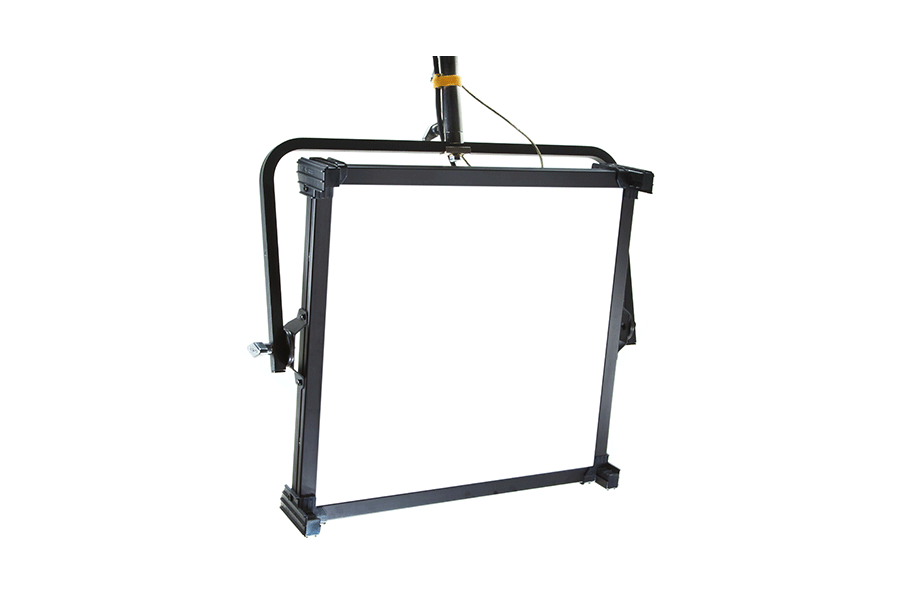


The Kino Flo Celeb 450Q LED DMX is a squarer full-colour LED soft panel with integrated electronics, wired DMX and LumenRadio wireless DMX. Its approximately 30 × 26 inch yoke-format body is useful for close soft keys, studio interviews and reflections that benefit from a taller luminous area than the long Celeb 450.
Kino Flo marks the 450Q discontinued from January 1, 2023. It is a distinct model from the 450 and the earlier 400Q/401Q. The 450Q manual specifies 270 W consumption, and its yoke and pole-operated assemblies have different overall dimensions and weights.
- Type
Colour-capable LED soft panel; integrated power and control - Power
270 W; 100–240 V AC, 50/60 Hz - Colour Temperature2700–6500 K standard; 2500–9900 K extended. Colour modes depend on firmware.
- Weight / Mount
11 kg yoke / 12 kg pole-op; 28 mm junior pin accessory for the yoke. - Beam Control
Broad soft output; removable 90° louver, optional 60° louver and model-specific softbox/grid accessories. - IP Rating
Not specified in the linked manufacturer manual; do not assume weather protection. Read the IP rating guide.
Key Specifications
| Specification | Details |
|---|---|
| Fixture class | Integrated full-colour LED soft panel |
| Manufacturer status | Discontinued January 1, 2023 |
| Model identifiers | CEL-450QU / CEL-450QPU |
| AC input | 100–240 V, 50/60 Hz |
| Rated power | 270 W |
| Listed mains current | 2.7 A at 120 V; 1.1 A at 230 V |
| Operating colour range | 2500–9900 K in the manual; standard white interface and extended colour modes are distinct |
| Colour metrics in product page | CRI >96, TLCI >96, TM-30-18 Rf 95 / Rg 103 |
| Control | Onboard, wired DMX and LumenRadio wireless DMX |
| Colour/control functions | White, gels/hue, RGB, xy, FX and firmware-dependent camera/colour-space options |
| Manual dimming table | 1–100% operating range; check low-end fade and blackout behaviour on the actual firmware |
| Operating temperature | −10 to 40°C |
| Louvers | Removable 90° louver; compatible 60° louver and other model-specific modifiers |
| Yoke assembly | 30 × 5 × 26 in; 24 lb / approximately 11 kg |
| Pole-operated assembly | 30 × 5 × 30.5 in; 26 lb / approximately 12 kg |
Output Calculator
Select the published setup and a manufacturer distance, or enter a custom throw where supported. The results describe centre-beam output, not the brightness across the whole beam.
Camera Settings
If the calculator does not load, use the published photometric table or source on this page. JavaScript is required.
F-stop is a planning estimate, not a meter reading. It uses direct, on-axis illuminance and includes only the optics and diffusion named in the selected setup. Meter on set to account for lens transmission, filters, added diffusion, bounce, dimming and ambient light.
How the exposure estimate works
N = √(E × ISO × t / C), where E is illuminance in lux and t = shutter angle ÷ (360 × fps). The default C = 340 is a dome reference; C = 250 is a flat reference. These are calibration constants, not a measured T-stop. A small nonzero digit is tenths of a stop above the displayed full stop.
Distance estimates and comparisons
Published points are used as given. Between published points the calculator fits a curve through the two nearest readings. Outside those points it uses the inverse-square law only when the fixture’s dataset permits it. Distances outside a configuration’s supported range are reported separately. Comparisons use one shared distance and camera setup; equal lux does not imply equal coverage.
View published readings for the selected configuration
Strengths and Limitations
Strengths
- A broad emitting face suits soft keys and controlled reflections.
- Model-specific controls allow repeatable white or colour settings.
Limitations
- Diffusion and grids change both the exposure and the useful coverage.
- The controller, supply and rigging are part of the complete package.
Practical Uses
A squarer panel can give a different catchlight and facial wrap from a long strip. The 450Q is useful where the source needs meaningful height as well as width, such as a close portrait key or a broad reflected highlight. Choose it for that geometry rather than assuming the “Q” is merely an accessory change on the long 450.
Diffusion, distance and orientation still determine the apparent source. Moving a panel away makes it relatively smaller to the subject, while a close source can create faster falloff across a small set. Check the actual face, background and object reflections rather than judging softness from the panel category alone.
The yoke version and pole-operated version are different mounting packages. A studio may value adjustment from below, while a location package may prioritise the smaller yoke assembly. Include the chosen version’s dimensions, mass and required grip hardware in the rental request.
| Setup | Working approach |
|---|---|
| Interview key | Set source size and distance for the required wrap, then add a grid or flags. |
| Product reflection | Watch the actual reflection while adjusting orientation and diffusion. |
Output and Colour
The manufacturer-hosted Light Laboratory report was issued in June 2017 for the named model at 100% intensity, 6500 K and without a louver. It is an absolute photometric report, not a measured result for every colour mode, current firmware or accessory combination.
A calculated far-field estimate from its peak intensity is approximately 241 lux at five metres, using illuminance = candela ÷ distance². This is a derived orientation figure rather than a new meter test; close placements and modified configurations need their own assessment.
| Report datum | Value |
|---|---|
| Luminaire light output | 16,658 lumens |
| Peak intensity | 6,013 candela |
| Recorded test input | 249.75 W |
| CCT / modifier state | 6500 K / open face, no louver |
Power and Batteries
The 450Q’s specification block lists 270 W AC operation and 2.7 A at 120 V. The shared Celeb 250/450/450Q manual also contains DC specifications for the 250; those are not the 450Q’s battery-input specification. Do not attach a low-voltage supply based on a different model’s section of the manual.
The integrated design simplifies a separate-head/controller layout but puts the electronics and their mass at the fixture. Use the correct retained mains cable, keep heat-dissipation paths clear and support the cable so it does not pull on the head. Base circuit planning on the actual fixture label, supply and total circuit load.
A portable power station must supply a suitable AC output and enough continuous capacity for the complete load. Stored energy and inverter power are separate limits. Do not improvise a DC conversion or treat a different Celeb model’s power interface as permission to modify this unit.
Control, Cooling and Camera Operation
The manufacturer describes a standard white interface alongside an extended 2500–9900 K colour range, green/magenta adjustment, gels, hue/saturation, RGB, xy and effects. The selected mode, camera-profile option and colour space can change how values are interpreted. Record those choices when matching a second panel or returning to a setup.
Camera-profile LUTs are fixture-side colour compensation tools rather than a grade applied to the recorded image. Check skin tones, fabrics and saturated cues through the intended camera. A high white-light CRI/TLCI score does not establish equal brightness or identical spectral behaviour at every colour setting.
Used units may have different firmware. Identify the installed version and consult the corresponding instructions/DMX personality before assuming a current feature list is present. Check low-end dimming and blackout in the actual console route when smooth fades matter.
The fixture has wired DMX input/output and built-in LumenRadio wireless DMX. Select the correct profile, addressing and wireless pairing, and test cue response and signal-loss behaviour. A console profile for an earlier Celeb generation or a differently configured unit can expose the wrong parameters.
The removable louver controls off-axis light without making the face a sharply focused projector. A SnapBag, diffusion or compatible grid changes the source’s appearance, spill and available level. Use model-specific accessories and keep their weight, depth and retention in the mounting plan. The archival open-face report is not their output table.
Modifiers, Rigging and the Working Package
Center-mount, yoke and pole-operated versions use different overall hardware. Confirm the exact assembly, stand/grid adapter, tilt or pan locks and safety attachment. Include modifiers and cable load in support calculations and provide appropriate secondary retention above people. An interface dimension does not establish the capacity of every stand or clamp that accepts it.
Inspect the panel face, diffusion, LED uniformity, housing, mount, mains connector, DMX sockets and controls. Test white settings, saturated colours, low levels, radio and wired control after electrical condition is established. Protect the unit from weather outside its instructions and observe the −10 to 40°C operating range.
Discontinued status does not by itself make a sound fixture unusable, but it makes the availability of the correct parts and service worth checking before purchase. A cheap panel with damaged optics, an unstable mount or a failing integrated driver can be much less useful than a complete serviced package.
Alternatives and Related Fixtures
The long Celeb 450 is useful for strip-shaped reflections, while the 850 gives a larger face and a higher electrical load. A modern Nova P300c is a different panel, mount and colour-engine package. Compare the actual source geometry and control needs rather than a generic soft-panel equivalence.
| Fixture | Choose it for |
|---|---|
| Kino Flo FreeStyle | A modular soft-source and controller system. |
| LiteMat Spectrum | A shallow full-colour format with generation-specific control hardware. |
What People Are Saying
Field Feedback at a Glance
These are documented operating characteristics and prep considerations, not independent owner reviews. Kino Flo Celeb 450Q model reference · True Match 5.0 profile reference.
Where it helps
- The 30 × 26 in. face gives a broader shape across both axes than the rectangular 450, useful for a wide close key.
- Kino Flo lists a dedicated 450Q SnapBag, 40° SnapGrid and optional 60° louver; the controls can be selected for the set rather than using the open face everywhere.
- Yoke or pole-operated versions let the crew pick stand access or overhead adjustment.
Drawbacks to plan for
- Keep 450Q-specific accessories and output data separate from the rectangular 450. The model suffix matters even though both use the CEL4 family profile.
- Allow 11 kg on the yoke version or 12 kg on the pole-operated version before any control accessories.
- Budget from this model’s AC requirements and booked unit’s label, not the rectangular 450 or the newer Celeb IKON. No numeric weather-protection rating is established by the cited manual.
ProAV: Large-Panel Studio Lighting
ProAV’s IBC interview introduces the large Celeb 850 alongside other Kino Flo releases. It shows the studio-panel concept; its size and output should not be assigned to smaller Celeb models. View the source.
Videos
Celeb 450Q: Control and Setup Reference
Use the Kino Flo 250/450/450Q Quick Start Guide for this fixture’s controls, mounting and accessories. The ProAV clip linked above shows the larger Celeb 850 only; its mounting and output details do not apply to the 450Q.
Rental and Used-Fixture Checks
Before You Book
Check the exact model, matching power components and control leads. Inspect the emitting surface, protective parts, mounts and connectors. Test the intended operating mode, low-level control and camera settings before rigging.
Documentation and Specifications
official archived model page, operating manual and identified open-face photometric report.
Product photograph: Kino Flo official product photograph.
Browse Kino Flo lights · LED panels · all equipment.