
Last Updated 13 hours ago
Overview
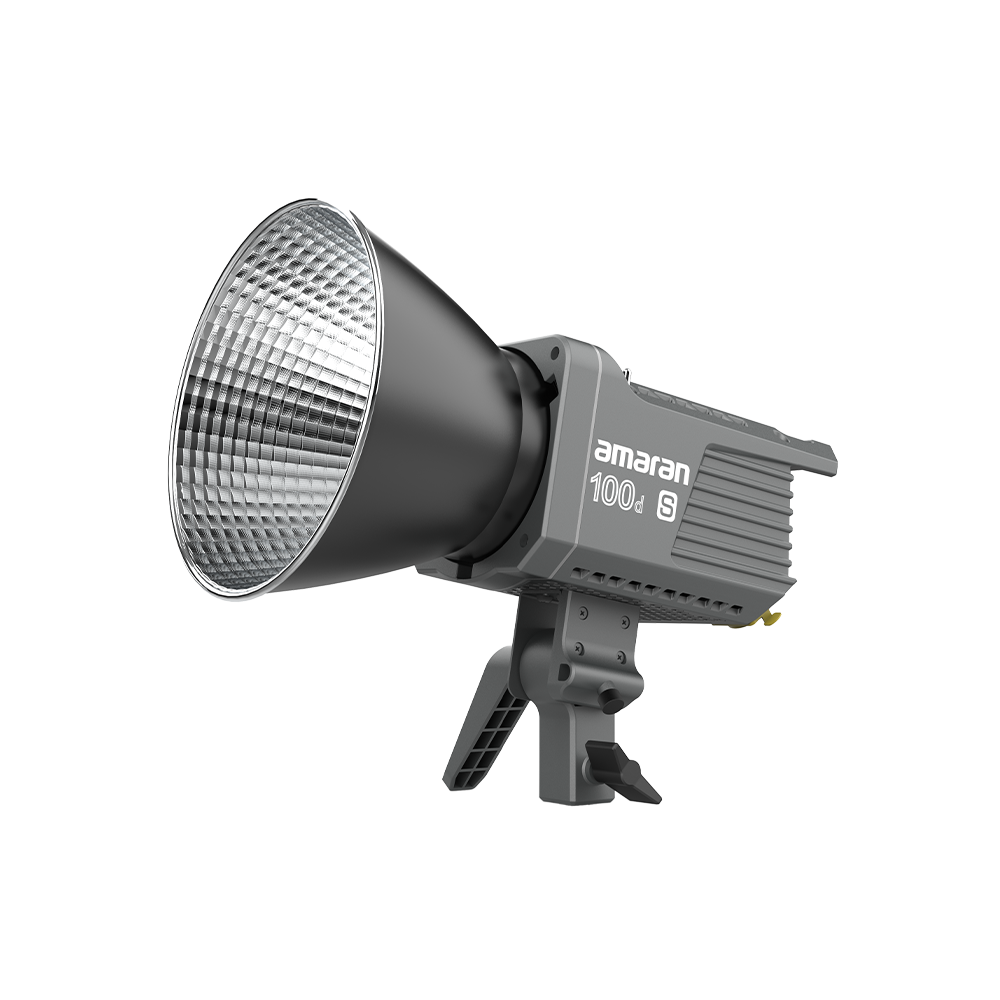
The amaran 100d S is a compact 100 W-class daylight COB spotlight with a Bowens mount, local controls and Bluetooth/Sidus Link control. Its fixed 5600 K output suits interviews, small product setups, bounce and softbox keys where variable white is unnecessary.
The S version uses the upgraded dual-blue chipset rather than the original 100d engine. Its published maximum consumption is 110.9 W; the “100 W” description is the lamp-power class, not a measurement of optical radiant output. It remains a white-light fixture rather than an RGB source.
Key specifications
| Specification | Details |
|---|---|
| Fixture class | Bowens-mount white-light COB spotlight, S-generation |
| Nominal lamp-power class | 100 W |
| Published maximum consumption | 110.9 W |
| White range | 5600 K daylight |
| Manufacturer colour metrics | CRI 96+, TLCI 99+, TM-30 Rf 96 / Rg 103; current-page SSI(D56) 86+ |
| Published luminous flux | 10,000 lm |
| Head supply | 48 V / 2.7 A |
| AC power system | 100–240 V through the designated adapter |
| Head dimensions with bracket | 207 × 119 × 200 mm in manual |
| Listed head weight | 1.42 kg |
| Beam angles | 110.9° bare; 17.1° with Hyper Reflector Mini |
| Dimming | 0–100%; local intensity and app control |
| Control | Onboard and Sidus Link Bluetooth; no native DMX/CRMX listed |
| Cooling / operating ambient | Active cooling; −10 to 40°C |
Strengths and limitations
Strengths
- A fixed 5600 K engine concentrates on daylight white light.
- The S-generation dual-blue chipset improves spectral similarity over the original series.
- Bowens modifiers and integrated controls make a straightforward interview or studio package.
Limitations
- Warm-source matching needs correction gel or a separate bi-colour light.
- A high spectral score does not establish a perfect match on every camera or material.
- Cooling, adapter support and the complete modifier load still need planning; native DMX and CRMX are absent.
Practical uses
The 100d S is a useful small daylight engine for an interview softbox, an umbrella bounce or a controlled product edge. It keeps the interface at the head, which simplifies a modest stand setup but can make local adjustment awkward when the light is high. The 1.42 kg head figure excludes the complete adapter, cables, stand and modifier package.
Choose the source for the image: a softbox creates a broader reflection and softer nearby shadows, an umbrella provides a different spill pattern, and a reflector retains a harder direction. Inspect a glossy product through the camera while moving the source, because the modifier’s shape becomes part of its highlight.
The native Bowens mount accepts compatible accessories, but front-heavy modifiers increase leverage at the tilt lock and stand. Use the manufacturer compatibility guidance for optical attachments and support arrangements. A physically fitting mount does not establish that every large accessory can be carried without additional support.
| Setup | Working approach |
|---|---|
| Soft interview key | Use a compatible softbox close to the subject, with the diffusion and grid selected before setting exposure. |
| Bounce or diffusion | Fill the useful area evenly; a narrow reflector’s centre reading does not describe an evenly filled frame. |
| Background or edge | Choose a supported modifier and working distance for the intended field and shadow quality. |
| Creator studio | Use onboard or Sidus Link control and support the external power adapter independently of the head connector. |
Output and colour
The table uses the matching manufacturer manual, with lux retained at the stated distance and CCT. Bare-head and Hyper Reflector measurements are separate configurations. These are manufacturer averaged figures, not a new site test or readings through an added softbox.
The reflector concentrates output into a much narrower field than the bare head. Its higher centre value is not evidence that a wider area receives the same illumination. Evaluate beam coverage, edge falloff and the final diffuser at the subject.
The current product table states SSI(D56) 86+, while the linked manual prints 87. The current-page value is identified here rather than presenting either number as a new measurement.
| CCT / setup | 1 m, lux | 3 m, lux | 5 m, lux |
|---|---|---|---|
| 5600 K, bare | 4,060 | 490 | 189 |
| 5600 K, Hyper Reflector | 34,600 | 3,750 | 1,302 |
The S-series dual-blue chipset is intended to improve spectral continuity compared with the preceding generation. CRI, TLCI, TM-30 and SSI measure different things; an SSI reference score should not be treated as a CRI percentage or a universal camera-match guarantee.
Record the white setting where adjustable, intensity, reflector and diffusion for a repeatable setup. Check skin, fabrics and product colours through the production camera when matching daylight, practicals or other LED brands. A shared Kelvin setting alone does not prove identical spectral rendering.
Power and batteries
The head takes the specified 48 V DC supply from its external adapter; it does not plug straight into mains at the DC connector. Support the adapter independently and use the retained head cable and strain relief so aiming the fixture does not pull on its socket.
The manufacturer describes battery use through the compatible Aputure two-bay Battery Power Station, sold separately. That is a complete approved 48 V power arrangement, not a direct connection from one ordinary camera battery. Confirm the station, battery type, discharge capability and remaining energy for the selected output.
Budget from the published maximum consumption and actual supply label rather than assuming the model’s number is the whole-system load. Battery watt-hours estimate stored energy; continuous current capability determines whether the pack can sustain the required power.
Control, cooling and camera operation
The head provides a local display and adjustment controls plus Sidus Link Bluetooth operation and app-based firmware updates. The checked specifications do not list native five-pin DMX or a built-in CRMX receiver. App control is therefore a different workflow from a console-addressed production wireless-DMX rig.
Set up pairing and the intended effects before placing the fixture in an awkward position. The manual describes eight app effects for the daylight models and nine for the 100x S, with availability tied to the installed firmware. Test low fades, reconnection and the intended camera shutter/frame rate before cue-dependent work.
Modifiers, rigging and the working package
These heads use active cooling. Test the actual fan sound at the microphone position and maintain clear airflow rather than covering the housing to reduce noise. Observe the −10 to 40°C operating range and the matching manual’s environmental instructions.
Inspect the COB window, reflector lock, stand adapter, tilt handle, bracket, DC lead and power supply. Remove the protection cap before operation and let the light cool before packing. Check low dimming, colour stability, local controls and app connection on a used unit.
The listed weight is the head reference, not a complete stand-mounted package. Include modifiers, adapter and cable loads in the support plan and provide appropriate secondary retention for elevated placement.
Alternatives and related fixtures
A fixed daylight setting can simplify repeatable work in a controlled room. If the scene mixes warm practicals, either gel the source with the associated output loss or choose a bi-colour model. The 100x S offers variable white, while the 200x S covers a higher-power bi-colour class.
| Fixture | Choose it for |
|---|---|
| amaran 100x S | The same size family with a different white-light range. |
| amaran 150c / 300c | RGBWW colour and tint adjustment when saturated effects are part of the job. |
| Aputure LS 300x | A larger Light Storm bi-colour working package with different power and control hardware. |
What people are saying
Adam Talks Tech: good light quality in a lightweight body
Adam Talks Tech’s 100d S review praises the quality of light and Sidus Link support, while pointing out the lightweight plastic body used to keep cost and mass down. His separate daylight-family comparison puts the 100d S between the compact 60d S and higher-output 200d S.
Videos
Adam Talks Tech: 100d S review
A model-specific review of the S-generation daylight head.
60d S, 100d S and 200d S comparison
A comparison of the three daylight output classes.
Rental and used-fixture checks
Confirm the S designation on the fixture and identify the correct power adapter. Inspect the Bowens latch, bracket, stand connection, fan vents and locking DC socket. Run a low-level fade and the required white setting, test app pairing, and check the entire head/modifier arrangement for play before raising it.
Documentation and specifications
official product specifications, manufacturer operating manual and the model page’s accessory-compatibility download.
Product photograph: amaran.
Browse amaran lights · COB lights · all equipment.