
Last Updated 6 hours ago
Halo 600x Overview
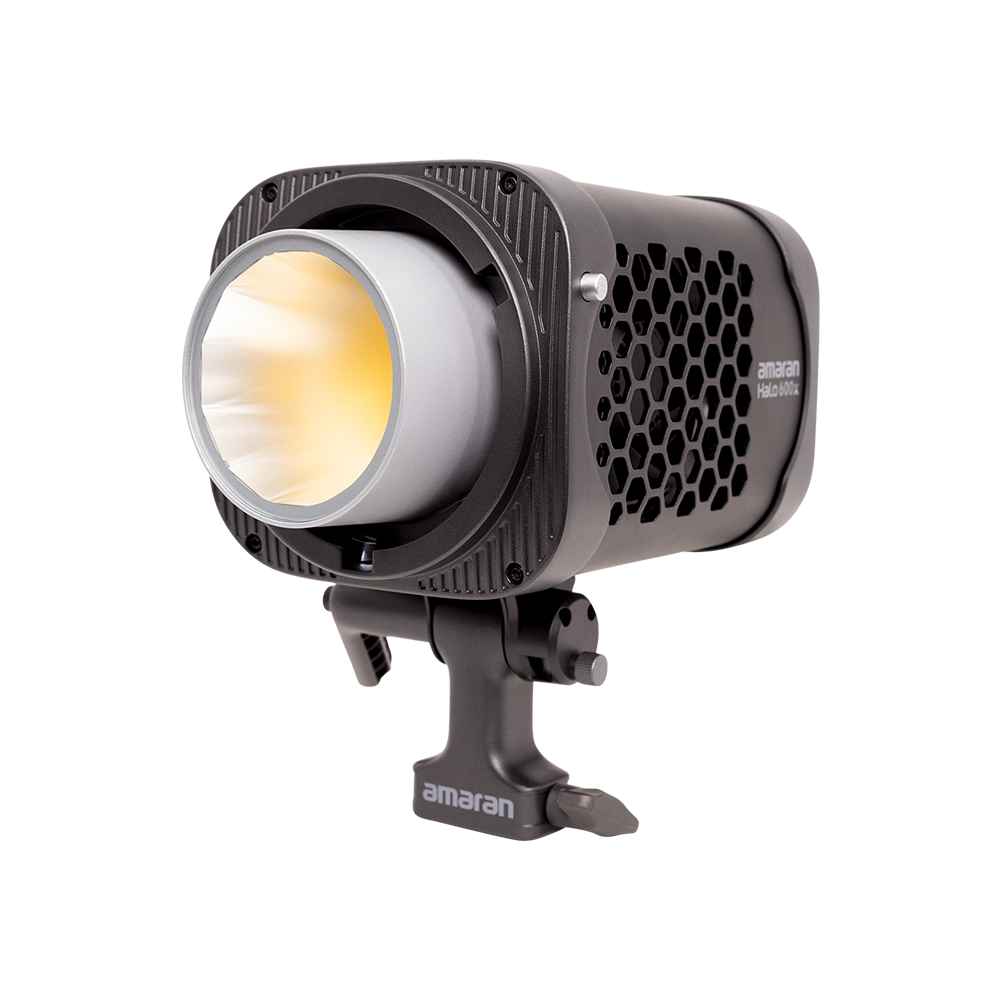


The amaran Halo 600x is a bi-colour Bowens-mount COB intended for a large diffused key, stronger bounce or more distant source. It adjusts from 2,700–6,500K and provides local controls, amaran app operation and an optional wired DMX route.
The model name identifies its place in the range: amaran specifies 545W maximum LED output and 610W maximum consumption. Those electrical figures should stay separate from illuminance, beam angle and the size of a softbox.
- Fixture TypeBi-colour COB LED
- Power545W maximum LED output; 610W maximum consumption; 100–240V AC
- Colour Temperature2,700–6,500 K
- Weight and Mount2.91kg fixture; full-size Bowens modifier mount
- Beam Control85° bare beam; compatible reflector, Fresnel and soft modifiers
- IP RatingIP20 Solid objects ≥12.5mm; no rated water protection. Not dust-tight. IP Ratings Guide
Halo 600x Specifications
| Specification | Details |
|---|---|
| Maximum LED output / consumption | 545W / 610W |
| CCT | 2,700–6,500K |
| CRI / TLCI | 96+ / 97+ |
| SSI P3200 / D56 | 84 / 74 |
| TM-30 Rf / Rg | 94 / 102, manufacturer averages |
| Bare beam | 85° |
| Mount | Bowens |
| Fixture weight | 2.91kg |
| Cooling | Active; Silent, Smart and High modes |
| Silent power limit | 55W |
| Weather rating | IP20 |
| Controls | Onboard, amaran app; wired DMX via optional adapter |
| Power input | 100–240V AC, 50/60Hz |
Output Calculator
Select the published setup and a manufacturer distance, or enter a custom throw where supported. The results describe centre-beam output, not the brightness across the whole beam.
Camera Settings
If the calculator does not load, use the published photometric table or source on this page. JavaScript is required.
F-stop is a planning estimate, not a meter reading. It uses direct, on-axis illuminance and includes only the optics and diffusion named in the selected setup. Meter on set to account for lens transmission, filters, added diffusion, bounce, dimming and ambient light.
How the exposure estimate works
N = √(E × ISO × t / C), where E is illuminance in lux and t = shutter angle ÷ (360 × fps). The default C = 340 is a dome reference; C = 250 is a flat reference. These are calibration constants, not a measured T-stop. A small nonzero digit is tenths of a stop above the displayed full stop.
Distance estimates and comparisons
Published points are used as given. Between published points the calculator fits a curve through the two nearest readings. Outside those points it uses the inverse-square law only when the fixture’s dataset permits it. Distances outside a configuration’s supported range are reported separately. Comparisons use one shared distance and camera setup; equal lux does not imply equal coverage.
View published readings for the selected configuration
Strengths and Limitations
Strengths
- Simple separate intensity and CCT knobs.
- Bowens modifier support and wired DMX capability across the Halo range.
- Integrated AC supply keeps the stand area relatively simple.
Limitations
- Bi-colour white light; saturated colours require gels or another fixture.
- IP20 is an indoor protection rating.
- Silent mode caps this model at 55W, well below its maximum-power setting.
Practical Uses
| Setup | Working approach |
|---|---|
| Talking-head key | Use a softbox or bounce at an appropriate distance, then flag the background rather than lighting the whole room. The small COB face used bare produces harder shadows. |
| Product tabletop | Use a compatible optic or diffusion to build the reflected shape in the object. A narrow hotspot can be useful on a background while remaining unsuitable as a broad product reflection. |
| Repeatable studio cues | Save the working CCT and intensity, then use the documented DMX profile for fades and repeat setups. Test blackout and lost-signal behaviour with the final power and control package. |
Output and Colour
The tables below keep the CCT, distance and accessory fixed. Reflector and Fresnel readings concentrate light into different fields; a higher centre lux figure is not a claim that the same amount of light covers a larger area. Meter the final diffusion and subject position before choosing a larger or smaller head.
| 5,600K configuration | 1m | 3m |
|---|---|---|
| Bare | 32,500 lux | 3,610 lux |
| Reflector | 102,100 lux | 9,680 lux |
| Compatible Fresnel, 15° spot | 259,100 lux | 31,600 lux |
CRI, TLCI and SSI describe different aspects of colour reproduction. A high CRI value does not establish a perfect match to daylight, tungsten or another LED. Compare important skin tones, wardrobe and product colours on the camera used for the job.
Power and Batteries
The Halo 600x takes 100–240V AC directly into its integrated supply. There is no separate low-voltage battery input in the manufacturer’s power-route listing.
For a battery-powered setup, verify continuous output, voltage and cable rating before comparing battery capacities. A portable power station must supply AC at the fixture’s complete input demand; include other devices using the same outlet or inverter.
Weather and Cooling: IP20 does not provide rated protection from water. The manufacturer’s safety instructions prohibit immersion, require a grounded outlet and clear ventilation, and require completely dry ports and plugs in humid or wet environments. That wording does not make the fixture rain-rated. The specified operating range is −10°C to 40°C. The Halo 600x product specifications limit Silent mode to 55W; the calculator’s full-output photometrics do not model that reduction.
Control, Cooling and Camera Operation
Set the fan mode before establishing exposure. The 55W Silent setting is useful near microphones but reduces the power available to the LEDs. Smart varies fan speed with temperature; High prioritises cooling.
NFC helps the amaran app pair over Bluetooth. Wired DMX requires the specified amaran USB-C to 5-pin In & Out Adapter, sold separately. A third-party passive USB cable is not a substitute, and the fixture does not list an internal CRMX receiver.
Modifiers, Rigging and the Working Package
Compatible accessory profiles · amaran Light Box 60×90 Rectangular Softbox
The full-size Bowens interface accepts compatible softboxes and beam-shaping tools. Check the actual Halo model in the compatibility sheet: a shared bayonet does not guarantee optical clearance, loading or performance with every heavy projector or Fresnel.
Use the supplied stand adapter as intended, keep the tilt lock secure and support the mains or DC cable with enough slack for adjustment. A large softbox adds torque and catches air; choose the stand and ballast for the assembled rig.
Alternatives and Related Fixtures
| Fixture | Choose it for |
|---|---|
| amaran 200x S | Earlier bi-colour COB with different spectral ratings and power hardware. |
| amaran 300c | RGBWW when colour mixing and tint adjustment are needed. |
| amaran P60x | A compact panel instead of a point source and softbox. |
What People Are Saying
Field Feedback at a Glance
Will Cheung tested the 600x with an amaran Lantern 90 and Octa Dome 60. His readings are for his own modifier, camera settings and distances. Will Cheung’s ePHOTOzine test.
What Works
- Usable output through a broad modifier: At 4,300 K and full output, Cheung metered f/5.6 at 3 m with the Lantern 90 (ISO 100, 1/30 s). That is a soft-light reference, separate from the manufacturer’s bare or reflector tables.
- Colour stayed reasonably stable in his test: Cheung compared a chart from 10% to 100% using the Lantern 90 and saw little variation. That is not a guarantee for every camera, other modifier or very low dimmer setting.
- High mode handled a long run: He ran his unit for several hours with a modifier and High cooling. It grew warm, but he did not report overheating.
What to Watch For
- Quiet surroundings can expose the fan: Cheung could hear it in a quiet room; with the Lantern 90 at 1 m his Silent reading was more than three stops below normal. amaran’s 55 W Silent power cap is not modelled by full-output photometrics.
- A protective case is not a given: Cheung wanted a carry case for the 600x. Check the packing and support plan for the head plus the chosen modifier, not only the source package.
- Check whether the box protects the emitter on a job: One purchaser’s kit came without a reflector or protective front cap. Confirm the contents with your rental or supplier. Richard’s B&H owner report.
Gerald Undone’s Halo family walkthrough covers power, DMX, modifier fit, menus and fans across different head sizes. amaran lists him as a brand ambassador; treat the video as a lineup overview, not an independent verdict on this head.
Videos
Halo Series: Controls, Modifiers and Fan Modes
Gerald Undone compares the Halo range. amaran lists him as a brand ambassador.
amaran Halo: Manufacturer Introduction
Manufacturer overview of the five-model range.
Rental and Used-Fixture Checks
- Confirm the exact model and generation on the label, then compare the included supply, cables and accessories with the matching manual.
- Inspect the emitting face, housing, connector pins, mounting threads and locks. Test every supplied modifier and make sure the release mechanism fully engages.
- Run the light at the intended output until it reaches normal operating temperature. Check for flicker, unexpected shutdown, uneven emitters and unusual fan noise.
- Test white light and every available colour mode; check low-level dimming, blackout and the camera/shutter combination used for the job.
Documentation and Specifications
- Official model information
- Manufacturer kit contents and accessories
- Halo specifications and photometrics
- Manufacturer product manual
Browse amaran lights or search the equipment directory.