
Last Updated 4 days ago
Overview
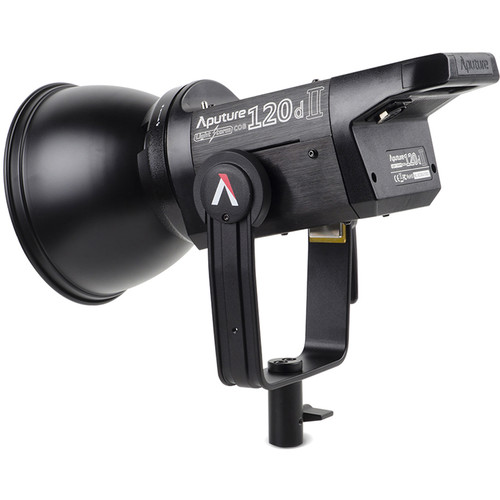
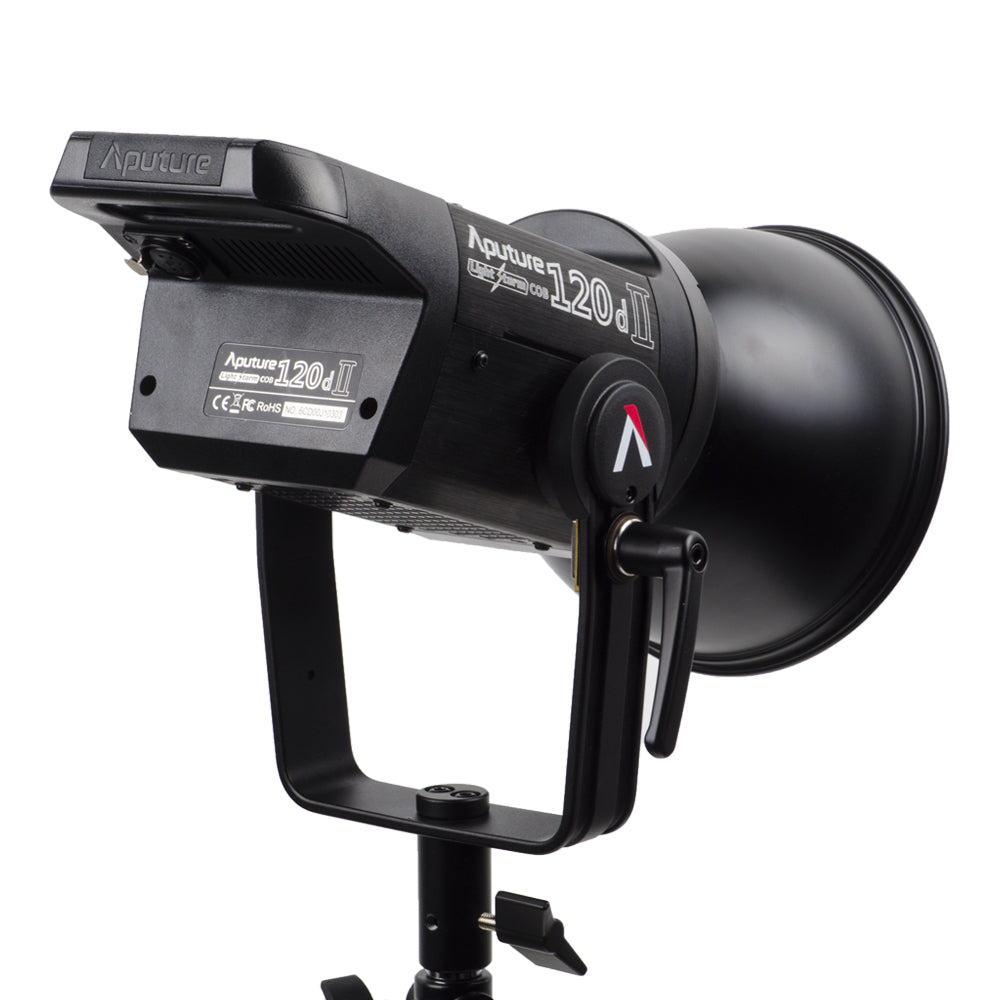

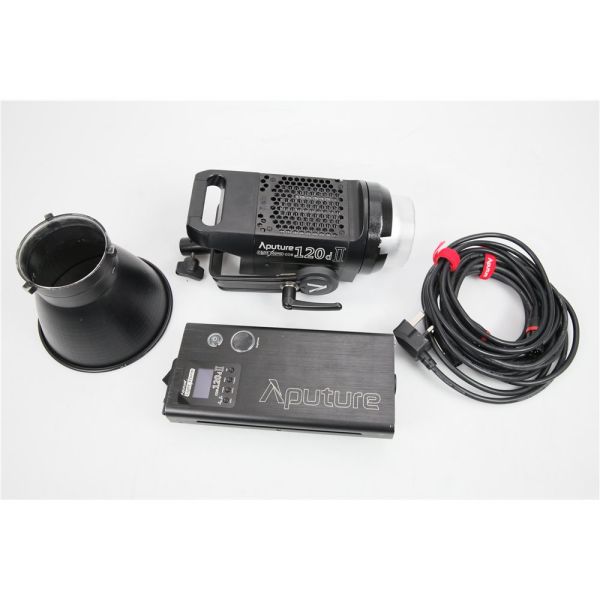
The Aputure Light Storm LS 120d II is a discontinued daylight COB fixture with a Bowens accessory mount, an integrated power/controller box and wired DMX control. Its 5,500K output and 180W maximum consumption suit close interview keys, small bounce sources and projection work. It remains relevant in rental and used packages.
The “II” matters: this is the redesigned second-generation 120d, not the original 6,000K model. Assess it as a complete older kit, including controller, battery plate, head cable, yoke and modifier, rather than judging the head in isolation.
- Fixture Type Fixed-daylight COB LED with a Bowens accessory mount.
- Power 180 W maximum electrical consumption; 100–240 V AC. Separate combined controller/power supply; battery plate depends on version.
- Colour Temperature5,500 K daylight; use CTO gel to warm it toward a tungsten source.
- Weight 2.2 kg with reflector · Retailer listing; the Aputure manual does not specify bare-head weight. Studio Depot specifications. Bowens front mount and handbrake-locking yoke. Include controller, battery and modifier loads in the working package.
- Beam Control Optional Fresnel 2x focuses from 12°–40°; compatible softboxes and projection optics serve different jobs.
- IP Rating No numeric IP rating verified for this model. Do not assume rain or dust protection for the head, controller or connections. Read the IP rating guide.
Key Specifications
| Specification | Details |
|---|---|
| Generation | Second-generation LS 120d; discontinued |
| Colour temperature | 5,500K daylight |
| Maximum electrical consumption | 180W |
| AC input | 100–240V, 50/60Hz |
| Colour references | CRI ≥96; TLCI ≥97 |
| Accessory interface | Bowens mount |
| Dimming | 0–100% intensity control |
| Control | Onboard, compatible 2.4GHz remote, wired DMX |
| Battery options | Single V-Mount or Gold Mount controller variant; confirm battery current capability |
| Cooling | Active fan cooling |
| Typical modifier options | Compatible Bowens softboxes, Fresnel 2x and original Spotlight Mount |
Output Calculator
Select the published setup and a manufacturer distance, or enter a custom throw where supported. The results describe centre-beam output, not the brightness across the whole beam.
Camera Settings
If the calculator does not load, use the published photometric table or source on this page. JavaScript is required.
F-stop is a planning estimate, not a meter reading. It uses direct, on-axis illuminance and includes only the optics and diffusion named in the selected setup. Meter on set to account for lens transmission, filters, added diffusion, bounce, dimming and ambient light.
How the exposure estimate works
N = √(E × ISO × t / C), where E is illuminance in lux and t = shutter angle ÷ (360 × fps). The default C = 340 is a dome reference; C = 250 is a flat reference. These are calibration constants, not a measured T-stop. A small nonzero digit is tenths of a stop above the displayed full stop.
Distance estimates and comparisons
Published points are used as given. Between published points the calculator fits a curve through the two nearest readings. Outside those points it uses the inverse-square law only when the fixture’s dataset permits it. Distances outside a configuration’s supported range are reported separately. Comparisons use one shared distance and camera setup; equal lux does not imply equal coverage.
View published readings for the selected configuration
Technical reference: Aputure LS C120d II operating manual (manufacturer manual, hosted by 3z.rent), specification page 15.
Strengths and Limitations
Strengths
- A compact daylight hard source with useful Bowens soft-light and projection options.
- Combined controller/power supply reduces the number of separate components compared with the original generation.
- Wired DMX and a compatible remote remain useful on simple interior setups.
Limitations
- Use CTO gel to warm the fixed daylight output toward the practicals and check the match on camera. If the fixture looks too green or too magenta against the other lights, test minusgreen or plusgreen gel respectively.
- Output is limited for strong daylight or large, heavily diffused sources.
- Older control hardware should not be assumed to provide native Bluetooth, internal CRMX or Ethernet.
- Used-kit value depends heavily on cable, controller, battery and yoke condition.
Practical Uses
| Setup | Working approach |
|---|---|
| Close interview key | Use a suitable softbox close to the subject. Add negative fill or a grid where the broad soft source would otherwise flatten the room. |
| Background gobo | Use the compatible Spotlight Mount and a lens suited to the throw. Defocus a pattern or shape a pool to add detail without washing the whole background. |
| Small controlled bounce | Concentrate the light on the selected bounce surface and check the returned level at the subject. Avoid wasting output on surfaces outside the shot. |
| Travel interior package | Compare the complete case with a newer compact fixture. An inexpensive head is not a useful bargain if the matching controller or cable is missing. |
Output and Colour
The Fresnel 2x readings below are Aputure’s published centre illuminance at one metre. They describe that accessory’s spot and flood settings, not bare-head output. Narrowing the beam increases the centre reading while reducing coverage.
For a soft key, estimate exposure only after fitting the working softbox, diffusion and grid. For projection, the lens angle, gobo and pattern size determine how far the useful output goes.
| Configuration | Distance | Published illuminance |
|---|---|---|
| Fresnel 2x, flood | 1m | 23,000 lux |
| Fresnel 2x, spot | 1m | 67,000 lux |
Published photometrics: measurement configurations and full output tables.
Power and Batteries
Maximum consumption is 180W. Check the complete controller’s label and condition, especially on a used kit whose head and controller may have been separated.
The controller was sold in V-Mount and Gold Mount variants. A battery needs sufficient discharge capability, not just enough watt-hours. Test the intended pack at the required output before a long interview or remote location.
Inspect the correct head cable and AC cable as part of the package. Similar-looking connectors from another Light Storm generation are not evidence of electrical compatibility.
Control, Cooling and Camera Operation
Onboard intensity adjustment, a compatible 2.4GHz handheld remote and wired DMX form the basic control package. The remote radio is not the same thing as native Bluetooth or CRMX reception.
If an optional bridge or external DMX receiver is part of the rental, identify it explicitly and test that complete control path. Do not list the head as having built-in modern radio hardware that it does not contain.
The fan should be checked after the fixture is warm. Run any low fade and high-frame-rate shot with the production camera; a quiet, clean test at full brightness alone does not cover those conditions.
Modifiers, Rigging and the Working Package
Compatible accessory profiles · Aputure Fresnel 2X
| Component / accessory | Package considerations |
|---|---|
| Head and yoke | Inspect the handbrake lock under the intended modifier load and confirm full required tilt clearance. |
| Combined controller | Keep its weight off the head cable and provide a suitable support point. |
| Fresnel 2x | Compatible focusable accessory; identify the actual Fresnel generation before using its output table. |
| Original Spotlight Mount | Mount the projector on its own support as designed, then attach the lamp. The projector is larger and heavier than the small lamp head. |
| Softbox | Check the Bowens ring and release mechanism; large softboxes add leverage and transport volume. |
The product photograph shows the fixture package, not a promise that every used or rental listing includes the same accessories. Confirm the inventory before collection.
Alternatives and Related Fixtures
| Fixture | When to compare it |
|---|---|
| amaran 100d S | A newer compact daylight fixture when an older rental-control package is unnecessary. |
| amaran 200d S | A higher-power compact daylight alternative; compare support and control requirements. |
| LS 300d II | A larger daylight head when more output is needed. |
| STORM 400x | A newer tunable-white package when CCT, tint correction and weather protection matter. |
What People Are Saying
Field Feedback at a Glance
What worked
- The revised yoke gave Sheldon more room to tilt the head, and the combined power supply and controller cut the number of pieces he had to set up. Graham Sheldon, CineD.
- Sheldon found the lamp quieter than the first-generation 120d. He considered it suitable for close interview work in his setup; that was not a sound-level measurement. Graham Sheldon, CineD.
- With the original Spotlight Mount and its 19° lens, he could cut a sharp edge, project soft patterns on a background or aim a bounce into a tight space. Graham Sheldon, CineD.
Drawbacks to plan for
- He found the fixture fell short for most daylight exterior work in the conditions he was considering; shade and ambient level change how much it can contribute. Graham Sheldon, CineD.
- The combined controller did not come with a light-stand mount like the one on the 300d II kit he compared it with. Graham Sheldon, CineD.
- The original Spotlight Mount was bigger and heavier than the lamp head. He put the projector on the stand and attached the 120d II behind it; he also found the 19° lens needed room to work. Graham Sheldon, CineD.
Scott Dumas, October 2018. His detailed video covers the second-generation changes and sample footage. Watch the original review.
Videos
Scott Dumas: Aputure 120d II test and review. An overview of the second-generation fixture, its changes and sample footage.
Rental and Used-fixture Checks
Before You Book
- Confirm the II marking and matching controller; do not substitute first-generation specifications.
- Inspect the controller, battery plate, head-cable connector, yoke lock and Bowens mount.
- Test the intended battery at working output, including a warm restart.
- Listen to the fan and check low-level dimming after warm-up.
- Verify the handheld remote or external control accessories if included.
- Compare the complete used price with a current compact fixture, including service and replacement-cable availability.
Documentation and Specifications
- Aputure legacy product listing
- Aputure LS C120d II operating manual (manufacturer manual, hosted by 3z.rent)
- Aputure Fresnel 2x compatibility and photometrics
- CineD field review and handling observations
- Rental fixture specifications and product photograph
Browse Aputure lights · COB lights · all equipment.