
Last Updated 2 days ago
Overview
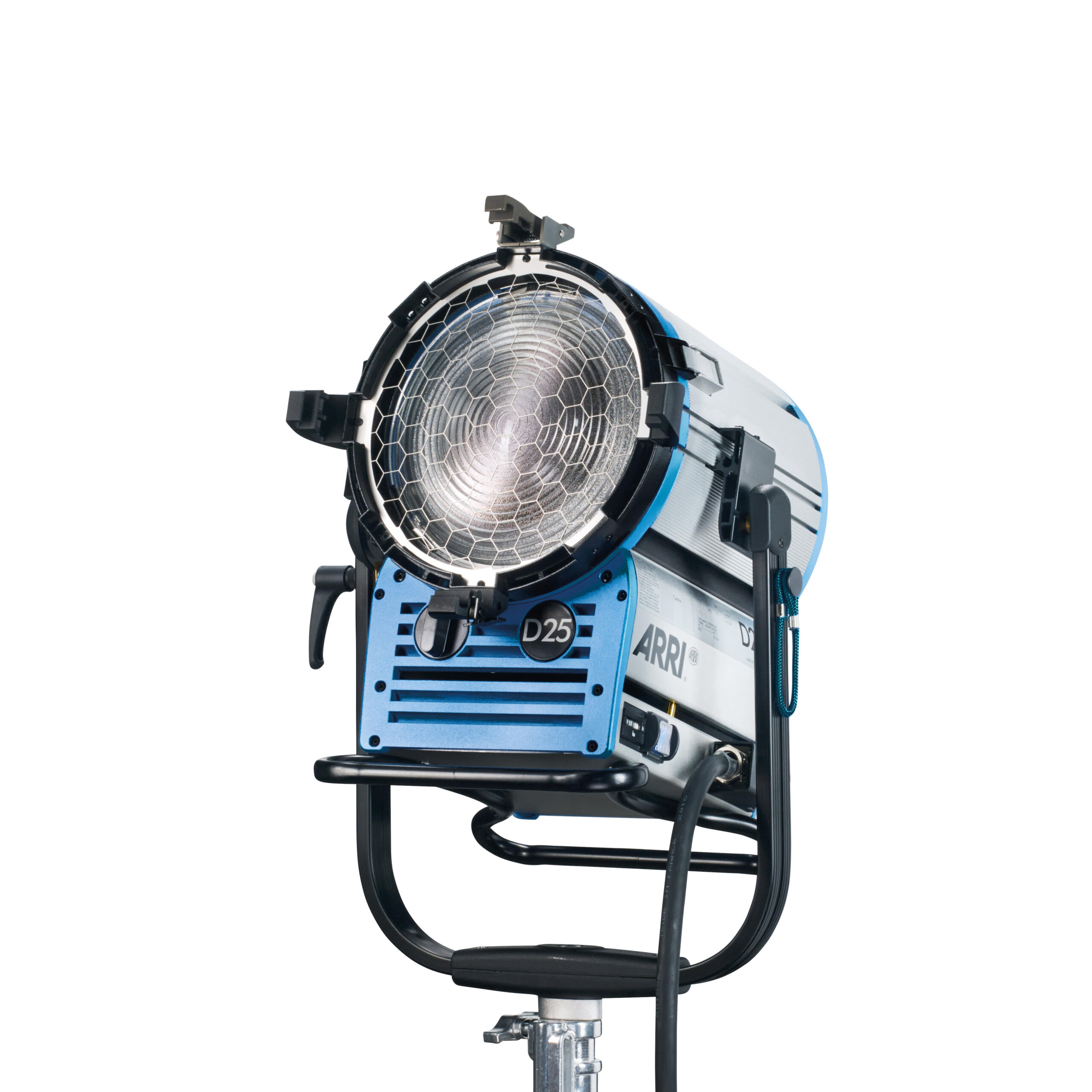
The ARRI True Blue D25 is a 2,500W HMI Fresnel with a 250mm lens, built for substantial daylight keys, backlight and distant bounce. It combines a continuously focusable Fresnel field with the output and supporting package of a 2.5kW discharge lamp. Plan a suitable supply and ballast before choosing a position; this is a distribution-fed lamp, rather than a household-plug LED.
Key specifications
| Specification | Details |
|---|---|
| Lamp / technology | 2,500W single-ended metal-halide; HMI Fresnel |
| Lamp base | G38 |
| Nominal lamp colour | 6,000K; lamp type, age and ballast mode affect the result |
| Focus range | 6°–59° |
| Lens diameter | 250mm |
| Lamphead weight | 15.5kg, manufacturer net reference; ballast and cable separate |
| Dimensions including pin (H × W × L) | 777 x 464 x 390 mm |
| Stand interface | 28mm junior spigot |
| Scrim / barndoor interface | 330mm scrim; 344mm barndoor |
| Published matching ballast | EB MAX 2.5/4; select lamp wattage and correct head connection |
| Dimming | 50–100% through a compatible ARRI ballast |
| Lamp circuit voltage | 115 V nominal at the lamp; this is not the ballast mains input |
| Protection | Class I; IP23 lamphead |
| Remote control | Determined by the ballast; no LED colour engine or built-in wireless receiver |
Technical reference: ARRI specifications.
Strengths and limitations
- Strengths: a continuously focusable Fresnel beam, replaceable discharge lamp and conventional barn-door and scrim control.
- Trade-offs: separate ballast and head cable, lamp warm-up, high surface temperature and a lamp-specific operating package.
- Choose it for: controlled daylight at a workable distance; compare an LED when immediate restart, low-power dimming or electronic colour adjustment is central to the job.
Practical uses
| Setup | How to use this head |
|---|---|
| Daylight from outside a set | Position the lamp far enough away to give the required direction through the opening. The small spot field is useful for a selected window; medium or flood is the more useful starting point for several windows or a broad backing. |
| Large bounce | Use the 2.5kW lamp to fill a reflector from a distant position. Shape the bounce at the surface and its edges; barn doors on the Fresnel cannot contain all the light leaving a broad white surface. |
| Hard separation on a stage | Use a controlled back or side beam with room for flags and safe access. Check the entire actor path rather than metering one stationary mark under a spot setting. |
Output and colour
The ARRI D-Series overview poster lists the following nominal centre illuminance with the 2,500W lamp. Distance is 20m; beam diameter is the manufacturer’s field reference for each focus setting.
| Focus / beam | Centre illuminance | Beam diameter |
|---|---|---|
| Spot / 6° | 4,057 lux | 2.10m |
| Medium / 30° | 692 lux | 10.72m |
| Flood / 59° | 307 lux | 22.63m |
Spot raises the centre intensity by narrowing the useful area. Use medium and flood figures when sizing a window source or diffusion frame. These are nominal manufacturer values, not measurements of a particular rental lamp; lamp age, lens condition, focus and operating mode can change the result.
The published 6,000K figure is a nominal lamp reference. HMI does not provide the continuous CCT and green–magenta controls of an RGB LED. Check the warmed lamp with the production camera and meter before choosing correction; changing ballast power can also alter colour.
Power and ballast requirements
The 2,500W figure belongs to the lamp. The ballast draws additional power and may draw different current at different mains voltages. Use the input label and manual of the actual ballast when planning distribution; dividing lamp wattage by outlet voltage understates the operating package.
ARRI lists the EB MAX 2.5/4 for this head. Confirm lamp selection, connector type, approved cable and any head-cable extensions. VEAM and Schaltbau versions appear in the catalogue; a compatible wattage rating alone does not establish cable compatibility.
A lamphead is not connected directly to mains or a conventional lamp dimmer. Feed the ballast from its specified supply, keep ventilation clear and allow it to run the lamp through its proper start and warm-up sequence. A portable power system must support the ballast’s continuous input and starting behaviour.
Control, cooling and camera operation
Focus and aim are mechanical at the lamphead. Intensity adjustment, lamp on/off, low-noise operation and high-speed modes belong to the ballast, with features depending on the ballast generation. A listing for this head does not guarantee that a rental includes DMX or a high-speed ballast.
Select the ballast’s operating mode before testing the camera. Higher lamp-drive frequency can help high-frame-rate photography, but “flicker-free” is not a guarantee for every shutter angle and frame rate. Test the intended combination at working output; lamp or ballast sound can matter in quiet interiors.
Modifiers, rigging and the working package
| Item | Working-package detail |
|---|---|
| Barn doors / scrims | Use the 344mm barndoor and 330mm scrim references for this model; do not order by lamp wattage alone. |
| Diffusion / bounce | Use a separately supported, heat-appropriate frame or bounce with the required clearance. Verify even coverage rather than judging only the bright centre. |
| Support | The head is approximately 15.5kg before loose accessories. The 28mm pin identifies the mounting interface, not the load capacity of the complete support. |
| Cable and ballast | Include the correct head cable, ballast, mains lead, cable management and safe access in the order. |
ARRI’s D-Series manual gives 15.2m as the minimum distance to illuminated persons, objects and surfaces for the D25, plus 1m around the fixture to flammable material. Follow the lamphead label and manual for the particular unit. Keep the lens, protective parts, latch and interlock in serviceable condition; a damaged enclosure is a reason to take the head out of use.
Alternatives and related fixtures
| Fixture | Why compare it |
|---|---|
| ARRI M40 | A lensless MAX-reflector alternative; compare the beam and useful coverage at the same distance, not lamp wattage alone. |
| ARRI Orbiter | A smaller full-colour LED package with interchangeable optics when controllability and quick colour changes matter more than discharge-lamp output. |
| ARRI Compact 6000 Plus | A larger daylight Fresnel when the required distant coverage and exposure exceed this head’s working output. |
| ARRI True Blue D40 | A 4kW daylight Fresnel with a 300mm lens; compare the finished field and ballast package. |
Manufacturer and handling notes
In ARRI’s D-Series presentation, cinematographer Bill Holshevnikoff demonstrates the smaller D5 and D12. The presentation is manufacturer material and is useful for seeing the head, focus and handling arrangement in context.
For the D25, use the exact-model output table, ballast list and accessory sizes above when planning the package. The D5/D12 demonstration below covers the family’s smaller heads and does not establish this model’s output or support requirements.
Videos
ARRI: Bill Holshevnikoff on the True Blue D5 and D12. Related D-Series handling demonstration; the featured heads are D5 and D12.
Rental and used-fixture checks
- Confirm the exact lamp, ballast, head cable and connector version before collection.
- Inspect the Fresnel lens, reflector, protective assembly, lamp holder and door interlock; do not bypass an interlock to test a damaged head.
- Run the lamp long enough to check stable colour, focus travel and the selected ballast mode.
- Check the tilt brake, sliding yoke and accessory latch with the actual barn doors fitted.
- Test the planned frame rate and shutter with the complete operating package, and include lamp hours and spare-lamp availability in a used purchase.
Documentation and specifications
- ARRI True Blue D25 specifications and downloads
- ARRI True Blue D-Series – Overview Poster
- ARRI True Blue D-Series – User Manual
- ARRI True Blue D25 – Photometric Files (IES) Feb2011
Browse ARRI lights · HMI lights · all equipment.