
Last Updated 15 hours ago
Overview
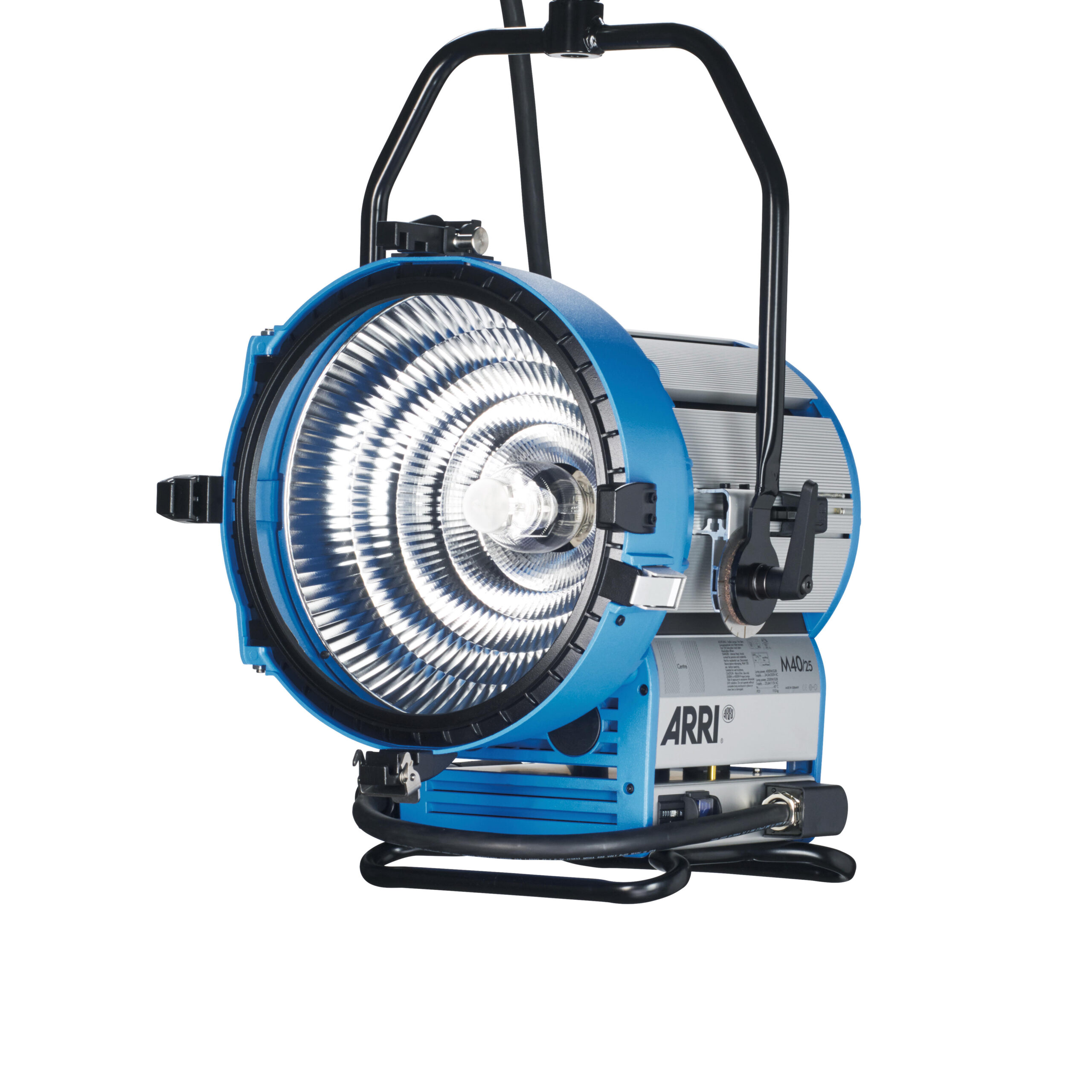
The ARRI M40 is a daylight metal-halide lamphead using the lensless MAX reflector system. It provides a focusable hard source without the interchangeable spreader lenses used by many conventional HMI PAR systems.
The M40 moves that optical approach into the 4,000W class, with approved 2,500W operation also documented. It is a substantial daylight source for window pushes, long throws, bounces and diffusion, with the power and handling demands of a complete HMI system.
Key specifications
| Specification | Details |
|---|---|
| Fixture type | Open-face metal-halide daylight lamphead |
| Optical system | Faceted MAX reflector; no spreader lens required for normal focus |
| Approved power classes | 4,000W or approved 2,500W |
| Lamp base | G38 |
| Nominal CCT | 6,000K, ARRI listing |
| Focus range | 18–52° with 4,000W lamp |
| Dimming | 50–100% through a compatible ARRI ballast |
| Head weight | Approximately 20kg |
| Support interface | 28mm / 1⅛in junior spigot |
| Scrim / door size | 400mm scrim / 413mm barndoor |
| UV-protection glass diameter | 350mm |
| Weather rating | IP23 |
| Maximum ambient temperature | 45°C |
| Ballast | Separate compatible ARRI electronic ballast required |
Strengths and limitations
Strengths
- A hard daylight source supports throw, bounce and large diffusion.
- Matched ballast options support production control.
Limitations
- Lamp, reflector or lens and ballast must be specified as a complete system.
- High-speed performance depends on the actual lamp, ballast mode and camera test.
Practical uses
The MAX reflector allows focus adjustment while retaining a hard-source character. Focus changes coverage and central illuminance. A narrow spot can be useful at distance, while flood may fill a bounce or diffusion frame more evenly. Check the actual distribution instead of selecting focus only for its centre reading.
Barndoors reduce unwanted spill, scrims reduce intensity without the same colour change as electrical dimming, and supported softboxes provide another distribution. All accessories add weight or heat considerations. Use the correct diameter and approved accessory arrangement.
The M40 suits scenes that need a substantial daylight source through a window, across distance or into a large bounce. Its optical and lamping system can be familiar to an experienced crew, while its weight and supply requirements reward proper prep.
Compare it with tunable-white LEDs using the same working distance, useful coverage and modifier losses. An LED offers electronic colour tuning; the HMI offers its own beam and system characteristics. The HMI explainer covers the technology behind the fixture.
| Setup | Working approach |
|---|---|
| Window or exterior push | Choose beam coverage and throw before calculating the required circuit and rig. |
| Large diffusion | Meter the useful lit area after diffusion and allow for transmission loss. |
Output and colour
The values below come from the ARRI data sheet, with the 4,000W lamp configuration. Lamp condition, focus and the complete optical setup affect practical output.
| Distance | Spot 18° | Medium 30° | Flood 52° |
|---|---|---|---|
| 7m | 40,300 lux | 13,500 lux | 5,000 lux |
| 10m | 19,700 lux | 6,500 lux | 2,450 lux |
| 15m | 8,750 lux | 2,900 lux | 1,075 lux |
Power and batteries
ARRI lists 200V for the 4,000W lamp and 115V for the 2,500W lamp at the head. Those numbers describe the lamp circuit, not the AC supply required by every compatible ballast.
Plan the electrical supply from the actual ballast’s input label, operating mode, cable and other connected loads. Lamp wattage does not include every part of the mains-side system. Match the selected lamp power to an approved ballast and header cable.
ARRI lists EB MAX 2.5/4 and compatible EB 2.5/4 systems. The same head’s 2,500W and 4,000W lamping options are separate operating configurations. Do not assume any ballast from another HMI package is suitable because its connector looks familiar.
The ballast also affects startup, dimming, high-speed capability, sound and control options. Read its manual along with the head’s manual. Any DMX or remote-control features belong to the chosen system; they should not be attributed to the bare lamphead without that qualification.
Control, cooling and camera operation
The nominal 6,000K listing is a reference for the discharge source, not an electronic CCT setting. Lamp age, power mode, diffusion and correction media can affect the match. Meter or test through the production camera when matching other HMIs, LEDs or real daylight.
Dimming is through the ballast within the approved range, rather than through an ordinary external tungsten dimmer. A high-speed-capable ballast is useful, but flicker performance still needs a test at the intended frame rate, shutter, lamp power and focus. “HMI” alone does not establish a flicker-free condition.
Modifiers, rigging and the working package
A discharge lamp needs the correct startup and operating procedure. Allow for stabilization and the documented restart conditions, particularly when a cue or schedule assumes immediate availability after power interruption. Inspect the lamp and complete head during prep.
The UV-protection glass and interlocks are essential operating parts. Do not bypass them or run the source with a damaged protection assembly. Isolate the system before lamp work and follow the manufacturer’s cooling and handling instructions.
The manual specifies 5m to illuminated persons, objects and surfaces, and 1m to flammable materials. Follow those manufacturer clearances for the documented configuration; a photometric table is not a separate clearance approval.
The head weighs approximately 20kg before its complete accessory and cable load. Use support appropriate to the assembled rig and account for the pull of the header cable. Keep the ballast separately supported, with a route that allows focusing and aiming.
IP23 is a limited weather-protection rating. Follow ARRI’s permitted orientation and operating conditions, and evaluate the ballast, connectors and distribution separately. A large diffusion frame or softbox also creates wind loading that the head’s IP rating says nothing about.
Alternatives and related fixtures
| Fixture | Choose it for |
|---|---|
| ARRI M-Series | Compare the exact lamp class, reflector and compatible ballast. |
| High-output LED spotlight | A different power, dimming and modifier system; compare coverage as well as centre lux. |
What people are saying
Meet the Gaffer: beam and power comparison
Luke Seerveld’s comparison meters the M18, M40 and Evoke 2400B, and examines shadows and power distribution. The chapters also include a correction concerning Constant mode on the LED fixture. View the source.
Videos
ARRI M40: family guide
Meet the Gaffer compares M18 and M40 with an Evoke 2400B; follow the stated optics and distances.
Rental and used-fixture checks
Check the exact model and revision, complete power package, mounting hardware and control leads. Inspect lamp holders, protective glass and ballast connections. Test the intended operating level, fade and camera settings before rigging.
Documentation and specifications
Official specifications, accessories and downloads · Operating manual · ARRI Photometrics.
Product photograph: ARRI.
Browse Arri lights · HMI lights · all equipment.