
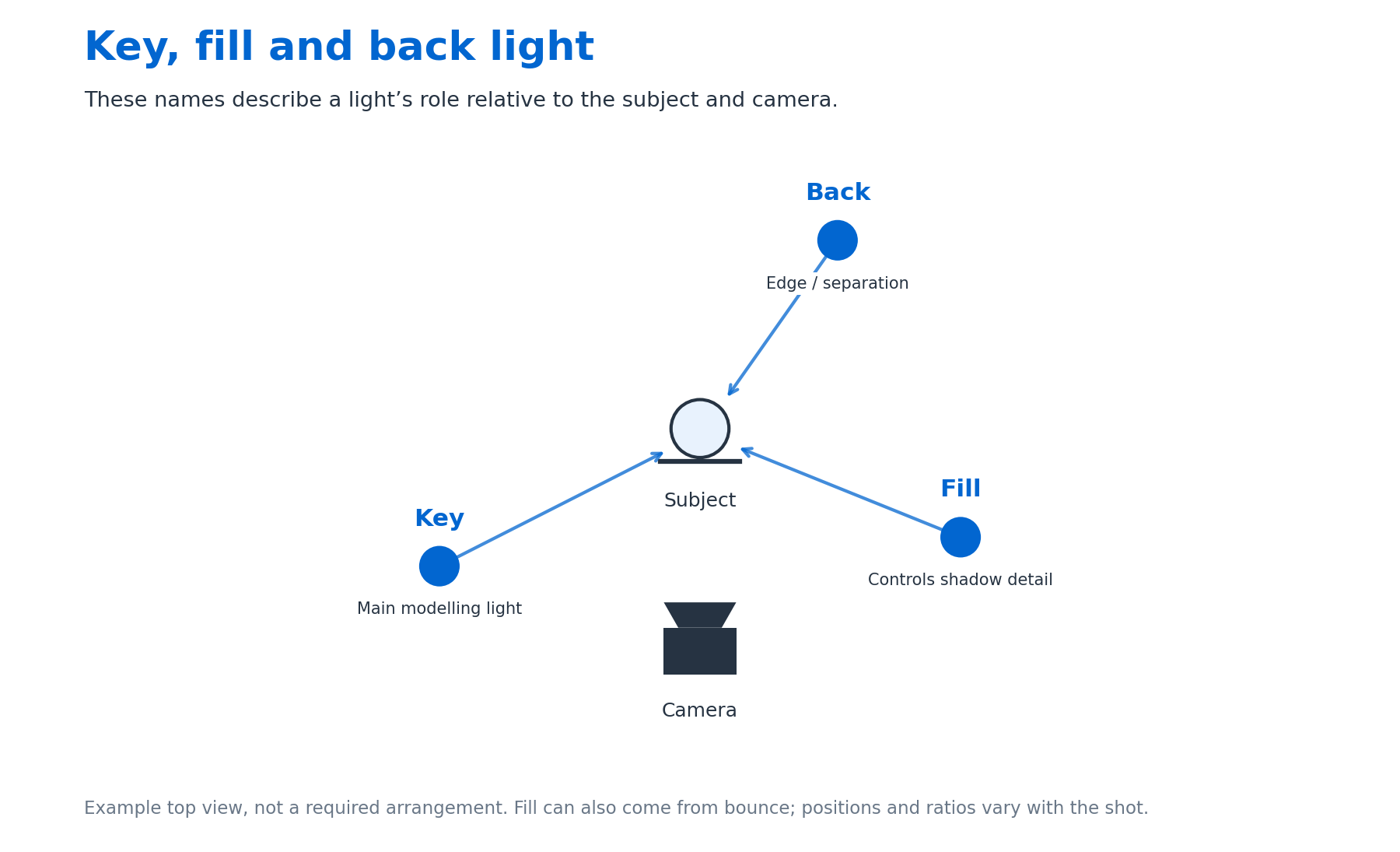
The key light is the principal light shaping a subject. It establishes the main direction of illumination and much of the scene’s modelling. A window, the sun, a practical or a film fixture can perform that role.
Choosing the key
Decide what motivates the light in the scene, then set its direction, size, height and level. The key may be hard or soft. It does not have to sit at a standard 45° angle, and it need not be the brightest object visible in the frame.
Working with fill
Once the key is established, judge how much detail remains on the shadow side. Fill can lift those shadows; negative fill can deepen them by reducing returning light. These changes affect contrast without necessarily changing the key’s softness.
Practical example
In an interview beside a window, the window may supply the key. A white board can return a little light into the opposite cheek, while a black solid can reduce that return. Both approaches preserve the window as the main lighting direction.
Related terms
Fill Light · Back Light · Negative Fill · Soft Light · Lighting Ratio · Incident Light Meter