
Last Updated 5 days ago
LA200Bi Overview
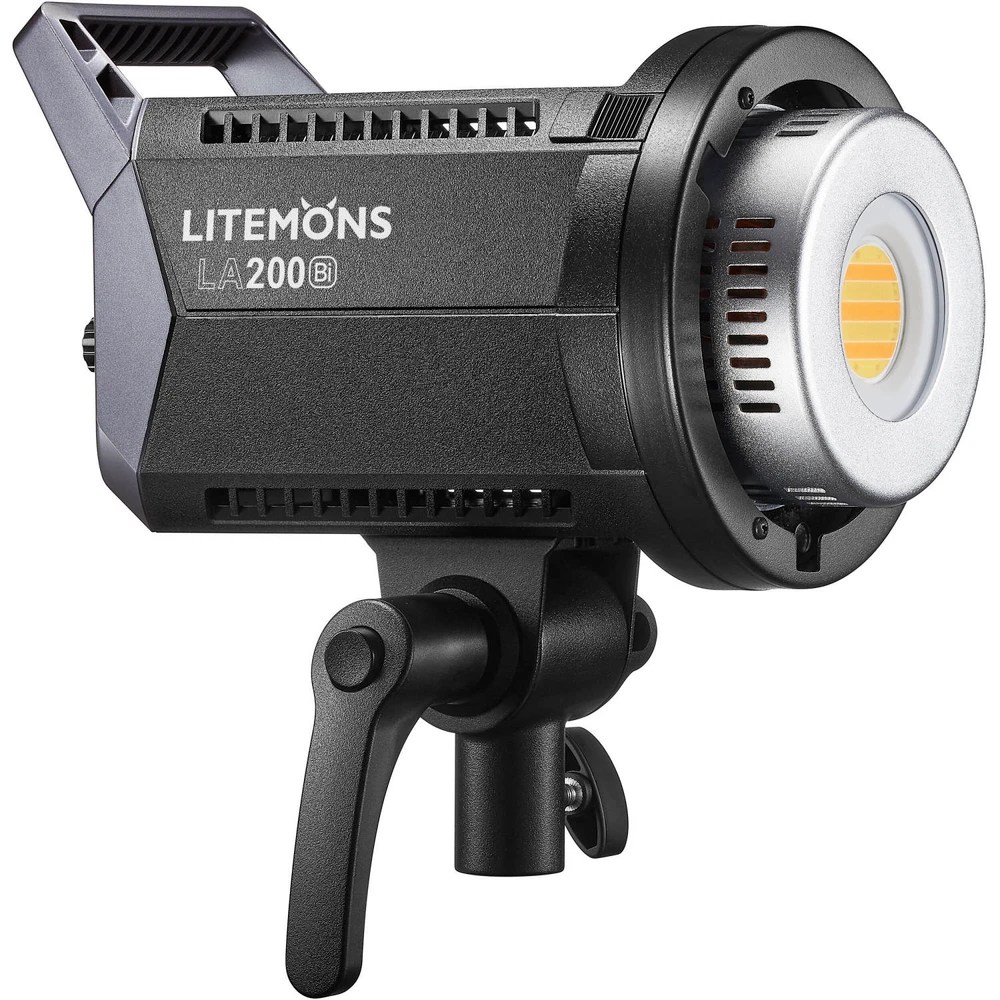
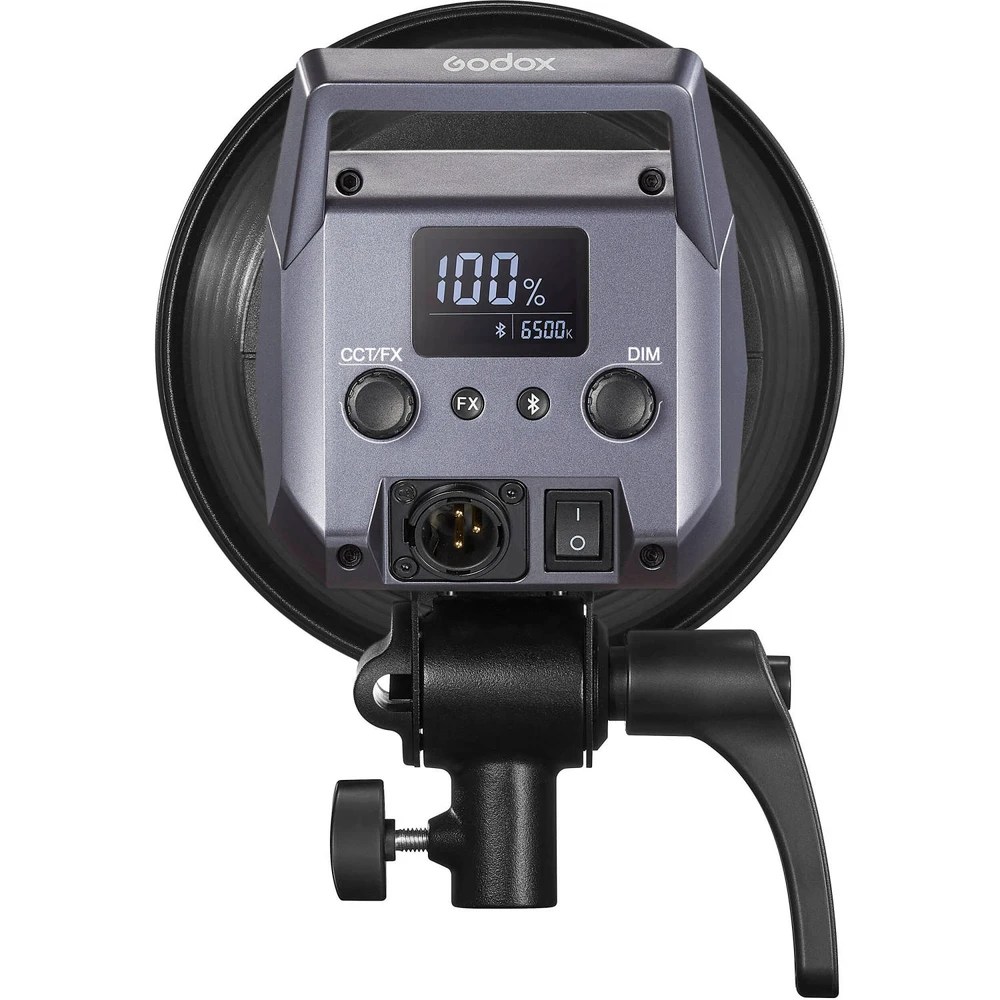
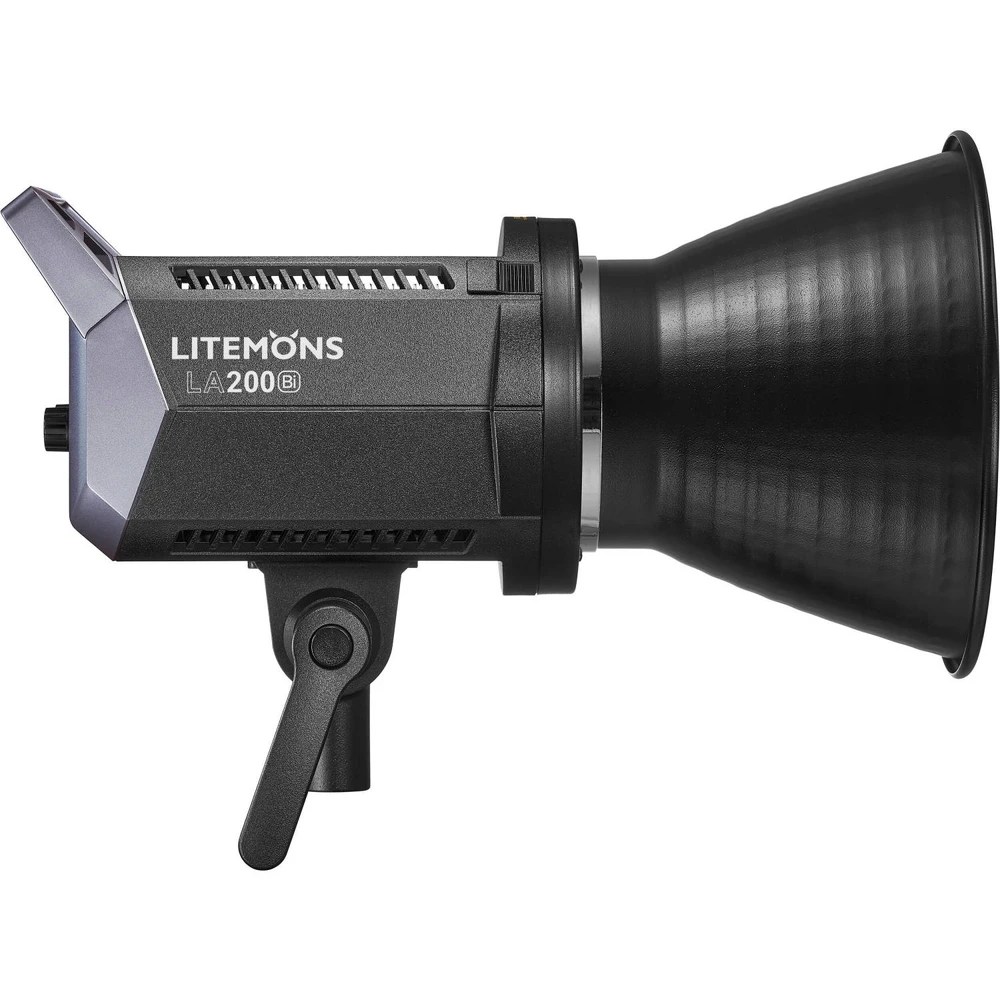
The Godox Litemons LA200Bi is a 2,800–6,500 K Bowens-mount COB with a 1.4 kg head and an external power supply. It suits interviews that move from daylight to tungsten during the day. At 3 m, with the supplied reflector, the published reading falls from 7,030 lux at 5,600 K to 4,340 lux at 3,200 K.
- TypeBi-colour COB with Bowens S mount
- Power230 W maximum. The external mains adapter supplies 48 V DC to the head.
- Colour Temperature2,800–6,500 K
- WeightApprox. 1.4 kg Head only; add the power supply and modifier.
- Beam AngleThe manual tabulates bare head and supplied reflector separately but does not identify an angle for those readings.
- IP RatingNot documented The linked manual does not specify a numeric IP rating. IP rating guide.
LA200Bi Specifications
| Specification | Details |
|---|---|
| Fixture | Bi-colour COB, Bowens S mount |
| Colour temperature | 2,800–6,500 K |
| Maximum power | 230 W (Godox manual) |
| Power connection | 48 V DC at the head via the external mains adapter |
| Colour rendering | CRI approx. 96, TLCI approx. 97 |
| Dimming and effects | 0–100%, 11 built-in effects |
| Control | Rear controls and Godox Light app over Bluetooth |
| Dimensions | 205 × 145 × 215 mm |
| Weight | Approx. 1.4 kg, fixture only |
Output Calculator
Select the published setup and a manufacturer distance, or enter a custom throw where supported. The results describe centre-beam output, not the brightness across the whole beam.
Camera Settings
If the calculator does not load, use the published photometric table or source on this page. JavaScript is required.
F-stop is a planning estimate, not a meter reading. It uses direct, on-axis illuminance and includes only the optics and diffusion named in the selected setup. Meter on set to account for lens transmission, filters, added diffusion, bounce, dimming and ambient light.
How the exposure estimate works
N = √(E × ISO × t / C), where E is illuminance in lux and t = shutter angle ÷ (360 × fps). The default C = 340 is a dome reference; C = 250 is a flat reference. These are calibration constants, not a measured T-stop. A small nonzero digit is tenths of a stop above the displayed full stop.
Distance estimates and comparisons
Published points are used as given. Between published points the calculator fits a curve through the two nearest readings. Outside those points it uses the inverse-square law only when the fixture’s dataset permits it. Distances outside a configuration’s supported range are reported separately. Comparisons use one shared distance and camera setup; equal lux does not imply equal coverage.
View published readings for the selected configuration
Strengths and Limitations
- Strength. The same light can match a warm interior, push into a daylight bounce, or settle between the two. Both the rear dial and the phone app can adjust it.
- Limitation. Available output varies with CCT. A tungsten-balanced setup needs more headroom if the key will pass through two layers of diffusion.
Practical Uses
| Setup | Placement |
|---|---|
| Interview moving from window light to practicals | Set the Kelvin value first, then check the key at the actor’s mark. Keeping the dimmer at the same percentage across both setups changes the exposure. |
| Mixed-colour practical set | Use the LA200Bi for the performer and leave the visible practical warmer. Switching the key to a slightly cooler white separates the face without adding saturated colour. |
Output and Colour
Godox measured the following configurations at full brightness. Each cell gives lux followed by the equivalent foot-candles, rounded to the nearest whole foot-candle.
| Configuration | 1 m lux / fc | 2 m lux / fc | 3 m lux / fc |
|---|---|---|---|
| 5,600 K · bare head | 6,970 / 648 | 1,870 / 174 | 937 / 87 |
| 5,600 K · supplied reflector | 79,200 / 7,358 | 16,800 / 1,561 | 7,030 / 653 |
| 3,200 K · bare head | 4,350 / 404 | 1,160 / 108 | 586 / 54 |
| 3,200 K · supplied reflector | 48,500 / 4,506 | 10,400 / 966 | 4,340 / 403 |
| 2,800 K · bare head | 3,570 / 332 | 951 / 88 | 478 / 44 |
| 2,800 K · supplied reflector | 39,300 / 3,651 | 8,440 / 784 | 3,550 / 330 |
| 4,300 K · bare head | 6,850 / 636 | 1,840 / 171 | 924 / 86 |
| 4,300 K · supplied reflector | 77,400 / 7,191 | 16,400 / 1,524 | 6,890 / 640 |
| 6,500 K · bare head | 5,630 / 523 | 1,510 / 140 | 774 / 72 |
| 6,500 K · supplied reflector | 64,300 / 5,974 | 13,600 / 1,263 | 5,670 / 527 |
At 2 m and 4,300 K the reflector gives 16,400 lux, close to its 16,800 lux at 5,600 K. Moving the same lamp down to 2,800 K gives 8,440 lux, almost a full stop less. Choose the colour temperature first, then check whether there is enough output left for diffusion.
Power and Batteries
The external supply feeds the head at 48 V DC. The operating manual lists a maximum of 230 W. For a mobile interview, include the power brick, its cable and a place to support it when the stand is raised. The standard head has no integral V-mount plate.
Control, Cooling and Camera Operation
The rear controls and the Godox Light app handle intensity and colour temperature. The fixture has 11 effects and an internal cooling fan. Check a dim fade and any effects through the production camera at its actual frame rate and shutter angle. For a quiet take, listen after the head has warmed up with the adapter in its working position.
Modifiers, Rigging and the Working Package
Set the Bowens accessory lock fully before tilting the fixture. With a lantern near a corner, a skirt or flag controls the wall return. With a softbox, its front diffusion becomes the effective light source, so take the final distance and exposure there.
Alternatives and Related Fixtures
| Related fixture | When to compare it |
|---|---|
| amaran 200x S | A comparable bi-colour Bowens light with amaran controls. |
| Godox KNOWLED M200Bi | A bi-colour alternative when a separate control box better suits the rig. |
What People Are Saying
Field Feedback at a Glance
What worked
- An event shooter used it as the main key in large reception rooms over six months. Nathan T., Adorama owner review.
- A portrait photographer found the Bowens mount held a variety of modifiers securely, including the Godox FLS8 Fresnel. Cary A., Adorama owner review.
- One owner ran it continuously for an hour and heard little increase in fan noise. John B., Adorama owner Q&A.
Drawbacks to plan for
- The event shooter could not run it directly from a V-mount battery and relied on venue AC. Nathan T., Adorama owner review.
- One owner found his existing umbrella shaft was too tight for the holder and had to force it. Bring the actual umbrella to prep rather than treating the holder as universal. Filippo N., Adorama owner review.
- A portrait shooter found that some deep Bowens adapters restricted the light spread inside the modifier. A shallower speed ring is worth testing before the job. Cary A., Adorama owner review.
Videos
TLDR Filmmaker compares the LA200Bi with the daylight LA200D using the same review setup: output at 1:17, colour chart at 1:59 and fan noise at 2:37. Watch the paired test on YouTube.
Rental and Used-Fixture Checks
Run the fixture at a warm setting and daylight, then fade slowly at each. Bring the chosen softbox to prep so you can check its tilt clearance and record the usable level at the actual distance.
Before You Book
- Confirm the 48 V adapter, AC lead and supplied reflector are in the case.
- Fit the intended softbox or umbrella and check the tilt, mount and usable level at the working distance.
- Run both colour-temperature extremes, check a slow fade and record a sound test at the intended microphone position.
Documentation and Specifications
- Godox operating manual and illuminance tables (PDF)
- Godox series specifications
- Godox USA product photographs and kit listing
Browse Godox lights · COB lights · all equipment.