
Last Updated 5 days ago
Hornet 200-C Overview
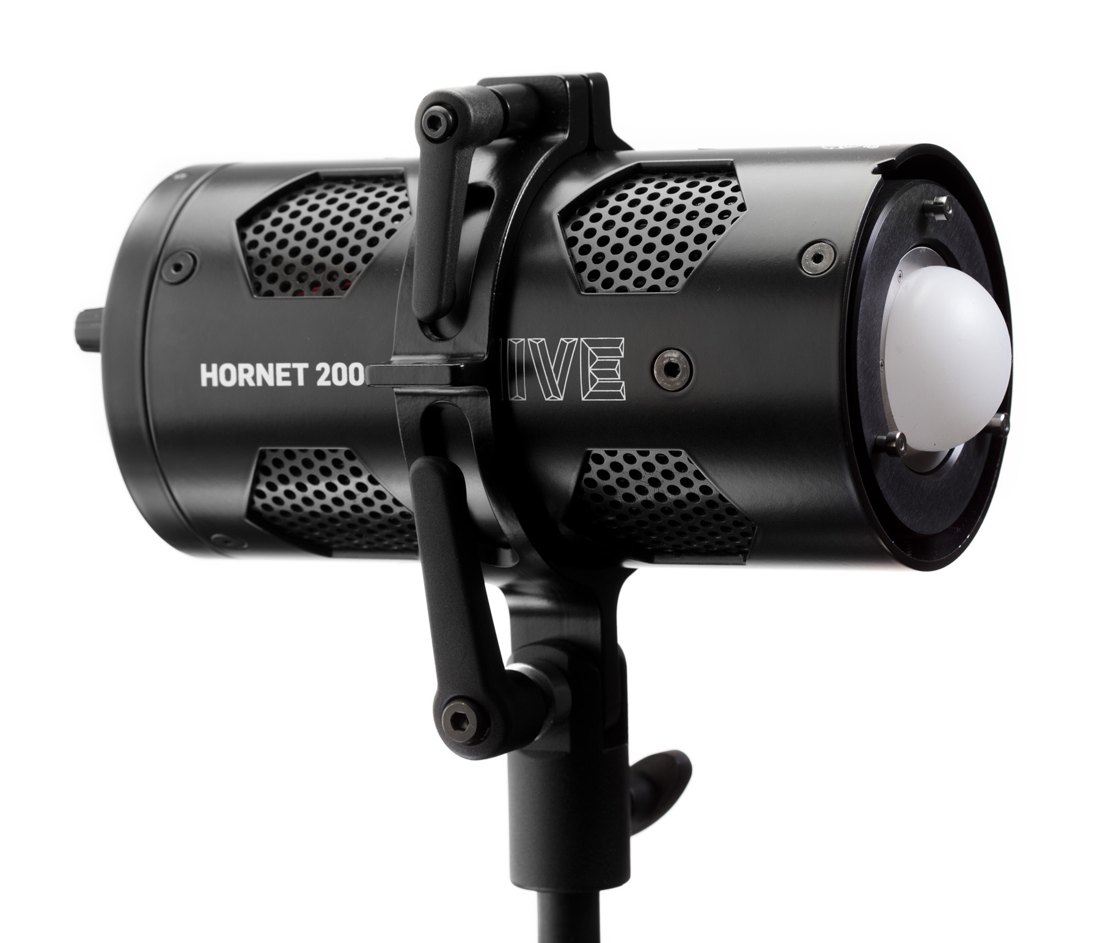
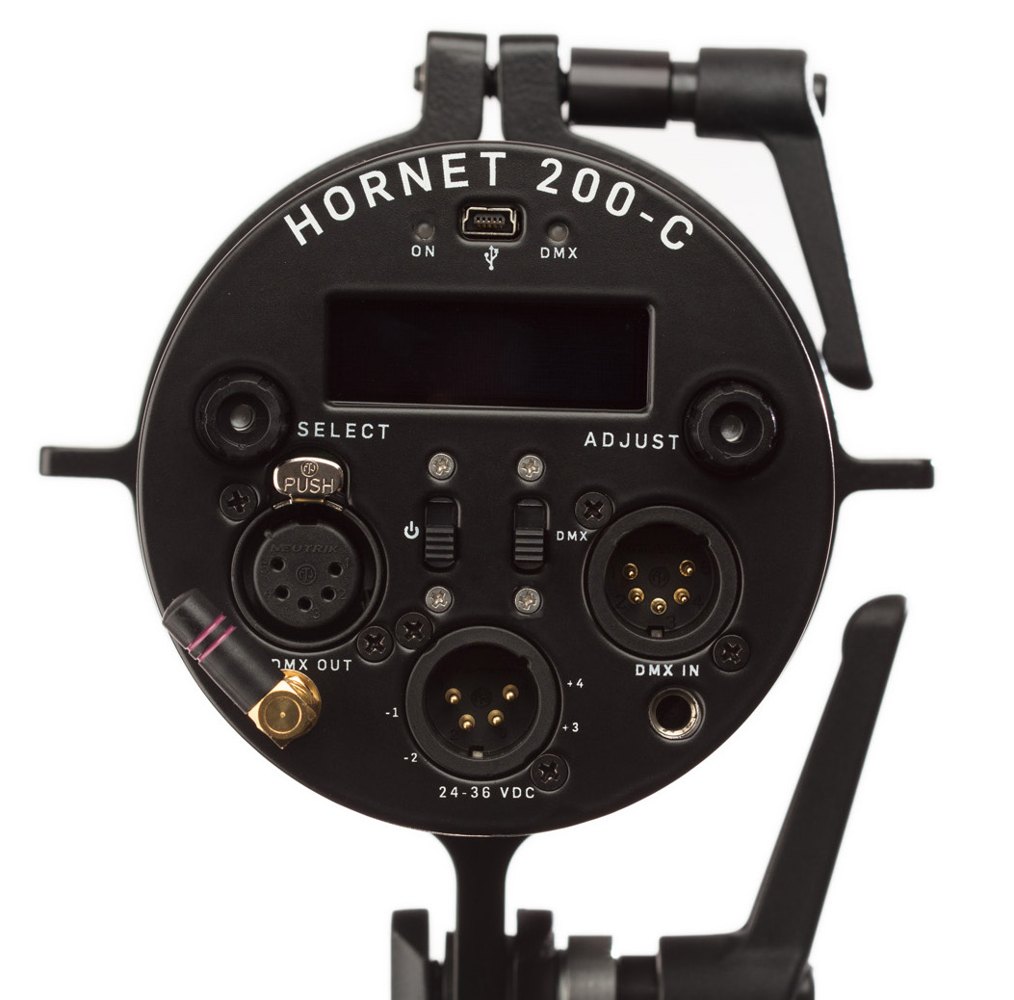
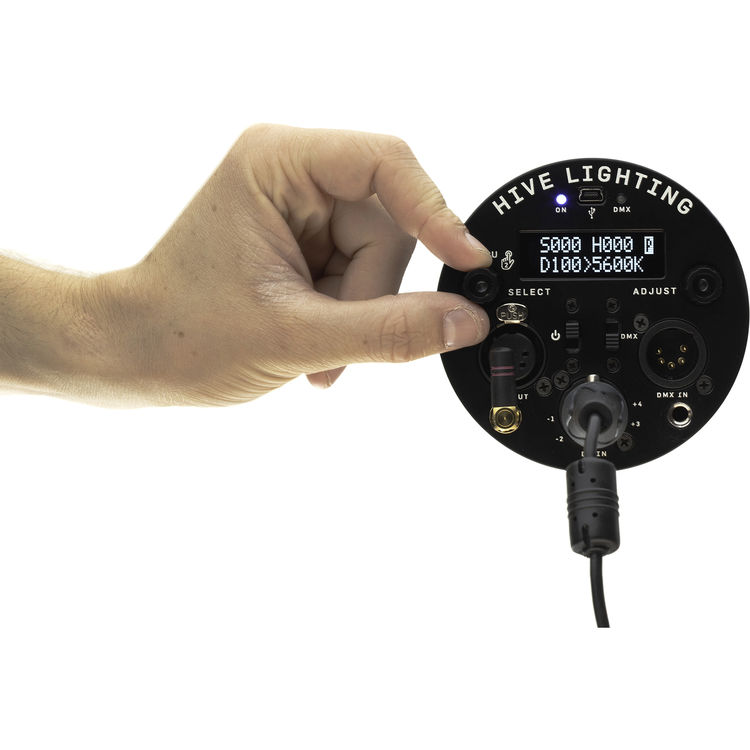
The Hornet 200-C puts Hive’s multichannel colour engine in a 1.2 kg head.
Its higher DC voltage is an important difference from the Wasp 100-C when preparing a battery kit.
- Omni-Color LED Hive colour engine; seven emitter colours.
- Power 150 W; 24–36 V DC via XLR.
- Colour Temperature1,650–8,000 K Tunable white and saturated colour.
- Weight 1.2 kg head per Hive’s data sheet; Hive and Profoto modifiers.
- Beam Angle Open face with removable reflectors; beam angle depends on the optic.
- IP RatingNot published No outdoor weather rating verified. Read the IP Rating.
Hornet 200-C Specifications
| Specification | Details |
|---|---|
| Manufacturer and model | Hive Lighting Hornet 200-C |
| Source or rated power | 150 W colour-tunable LED |
| Optics, colour or format | 1,650 to 8,000 K |
| Head or system detail | 24 to 36 V DC, 1.2 kg |
The calculator uses Hive’s single chart, from 2.5 to 20 ft (about 0.76–6.10 m). Hive does not identify the optic or colour temperature, so use the readings as a planning estimate rather than as output for a particular reflector.
Output Calculator
Select the published setup and a manufacturer distance, or enter a custom throw where supported. The results describe centre-beam output, not the brightness across the whole beam.
Camera Settings
If the calculator does not load, use the published photometric table or source on this page. JavaScript is required.
F-stop is a planning estimate, not a meter reading. It uses direct, on-axis illuminance and includes only the optics and diffusion named in the selected setup. Meter on set to account for lens transmission, filters, added diffusion, bounce, dimming and ambient light.
How the exposure estimate works
N = √(E × ISO × t / C), where E is illuminance in lux and t = shutter angle ÷ (360 × fps). The default C = 340 is a dome reference; C = 250 is a flat reference. These are calibration constants, not a measured T-stop. A small nonzero digit is tenths of a stop above the displayed full stop.
Distance estimates and comparisons
Published points are used as given. Between published points the calculator fits a curve through the two nearest readings. Outside those points it uses the inverse-square law only when the fixture’s dataset permits it. Distances outside a configuration’s supported range are reported separately. Comparisons use one shared distance and camera setup; equal lux does not imply equal coverage.
View published readings for the selected configuration
Strengths and Limitations
- A 1.2 kg head is easy to position with the power supply kept elsewhere.
- Its DC requirement rules out a straightforward swap with a lower-voltage Wasp battery setup.
Practical Uses
Use the head with a reflector for a saturated accent across a larger set, or fit a softbox when working closer. The front accessory determines how hard the shadow looks.
Output and Colour
Hive supplies these foot-candle readings without identifying the precise optic or CCT in the chart. Treat the figures as a reference for that published setup.
| Configuration | Distance | Lux | Foot-candles |
|---|---|---|---|
| Hive chart · optic and CCT unspecified | 2.5 ft (0.762 m) | 47,361 | 4,400 |
| Hive chart · optic and CCT unspecified | 5 ft (1.524 m) | 11,840 | 1,100 |
| Hive chart · optic and CCT unspecified | 10 ft (3.048 m) | 2,960 | 275 |
| Hive chart · optic and CCT unspecified | 15 ft (4.572 m) | 1,324 | 123 |
| Hive chart · optic and CCT unspecified | 20 ft (6.096 m) | 753 | 70 |
Photometric source and test conditions.
The manufacturer prints these five readings at 2.5, 5, 10, 15 and 20 ft. Metric distances are exact unit conversions, and lux values are converted from the printed foot-candles. The calculator is restricted to 2.5–20 ft (0.762–6.096 m); intermediate values are estimates, not additional factory measurements. The chart does not specify CCT, dimmer setting or test supply.
Power and Controls
The Hornet uses a 24 to 36 V DC input and a separate AC supply. Local, wired DMX and app control support single-head and multi-light setups.
Control, Cooling and Camera Operation
Hive shows separate wired DMX and CRMX setup paths on the Hornet 200-C. If one head shows as two devices in the app, Hive identifies them as the two internal modules; follow its merge procedure and test that both respond. Hive’s Hornet app troubleshooting guide · Hive’s Hornet DMX walkthrough.
Modifiers, Rigging and the Working Package
The head accepts a family of reflectors, lenses and photo modifiers. Hive’s short output chart does not identify a colour temperature or precise optic.
Alternatives and Related Fixtures
For the smaller Hive fixture, see the Hive Lighting Wasp 100-C.
For a higher-output colour COB, see Aputure LS 600c Pro (Original).
What People Are Saying
Field Feedback at a Glance
These are operator accounts hosted by Adorama, not retailer specifications or controlled tests.
What worked
- On a MINI Cooper commercial, Eric A. used DMX to dial in colour and saturation and reported smooth crossfades without colour spikes. Eric A., customer review.
- Matt P. saw a clean single shadow and found the narrow reflector useful for getting more throw. Matt P., customer review.
- Jonathan M. used several optical options on the same light, including a Fresnel, an ETC Source Four Mini attachment and a PAR reflector. Jonathan M., customer review.
Drawbacks to plan for
- Matt P. found saturated colours visibly dimmer, with the drop varying by colour. Meter the actual colour cue. Matt P., customer review.
- One operator didn’t get enough output for their portrait key through a softbox. Their review doesn’t specify the distance or modifier. Customer review, February 2021.
- The same reviewer found the app didn’t resize to fit their iPad screen in 2021 and preferred using a phone. Customer review, February 2021.
Videos
At the Bench: Hive Hornet 200-C Light
Rental and Used-Fixture Checks
Before You Book
- Package: Confirm it is a Hornet 200-C; the Hornet 200-CX is a different version. Verify the accessory.
- Power: Verify the 24 to 36 V supply.
- Control: Verify the control profile.