
Last Updated 14 hours ago
Overview
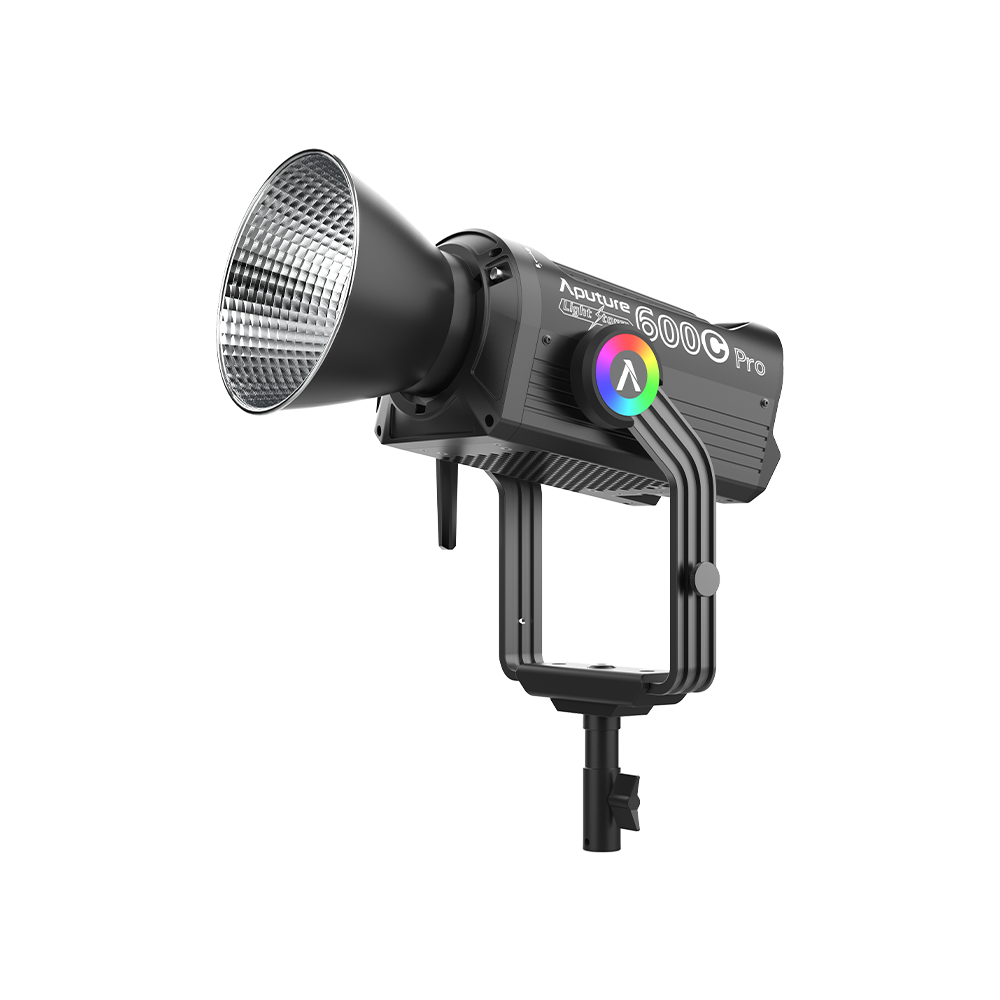
The Aputure LS 600c Pro is a 600 W RGBWW point-source LED with a Bowens accessory mount and separate control box. It combines full-colour control with a fixture format suited to reflectors, Fresnels, softboxes, lanterns and supported projection accessories. It can work as hard light, feed a bounce or become a larger soft source through a modifier.
The original LS 600c Pro is discontinued and was superseded by the LS 600c Pro II. The two generations have different emitter designs, optical performance and weather specifications. Confirm the generation when specifying a rental or comparing a used package.
Key specifications
| Specification | Details |
|---|---|
| Engine | RGBWW point-source LED |
| Maximum LED output / draw | ≤600 W / ≤720 W |
| CCT range | 2300–10000 K |
| Published colour metrics | CRI ≥95; TLCI ≥98; SSI D56 74, D32 85 |
| Accessory mount | Bowens; verify the particular optical modifier’s compatibility |
| AC input | 100–240 V; published operating-current rating 8 A |
| External DC input | 48 V / 15 A through the specified 3-pin XLR input |
| Battery plates | V-mount or Gold Mount package; supported voltage and current capability must match |
| Head with yoke mass | 5.86 kg |
| Control-box mass | 5.21 kg |
| Head with yoke dimensions | 453 × 267 × 150 mm |
| Control-box dimensions | 366 × 197 × 156 mm |
| Control routes | Local, Sidus Link, DMX/RDM, CRMX and Ethernet control as documented |
| Fan modes | Smart, High, Medium and Silent; the original manual limits Silent to 60 W maximum |
| Operating temperature | −20 to 45°C |
| Weather description | Weather resistant; follow original-model rain/tilt instructions, not a later model’s rating |
Strengths and limitations
Strengths
- RGBWW combines a wide white range, tint adjustment and saturated colour in one head.
- Bowens accessories let the head serve hard, soft and supported optical roles.
- CRMX, DMX/RDM and Ethernet fit console-controlled packages.
Limitations
- White-light output is lower than the daylight 600d Pro in comparable uses.
- Fresnel efficiency and colour can change with the optic; front-heavy combinations need substantial support.
- A separate heavy controller and demanding battery requirements add to the working kit.
Practical uses
The same head can supply a relatively hard reflector beam, a focused Fresnel field or a larger source inside a softbox. Select the optical arrangement for the required field and shadow character before comparing maximum output. A reflector reading is not the exposure available after a lightbank, diffusion or bounce.
Aputure’s original-model compatibility FAQ discusses the LS 600/1200 reflectors and F10 Fresnel. Check the approved combination for projection optics and other attachments. The Bowens interface alone does not guarantee uniform illumination, suitable thermal performance or enough mechanical support for every modifier.
| Setup | Working approach |
|---|---|
| Interview key | Use a supported softbox close to the subject and choose the fan mode before metering the setup. |
| Window effect | Use the appropriate reflector or Fresnel to cover the desired area, then meter after any curtain or diffusion. |
| Mixed-colour interior | Match CCT and tint to existing sources or use a gel preset as the starting point for a camera check. |
| Colour cue | Set output mode, control profile and signal-loss behaviour before programming the change. |
Output and colour
Aputure’s original LS 600c Pro chart identifies the modifier as well as CCT and distance. The Hyper Reflector below is the listed LS 600 reflector, not the much narrower BM1215. A larger centre number can result from concentrating the beam; it does not establish equal coverage or an equal softbox result.
| Configuration at 5600 K | At 3 m | At 5 m |
|---|---|---|
| Bare head | 1,937 lux | 817 lux |
| LS 600 Hyper Reflector | 5,020 lux | 1,889 lux |
| F10 Fresnel, flood | 3,320 lux | 1,254 lux |
| F10 Fresnel, spot | 7,440 lux | 3,010 lux |
The RGBWW engine provides tunable white and saturated colour. Use CCT and green/magenta adjustment for matching other white sources, and the appropriate HSI, RGB or xy workflow for a creative colour cue. High CRI and TLCI are useful context but do not describe every saturated setting or every camera response.
The configuration guide distinguishes Constant Output from Max Output. Constant Output is intended to keep brightness steadier through a CCT change; Max Output allows available brightness to vary with the setting. Record that choice when taking meter readings or building a cue so another operator can reproduce the result.
Tests and reviews
In Matthew Allard’s original-model test, the 600c Pro at 5600 K with its Hyper Reflector recorded extended CRI 95.14, TLCI 98 and R12 blue reproduction of 78.6. The bare source and F10 configurations shifted measured CCT. The modifier is therefore part of both the output and colour result.
Power and batteries
Size the complete electrical arrangement for the published 720 W maximum draw, not only the 600 W LED-output label. Use the correct AC supply or the specified 48 V / 15 A DC input arrangement. Correct voltage, connector pin assignment, cable current rating and supply capacity all matter; a physically fitting XLR plug is not proof of compatibility.
Aputure’s current Full Battery Power guidance says each of the two batteries must support 360 W continuous output for the fixture to meet its 720 W input requirement. This is a demanding battery configuration, not a promise that ordinary camera batteries provide full output. Confirm compatible batteries, firmware, plate rating and the actual available output before relying on a battery setup.
The control box can charge batteries, but the original manual imposes intensity limits when charging and lighting simultaneously, with limits varying by dimming curve. Specify whether the box is lighting, charging or doing both; do not treat it as a full-output light and unrestricted charger at the same time.
Control, cooling and camera operation
The original manual identifies Smart, High, Medium and Silent fan settings and states that Silent disables the fans while limiting output to 60 W maximum. That is a major operating difference from the head’s 600 W class. A quiet dialogue setup should be metered and checked at the selected fan mode, not planned from a full-output chart.
Keep ventilation clear and allow room for both the head and control box to dissipate heat. Placing the controller outside a sensitive microphone area may help, provided the approved cable arrangement and support remain suitable. Test the noise at the intended intensity and ambient temperature.
The head supports professional control alongside Sidus Link. The original manual treats Bluetooth, CRMX and Ethernet as selectable remote systems, with one of those systems active at a time. Choose the required route, addressing and DMX profile before programming rather than assuming every control network merges automatically.
Set signal-loss behaviour deliberately: the configuration guide includes hold, blackout and fade choices. Match the fixture profile to firmware and verify the transition on the camera. Frequency adjustment can help with camera artefacts, but the final shutter/frame-rate combination still needs a practical test.
Modifiers, rigging and the working package
The original 600c Pro uses a standard Bowens mount. Aputure’s compatibility FAQ covers the F10 and LS 600/1200 reflectors. Confirm the exact approved projection accessory and support heavy optics independently where required. The head’s RGBWW emitter layout differs from the daylight and bi-colour LS 600 models, so an accessory’s gain does not transfer automatically.
Alternatives and related fixtures
| Fixture | Choose it for |
|---|---|
| Aputure LS 600d Pro | Higher daylight output when saturated colour and CCT tuning are unnecessary. |
| Aputure LS 600x Pro | Bi-colour white-light work within the Light Storm ecosystem. |
| Aputure LS 600c Pro II | A separate generation with a redesigned emitter and different modifier performance. |
What people are saying
Matthew Allard: versatile colour, with an output and rigging compromise
Allard’s Newsshooter review found the original 600c Pro well built and flexible, especially for CCT and tint adjustment. He preferred the 600d Pro for maximum punch and flagged the front-heavy F10 combination and audible cooling as points to plan around.
Graham Sheldon: a frequently used key during several weeks of testing
In his CineD review, Graham Sheldon reports that crews repeatedly reached for the original 600c Pro as a key. He valued being able to try different colour looks quickly through Sidus or wireless DMX in controlled ambient light, while retaining daylight or bi-colour fixtures for jobs requiring more output.
Videos
Gaffer & Gear 190: original LS 600c Pro
A review of the original RGBWW Bowens-mount model.
Meet The Gaffer 264: LS 600c first look
A first look at the original fixture and its place in a working lighting package.
Rental and used-fixture checks
The head and controller together are roughly eleven kilograms before cables and modifiers. Support the control box and relieve cable strain; do not let a heavy controller hang by its connector. Inspect the seven-pin head cable, locking connectors, yoke, mount, LED protection and cooling paths before use.
Follow the original rain and tilt instructions, and protect the whole power/data arrangement appropriately. Do not assign the Pro II’s weather classification or output to this head. For a used package, verify the exact controller, correct head cable, reflector, battery version and fan operation, then test colour and output with an identified modifier.
The LS 600d Pro and LS 600x Pro are useful comparisons when daylight or tunable white is sufficient. The original 600c Pro’s reason to choose it is its full-colour point-source capability and complete modifier/control package.
Check the original-model identification on both head and controller, the seven-pin head cable, control-box clamp and reflector. Test fan modes, full colour, dimming and the intended control path, then inspect connector locks, battery plates and the Bowens latch. A low-output test alone will not reveal every power or cooling problem.
Documentation and specifications
Original 600c Pro technical specifications, operating manual, current configuration and battery guidance and original-model accessory FAQ.
Product photograph: Aputure.
Browse Aputure lights · COB lights · all equipment.