
Last Updated 21 hours ago
Compact 2500 Overview
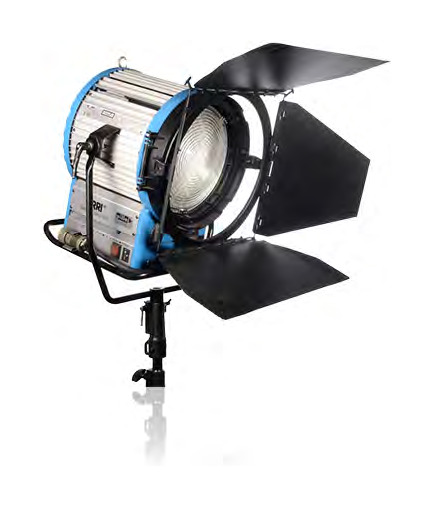


The ARRI Compact 2500 is a single-ended 2.5 kW daylight HMI Fresnel with a 250 mm lens and a 7°–59° published beam range. It is not the separate Compact 2500 Theater model.
The standard head takes a G38 lamp and requires a compatible 2.5 kW ballast and matching head cable. ARRI’s earlier brochure and later manual list different head weights, so confirm the weight of the actual unit before rigging.
- Fixture Type 250 mm HMI Fresnel
- Power 2,500 W G38 plus matched ballast
- Colour Temperature 6,000 K nominal daylight class
- Weight 14.8 kg in 2013 instructions; 16.8 kg in earlier brochure
- Beam Angle 7°–59° published focus
- IP Rating IP23 Check the exact head and connected package. Read the IP Rating Guide.
Compact 2500 Specifications
| Specification | Details |
|---|---|
| Model / ordering reference | L0.73670.B / L0.73675.B manual versions |
| Lamp / base | HMI 2500 W/SE / G38 |
| Nominal lamp circuit | 115 V; ballast mains input is separate |
| Nominal colour | 6,000 K daylight class in the period ARRI brochure |
| Optic | 250 mm Fresnel lens |
| Published focus range | 7° to 59° |
| Dimensions (H × W × L) | 500 × 487 × 387 mm |
| Head weight | 16.8 kg in the 2005 brochure; 14.8 kg in the 2013 instructions |
| Mount | 28 mm junior spigot |
| Documented ballast families | EB 2.5 kW, EB 2.5/4 kW, or compatible period 2500 W choke ballast |
| Protection | Class I / IP23 |
| Safety distances / tilt | 1 m to flammable objects, 8 m to illuminated surfaces and ±90° tilt in the 2013 instructions. |
| Status | Discontinued |
The Lexicon divides lamp wattage by a convenient supply voltage. That is not the lamp circuit and does not establish ballast input current. Plan distribution from the actual ballast nameplate and manual.
Output Calculator
Select the published setup and a manufacturer distance, or enter a custom throw where supported. The results describe centre-beam output, not the brightness across the whole beam.
Camera Settings
If the calculator does not load, use the published photometric table or source on this page. JavaScript is required.
F-stop is a planning estimate, not a meter reading. It uses direct, on-axis illuminance and includes only the optics and diffusion named in the selected setup. Meter on set to account for lens transmission, filters, added diffusion, bounce, dimming and ambient light.
How the exposure estimate works
N = √(E × ISO × t / C), where E is illuminance in lux and t = shutter angle ÷ (360 × fps). The default C = 340 is a dome reference; C = 250 is a flat reference. These are calibration constants, not a measured T-stop. A small nonzero digit is tenths of a stop above the displayed full stop.
Distance estimates and comparisons
Published points are used as given. Between published points the calculator fits a curve through the two nearest readings. Outside those points it uses the inverse-square law only when the fixture’s dataset permits it. Distances outside a configuration’s supported range are reported separately. Comparisons use one shared distance and camera setup; equal lux does not imply equal coverage.
View published readings for the selected configuration
Strengths and Limitations
| Strengths | Limitations |
|---|---|
| Focusable, even daylight field; complete manufacturer spot, middle and flood data; conventional accessories and serviceable construction. | Separate ballast and high-voltage head cable; hot single-ended discharge lamp; dated connector variants; discontinued head and accessory system. |
Practical Uses
| Setup | Working approach |
|---|---|
| Hard daylight key | Select focus for the required pool, then meter the subject rather than relying on centre output alone. |
| Window or exterior fill | Use spot or middle when throw matters and control spill with the retained barndoor. |
| Bounce or diffusion | Use flood to cover the modifier evenly, then meter after transmission or reflection loss. |
The front and rear focus controls move the source through the Fresnel system. Do not use the lens door, accessory latch or cable as a handling point.
Output and Colour
The period ARRI Daylight Compact brochure publishes all nine measurements for this exact 2,500 W head. ARRI states that the data follow ESTA practice and are normalised to nominal lamp lumens.
| Distance | Spot 7° | Middle 30° | Flood 59° |
|---|---|---|---|
| 8 m | 26,328 lux / 1 m | 4,375 lux / 4.3 m | 2,004 lux / 9.1 m |
| 12 m | 11,701 lux / 1.5 m | 1,944 lux / 6.4 m | 891 lux / 13.6 m |
| 16 m | 6,582 lux / 2 m | 1,094 lux / 8.6 m | 501 lux / 18.1 m |
Distance Limits: ARRI’s November 2013 Compact operating instructions specifies 8 m minimum to illuminated surfaces. This control is conservatively restricted to the retained published distances, 8–16 m; values between those distances are interpolations, not additional manufacturer measurements. No output is extrapolated outside that interval. Follow the instructions and nameplate for the exact head in use.
The historical table retains all nine documented centre readings; the calculator uses only the readings within the distance limits above. Beam diameter is shown for coverage planning and does not change the exposure calculation.
Power and Batteries
This head uses EB 2.5 kW, EB 2.5/4 kW, or compatible period 2500 W choke ballast. Confirm lamp wattage, lamp base, ballast setting, head connector and cable as one package. The 115 V figure describes the lamp circuit, not the supply outlet.
The HMI ballast and head-cable reference separates ARRI electronic and magnetic variants. Use the selected ballast input range, rated current, power factor, frequency mode and protective-device instructions for distribution.
Control, Cooling and Camera Operation
The head has manual focus knobs at front and rear. Keep ventilation clear and use the ballast’s documented camera mode if it has one. Check exposure at the actual frame rate and shutter; no head-only specification guarantees flicker-free operation. Observe ARRI’s minimum clearances and let the unit cool before handling the lamp or lens assembly.
Modifiers, Rigging and the Working Package
ARRI documents 1 m to flammable objects, 8 m to illuminated surfaces and ±90° tilt in the 2013 instructions. Operate only with an intact Fresnel, reflector, wire guard or safety glass, lens-door latch and interlock. Keep ventilation open and cables away from the housing.
Support the head, barndoor, filter frame, cable pull and modifier as one load. Use properly rated primary support and secondary retention. A cracked lens, dull reflector, brittle internal lamp lead, heat-damaged connector or unreliable latch removes the head from service.
Alternatives and Related Fixtures
| Fixture | Why compare it |
|---|---|
| ARRI True Blue D5 | A much smaller 575 W daylight Fresnel for lower load where a 2.5 kW head is unnecessary. |
| ARRI M8 | A smaller lensless 800 W MAX-reflector head with a different beam character, not an output substitute for this 2.5 kW Fresnel. |
| ARRI Compact family | Compare the surrounding wattages, lens sizes, support loads and ballast packages. |
What People Are Saying
Field Feedback at a Glance
The 2005 ARRI brochure and 2013 ARRI operating instructions document the original Compact 2500 head. The points here are model-specific working characteristics and limits, not independently reported owner reactions.
What worked
- Strong narrow daylight: the 7° spot measures 26,328 lux across a published 1 m beam diameter at 8 m.
- A wide option from the same lens: at 8 m ARRI reports a 9.1 m beam diameter at 59° flood for lighting a much larger target.
- Model-specific front control: ARRI lists the L2.80950.0 barndoor and L2.80970.0 diffuser frame for this 250 mm Fresnel.
Drawbacks to plan for
- Plan the throw around the manual: ARRI lists an 8 m minimum to illuminated surfaces and a 1 m clearance from combustible objects.
- Use the actual lifting weight: the 2005 brochure quotes 16.8 kg while the 2013 manual lists 14.8 kg. Weigh or confirm the supplied head, lens, doors and cable pull when selecting support.
- The 115 V lamp-circuit figure is not a wall-input rating. Verify the exact compatible 2.5 kW ballast, cable and supply before the shoot.
Videos
The ARRI Compact operating instructions show the manual-focus controls, front retainer and safety features and include a separate 2500 W specifications row. For the standard non-Theater head, use the matching Daylight Compact brochure table. The common manual does not make Theater-model photos or photometry interchangeable.
Rental and Used-Fixture Checks
Read the nameplate before accepting the package. Record the exact head variant, lamp, ballast model, connector and cable. Inspect lamp contacts, lens, reflector, focus travel, interlock, yoke, mount and accessory retention, then test cold start, stable output, hot restrike and the intended camera mode.
Documentation and Specifications
Official ARRI Compact archive · ARRI Daylight Compact brochure · ARRI operating instructions · ARRI Compact certification.
Product photograph: ARRI product photograph reproduced in the Lexicon Carbone source document for model identification.
Browse ARRI lights · HMI lights · all equipment.