
Last Updated 22 hours ago
Overview
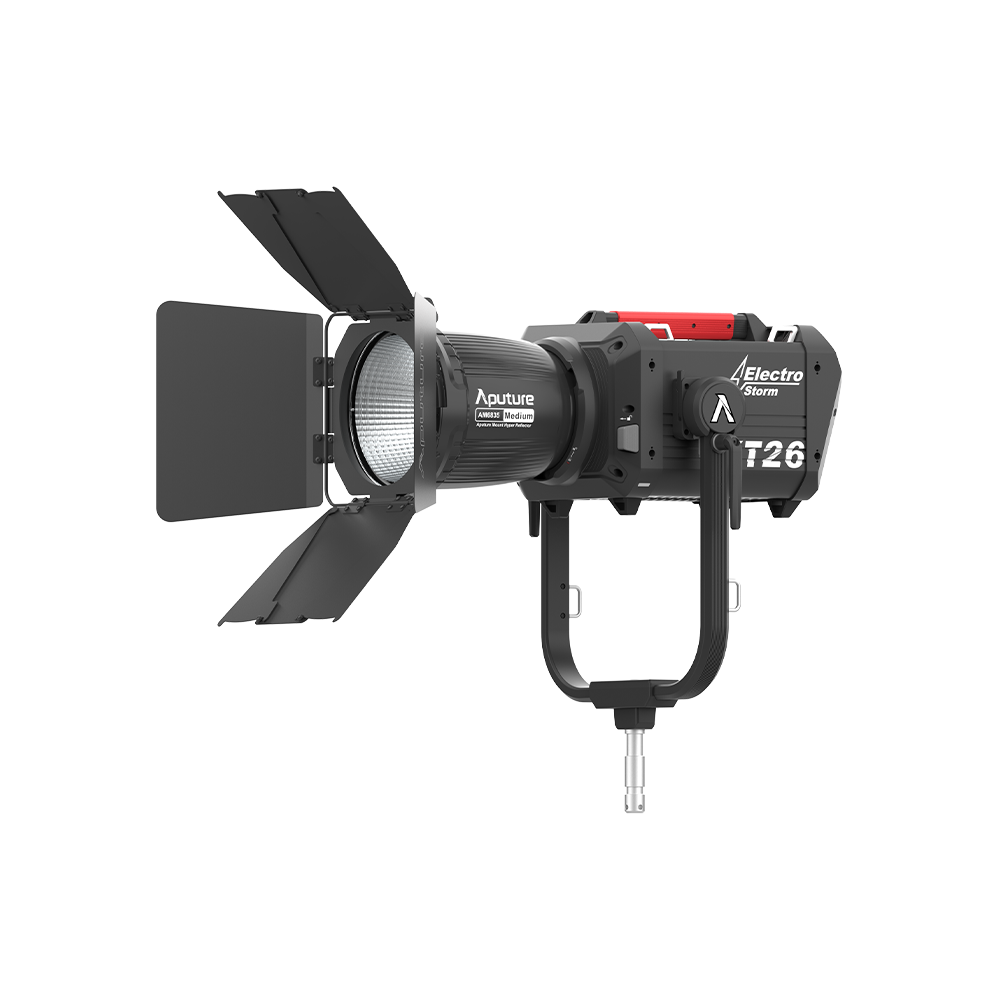
The Aputure Electro Storm XT26 is a high-output tunable-white point-source LED with 2,700–6,500K CCT control and green–magenta correction. Dual Bowens and electronic Aputure mounts support a range of large optics. Its 2,600W LED rating is separate from the 3,500W maximum electrical input.
The XT26 prioritizes white-light intensity over full-colour mixing. It is a large production package that needs appropriate distribution, support and space for the controller and cable.


Select a photograph to view it at full size.
Key specifications
| Specification | Details |
|---|---|
| Light type | Tunable-white point source with tint adjustment |
| CCT | 2,700–6,500K |
| Maximum electrical input / LED output | 3,500W / 2,600W |
| AC input | 100–240V, 50/60Hz |
| DC interfaces | Dual 48V DC inputs; supply capability and operating limits depend on configuration |
| Colour references | CRI 97 / TLCI 98 |
| SSI tungsten / D56 | 84 / 73 |
| Native / Aputure reflector options | 62° native; 20°, 35° and 50° reflectors |
| Accessory interfaces | Bowens plus electronic Aputure Mount |
| Bare head / manual yoke / controller | 18kg / 3.2kg / 20.5kg |
| Weather protection | IP65 |
| Controls | Onboard, Sidus Link, DMX/RDM, internal CRMX, Art-Net/sACN |
Technical reference: Aputure product information and downloads.
Strengths and limitations
Strengths
- High white-light intensity with CCT and green–magenta correction.
- Dual accessory interfaces support approved Bowens modifiers and electronic Aputure Mount optics.
- Remote-control options extend to the optional motorized Fresnel and yoke.
Limitations
- The controller and optics make this a cart-and-distribution package rather than a lightweight interview light.
- Full-power operation needs more current than a common 120V/20A branch circuit can supply.
- Large fans and cooling modes need checking with the sound department.
- White-light tuning does not provide the saturated colours available from the CS15.
Practical uses
| Setup | Working approach |
|---|---|
| Distant daylight through a window | Use the reflector or F14 for the required throw and beam width. Test exposure after adding nets, glass or diffusion. |
| Large daylight bounce | Fill the whole bounce rather than concentrating all output into one hot centre patch. Control unintended room spill from the bounce itself. |
| Warm practical motivation | Set CCT and tint against the practicals and camera, then establish the level at the selected warm setting. |
| High-mounted studio source | Keep the controller accessible and use the correct remote Fresnel or yoke personality for repeatable cues. |
Output and colour
The supplied 35° reflector is one optical configuration. The 20° optic concentrates more light into a smaller beam, while the 50° reflector spreads it more widely. Compare the same optic, distance, CCT and fan/output mode when ordering alternatives.
Published HMI or tungsten equivalence is a manufacturer comparison, not a guarantee that every beam spread and modifier will match. For the shot, establish useful coverage and exposure through the final optical package.
| CCT | Distance | Bare (lux) | 50° (lux) | 35° (lux) | 20° (lux) |
|---|---|---|---|---|---|
| 3,200K | 3m | 8,010 | 23,780 | 46,000 | 136,100 |
| 3,200K | 5m | 3,230 | 8,850 | 16,040 | 45,600 |
| 5,600K | 3m | 11,320 | 33,600 | 65,200 | 193,100 |
| 5,600K | 5m | 4,580 | 12,540 | 22,700 | 64,700 |
Published photometrics: measurement configurations and full output tables.
Tests and demonstrations
The Aputure Electro Storm walkthrough demonstrates the CS15, XT26 and F14 as a system. It is useful for seeing their physical scale and remote accessories; its output comparisons are manufacturer claims.
Power and batteries
Maximum AC consumption is 3,500W, not the 2,600W LED output figure. The supply voltage, cable connector and selected power limit must support the actual controller setting. Have the electrical department plan the circuit and distribution before the lamp is positioned.
The controller offers AC and dedicated DC power paths. Its dual 48V inputs are not equivalent to placing ordinary camera batteries directly on the fixture. Use an approved supply with sufficient continuous current and the correct cables for the chosen operating level.
Reduced-power household operation should be specified as a separate setup from full-output operation. Meter that configuration at the location instead of using the full-power photometric table to promise exposure.
Control, cooling and camera operation
Local controls, Sidus Link, DMX/RDM, internal CRMX and Ethernet Art-Net/sACN support stand, console and network workflows. Confirm the DMX chart for the fixture and any motorized accessory, then patch the entire system before rigging it out of reach.
The Electro Storm family uses liquid cooling with active airflow. Cooling-system condition and unobstructed ventilation matter; the presence of liquid cooling does not make the package acoustically silent.
Aputure lists mode-dependent fan noise, including approximately 30dB in Silent for these models. That label should not be interpreted as fan-off operation. Warm the unit in its intended mode and check the result at the microphone position.
High-speed and low-level cue performance depend on operating settings. Test the production shutter and frame rate while running the entire fade or effect, especially when mixing DMX resolution or different fixture generations.
Modifiers, rigging and the working package
| Component / accessory | Package considerations |
|---|---|
| Manual head and yoke | 18kg bare head plus 3.2kg yoke, before a reflector, Fresnel or cable load. |
| Controller and handcart | 20.5kg controller; include its cart and the route for the 15m standard head cable. |
| Aputure Mount reflectors | 20°, 35° and 50°; order the required beam coverage and matching barn-door arrangement. |
| Motorized F14 Fresnel | Electronic Aputure Mount for powered focus control; include the lens and barn doors in the support plan. |
| Optional motorized yoke | Published accessory weight 20kg; this substantially changes the rig compared with the 3.2kg manual yoke. |
| Bowens accessories | Use the manufacturer’s compatibility list for the exact softbox or projection accessory and power level. |
Keep the controller supported separately from its cable. Fit the actual optic before checking yoke clearance, head balance and stand selection. Electronic-mount contacts and cable connectors need clean, dry mating surfaces and inspection during prep.
Alternatives and related fixtures
| Fixture | When to compare it |
|---|---|
| STORM 1000c | A smaller full-colour package when its output meets the requirement. |
| STORM 1200x | A smaller tunable-white head with ProLock Bowens accessories. |
| STORM XT52 | A larger tunable-white system for jobs that justify its power and handling requirements. |
| Nanlux Evoke 1200B | A tunable-white comparison; choose by useful beam, full package and rental support. |
What people are saying
Aputure’s system demonstration. The launch walkthrough shows the two Electro Storm heads and electronic accessories together, making the transport and remote-control requirements easier to assess. Watch the CS15 / XT26 demonstration.
Manufacturer engineering overview. The Electro Storm family page explains the liquid-cooled construction and motorized accessory system. Treat its output-equivalence language as a manufacturer comparison.
Videos
Aputure: Electro Storm CS15 and XT26. Manufacturer walkthrough of the fixtures and F14 motorized Fresnel.
Aputure: Electro Storm system announcement. An earlier introduction to the heads, F14 and motorized accessories; consult current specifications for the shipping package.
Rental and used-fixture checks
- Verify the correct head, matching controller, head cable and AC connector as a complete set.
- Inspect mount contacts, mechanical locks, head-cable connectors and the manual or motorized yoke.
- Run to operating temperature and check cooling behaviour without obstructing airflow.
- Prep the F14 and any motorized-yoke control with the intended console.
- Confirm the selected power cap, supply capacity and usable output at the working colour.
- Allow sufficient people, carts and transport space for the head, controller, optics and cases.
Documentation and specifications
- Aputure product specifications, kit options and firmware downloads
- Product manual (PDF)
- DMX profiles (PDF)
- Manufacturer data sheet (PDF)
- Electro Storm system and cooling overview
Browse Aputure lights · COB lights · all equipment.