
Last Updated 22 hours ago
Overview
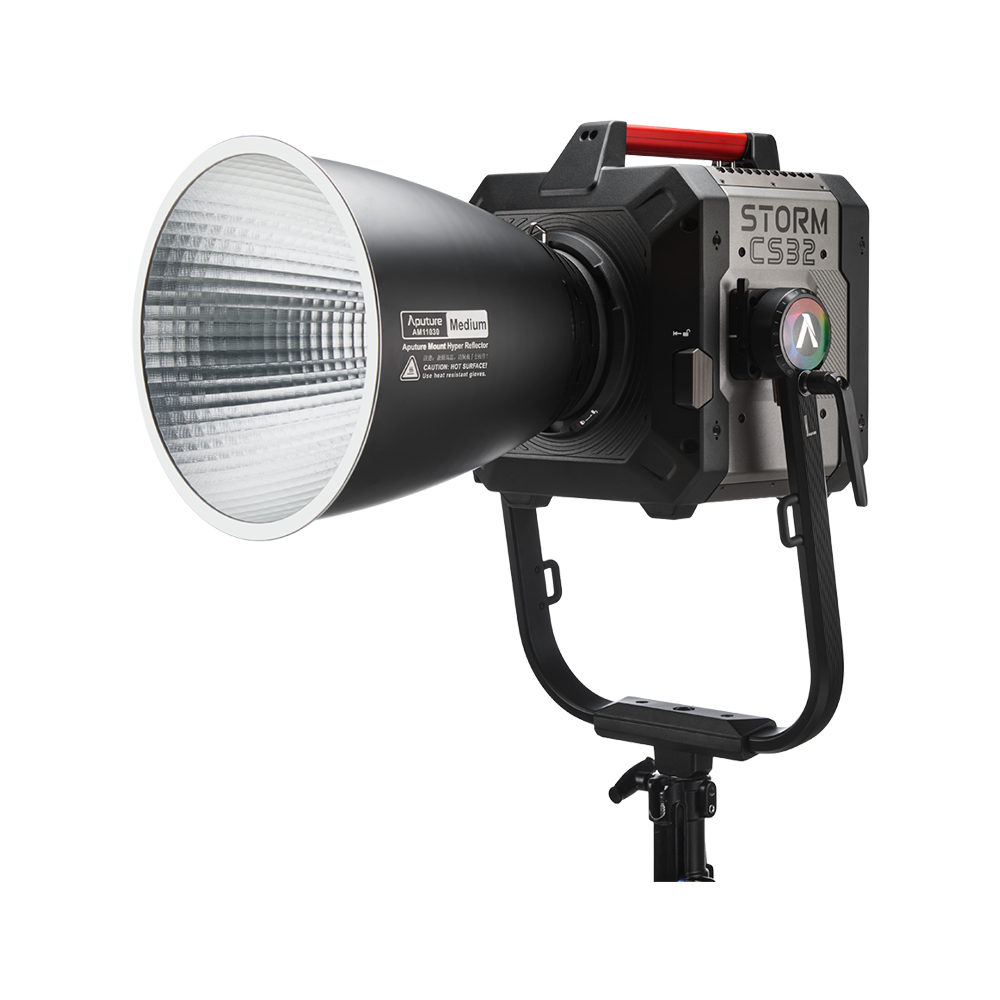
The Aputure STORM CS32 is a high-output, full-colour point-source LED built around the BLAIR-CG with Extended Red engine. Its 1,800–20,000K range, tint adjustment and electronic Aputure Mount suit large window sources, coloured exteriors and stage work. Maximum electrical input is 3,200W; a North American household connection runs the light at a reduced power limit.
The CS32 belongs in a package with a substantial stand or rig, appropriate distribution and dedicated Aputure Mount optics. Its head is smaller than the STORM XT52, but the modifier, controller and cable remain a significant working load.
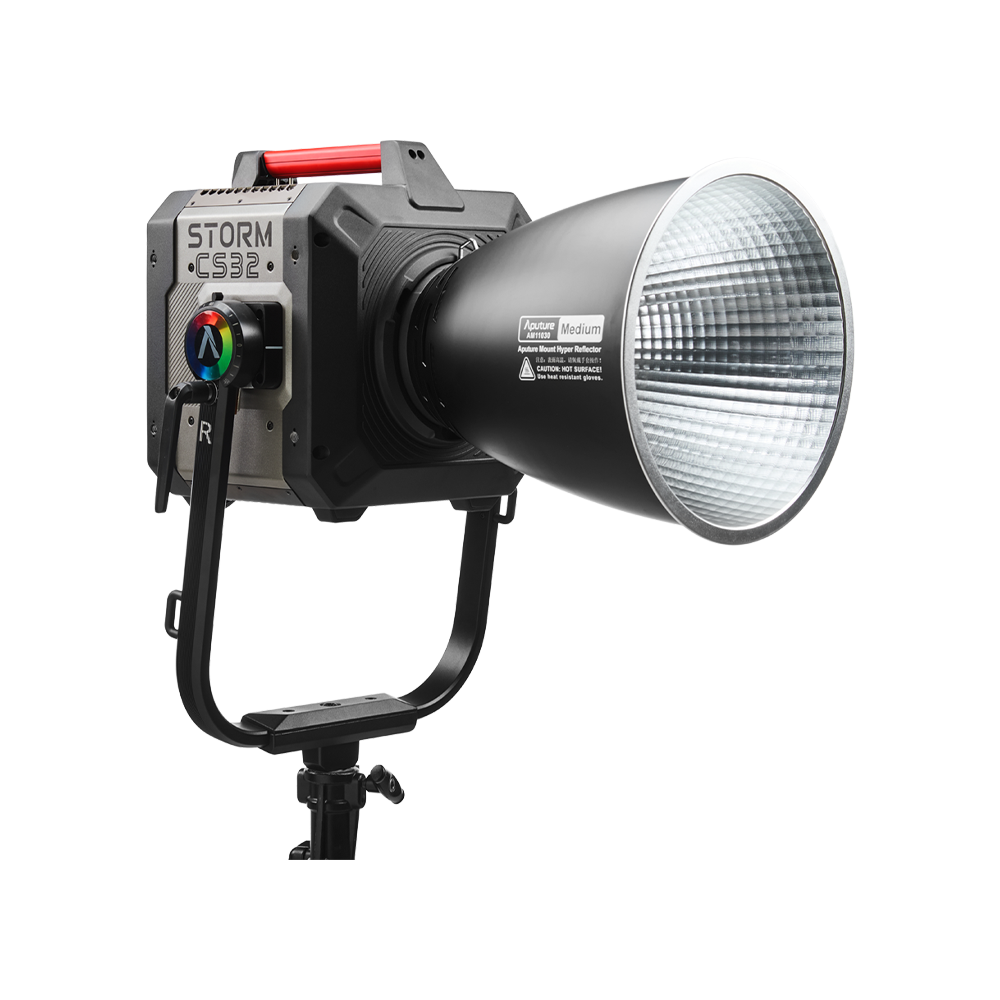
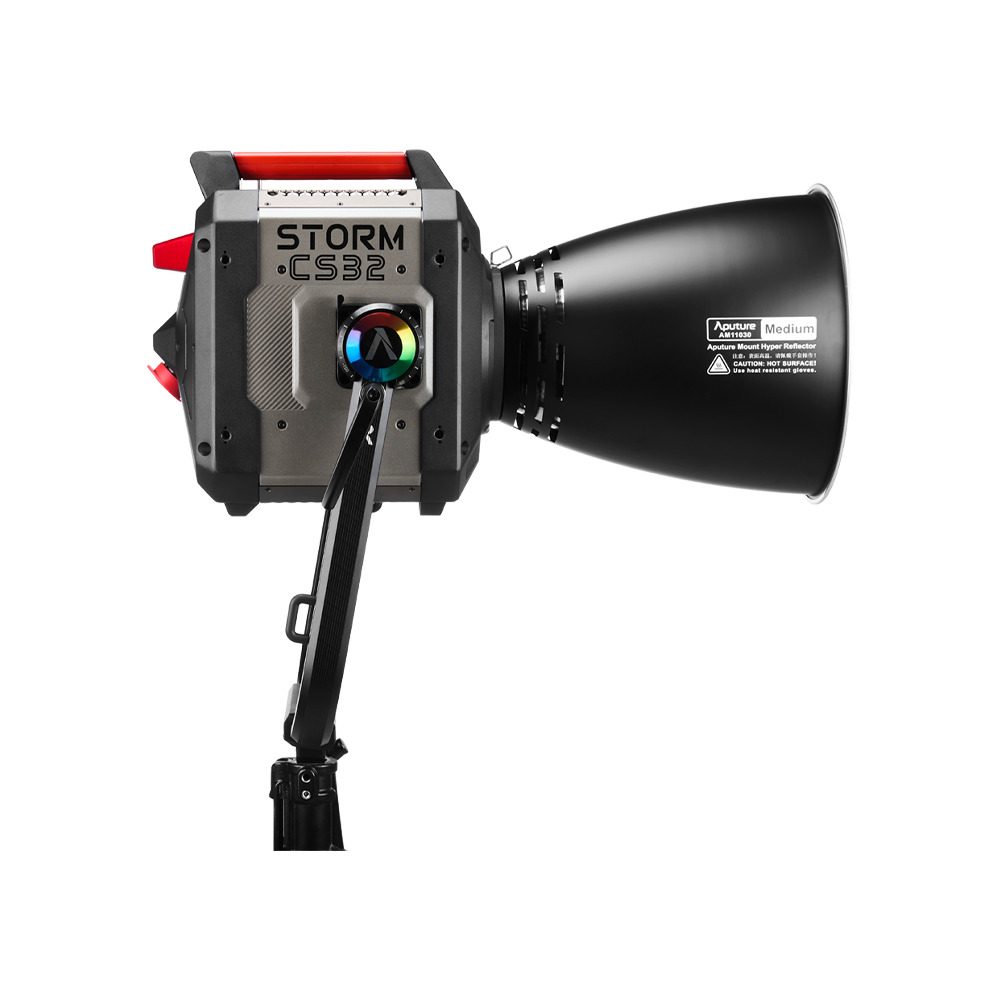
Select a photograph to view it at full size.
Key specifications
| Specification | Details |
|---|---|
| Light engine | BLAIR-CG with Extended Red; full-colour mixing |
| White-light range / tint | 1,800–20,000K; ±100% ASC MITC green–magenta adjustment |
| Colour references | CRI 97; TLCI 98; SSI tungsten 93 / D56 91 |
| Maximum electrical consumption | 3,200W; 100–240V AC, 50/60Hz |
| Accessory interface | Electronic Aputure Mount; no Bowens interface |
| Native / included reflector beam | 78° / 30° |
| Head weight | 16.8kg bare; 19.8kg with removable yoke |
| Controller / standard head cable | 10.8kg / 7.5m; supported cable extension up to 45m |
| Weather / operating temperature | IP65; −20°C to 45°C |
| Controls | Onboard, Sidus, DMX/RDM, CRMX, Art-Net/sACN |
Technical reference: Aputure product information and downloads.
Strengths and limitations
Strengths
- Full-colour operation with a wide white-light range and separate tint correction.
- Aputure Mount supports the larger optics developed for the XT52.
- Power limiting makes the same head usable on supplies below its maximum input.
Limitations
- Full output needs a supply that can deliver the complete 3,200W load.
- Aputure Mount optics are a separate ecosystem from the Bowens accessories in many smaller kits.
- Quiet fan settings reduce the output available for the shot; head-only weight excludes the yoke and modifier.
Practical uses
| Setup | Working approach |
|---|---|
| Sunlight through a window | Place the head far enough back to cover the required opening. Choose the reflector or Fresnel for the throw, then shape the beam outside the frame. |
| Warm exterior or sunset cue | Establish a warm colour and tint on the production camera, then check output through the intended optic. Do not assume the 5,600K reading carries over to a deep warm or saturated cue. |
| Large soft key or bounce | Use the output to fill a suitable diffusion or bounce surface. Check all corners of that surface before committing to its distance and angle. |
| Crane or high stage position | Plan the supported head-cable route and controller access before raising the head. The cable’s weight and the modifier belong in the rigging calculation. |
Output and colour
The narrow reflector readings describe centre illuminance. They are useful for throw, but do not show how evenly a diffusion frame will be filled. The bare head and 30° reflector are different optical configurations; their readings should not be treated as interchangeable.
White light is mixed from coloured emitters rather than dedicated warm and cool white LEDs. Match skin, reflective products and fluorescent wardrobe on the camera with the working modifier fitted. Select the same white-light standard across matching fixtures.
| CCT | Distance | Bare head (lux) | 30° reflector (lux) |
|---|---|---|---|
| 3,200K | 3m | 14,800 | 103,000 |
| 3,200K | 5m | 5,800 | 35,000 |
| 5,600K | 3m | 15,000 | 106,000 |
| 5,600K | 5m | 5,850 | 35,500 |
Published photometrics: measurement configurations and full output tables.
Tests and demonstrations
In CineD’s IBC 2026 interview, Aputure’s Brandon Le explains circuit-dependent power limiting, accessory compatibility and the output cost of quiet operation. It is a manufacturer interview, rather than an independent photometric test.
Power and batteries
The 3,200W input rating describes the complete electrical demand. It is separate from the lamp-head and LED power figures in the specification sheet. Use the controller label, selected power cap and connected cable when allocating the circuit.
Aputure supplies North American cable options for professional distribution and household use. With the Edison connection, the controller offers reduced-input choices described as approximately 1,700W for a 15A circuit and 2,200W for a 20A circuit. Those menu choices do not establish what an existing location circuit can safely supply; the electrician must account for the actual circuit and other loads.
This is an AC-powered package. A power station must support the selected continuous load as well as the required runtime. A large watt-hour figure alone does not establish that its AC inverter can start and run the fixture.
Control, cooling and camera operation
Onboard control, Sidus app operation, wired DMX/RDM, internal CRMX and Ethernet lighting protocols cover local and console workflows. Match the console personality and channel footprint to the installed firmware before programming colour cues.
Set the fan mode before exposure and record it with the lighting notes. Aputure’s published noise figures are mode dependent; Silent is a reduced-output operating choice rather than a full-power promise.
Aputure specifies high-speed flicker performance at output settings of 5% and above. That is not a guarantee for every lower fade level. Test the intended frame rate, shutter and complete cue, including its darkest portion.
Modifiers, rigging and the working package
| Component / accessory | Package considerations |
|---|---|
| Head and removable yoke | 19.8kg before the optic; 28mm junior pin support. |
| CF16 / XT52 reflectors | Dedicated Aputure Mount accessories; confirm the exact optic and any motorized-control requirements. |
| Large soft-light modifiers | Choose the Aputure Mount version, not the similarly named Bowens version. |
| Controller and cable | 10.8kg controller plus cable and clamp; support each independently. |
| Transport package | The fully loaded factory flight-case reference is 75kg; account for loading access and cart space. |
Check clearance through the full tilt range with the actual optic fitted. A reflector’s weight acts forward of the head, so the head-only number is insufficient for selecting support. Keep connector strain away from the cable termination.
Alternatives and related fixtures
| Fixture | When to compare it |
|---|---|
| STORM 1000c | A smaller full-colour head when lower output and a Bowens-based package meet the shot. |
| STORM XT52 | A larger tunable-white option when maximum white-light output is the priority. |
| STORM 1200x | A smaller tunable-white package with ProLock Bowens accessories. |
| Nanlux Evoke 5000B | A high-output tunable-white alternative; compare optics, power and support as complete systems. |
What people are saying
CineD at IBC 2026. The booth conversation addresses the practical trade between household power, maximum output and quieter cooling. Watch the interview and read the accompanying explanation.
Videos
CineD: STORM CS32 at IBC 2026. A manufacturer interview about power limiting, cooling and the Aputure Mount ecosystem.
Rental and used-fixture checks
- Verify the power cable, connector and controller input limit before the head is raised.
- Inspect the electronic mount, accessory lock, junior pin and yoke under the intended modifier load.
- Test DMX, CRMX and the selected network personality with the actual control system.
- Warm the head in its working fan mode, then test output, colour and the lowest programmed fade.
- Confirm the complete head-cable route and maximum supported extension.
Documentation and specifications
- Aputure product specifications, kit options and firmware downloads
- Product manual (PDF)
- DMX profiles (PDF)
- Manufacturer data sheet (PDF)
- CineD IBC 2026 interview
Browse Aputure lights · COB lights · all equipment.