
Last Updated 21 hours ago
ARRI Compact 200 Overview
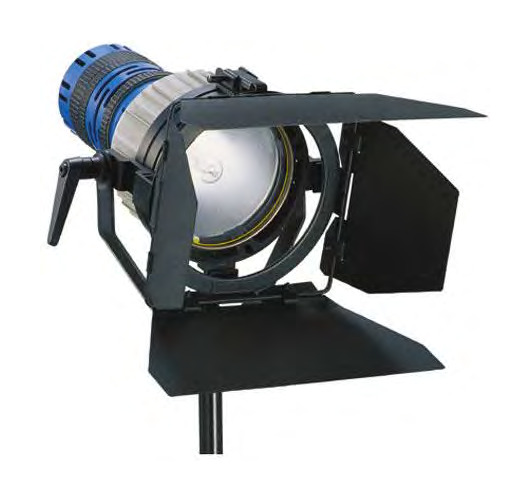


The ARRI Compact 200 is a 200 W daylight HMI Fresnel with a 112 mm lens. ARRI publishes a 7°–50° beam range; the head weighs about 2.3 kg before its ballast or cable.
Unlike the 200 W Pocket PAR, this head focuses by moving the lamp relative to a Fresnel lens. It takes a GZY9.5 single-ended lamp and a matching ballast and head cable.
- Fixture Type Compact daylight Fresnel
- Power 200 W GZY9.5 HMI + compatible ballast
- Colour Temperature 6,000 K Nominal daylight lamp class; actual CCT depends on the lamp and its condition.
- Weight 2.25 kg in 2005 brochure; approx. 2.3 kg in ARRI drawing
- Beam Angle 7° to 50° published focus; 112 mm Fresnel
- IP Rating IP23 Check the actual head and complete connected system; not waterproof. Read the IP Rating Guide.
Compact 200 Specifications
| Specification | Details |
|---|---|
| Model / ordering reference | L0.73330.X kit reference |
| Lamp / base | HMI 200 W/SE / GZY9.5 |
| Nominal lamp circuit | 70 V nominal lamp; some archived fixture listings round to 75 V; ballast mains input is separate |
| Nominal colour | 6,000 K daylight class in the period ARRI brochure |
| Optic | 112 mm Fresnel lens |
| Published focus range | 7° to 50° |
| Dimensions (H × W × L) | 232 × 218 × 193 mm |
| Head weight | 2.25 kg in the 2005 brochure; current manual drawing identifies the 2.3 kg class |
| Mount | 16 mm baby receiver / regional 17 mm pin version |
| Documented ballast families | EB 125/200 at 115/230 V, EBB 125/200 battery, or documented EBB 200/400 battery ballast |
| Protection | Class I / IP23 |
| Safety distances / tilt | 0.5 m to flammable objects, 2 m to illuminated surfaces and ±90° tilt in the ARRI operating instructions. |
| Status | Discontinued |
The Lexicon divides lamp wattage by a convenient supply voltage. That is not the lamp circuit and does not establish ballast input current. Plan distribution from the actual ballast nameplate and manual.
Output Calculator
Select the published setup and a manufacturer distance, or enter a custom throw where supported. The results describe centre-beam output, not the brightness across the whole beam.
Camera Settings
If the calculator does not load, use the published photometric table or source on this page. JavaScript is required.
F-stop is a planning estimate, not a meter reading. It uses direct, on-axis illuminance and includes only the optics and diffusion named in the selected setup. Meter on set to account for lens transmission, filters, added diffusion, bounce, dimming and ambient light.
How the exposure estimate works
N = √(E × ISO × t / C), where E is illuminance in lux and t = shutter angle ÷ (360 × fps). The default C = 340 is a dome reference; C = 250 is a flat reference. These are calibration constants, not a measured T-stop. A small nonzero digit is tenths of a stop above the displayed full stop.
Distance estimates and comparisons
Published points are used as given. Between published points the calculator fits a curve through the two nearest readings. Outside those points it uses the inverse-square law only when the fixture’s dataset permits it. Distances outside a configuration’s supported range are reported separately. Comparisons use one shared distance and camera setup; equal lux does not imply equal coverage.
View published readings for the selected configuration
Strengths and Limitations
| Strengths | Limitations |
|---|---|
| Focusable, even daylight field; complete manufacturer spot, middle and flood data; conventional accessories and serviceable construction. | Separate ballast and high-voltage head cable; hot single-ended discharge lamp; dated connector variants; discontinued head and accessory system. |
Practical Uses
| Setup | Working approach |
|---|---|
| Hard daylight key | Select focus for the required pool, then meter the subject rather than relying on centre output alone. |
| Window or exterior fill | Use spot or middle when throw matters and control spill with the retained barndoor. |
| Bounce or diffusion | Use flood to cover the modifier evenly, then meter after transmission or reflection loss. |
ARRI excludes the 125 W and 200 W models from its front-and-rear focus-knob feature; this does not mean they lack a focus control. Identify the actual focus mechanism and mounting version before rigging.
Output and Colour
The period ARRI Daylight Compact brochure publishes all nine measurements for this exact 200 W head. ARRI states that the data follow ESTA practice and are normalised to nominal lamp lumens.
| Distance | Spot 7° | Middle 30° | Flood 50° |
|---|---|---|---|
| 2.5 m | 15,696 lux / 0.3 m | 3,197 lux / 1.3 m | 1,858 lux / 2.3 m |
| 3.5 m | 8,008 lux / 0.4 m | 1,631 lux / 1.9 m | 948 lux / 3.3 m |
| 4.5 m | 4,844 lux / 0.6 m | 987 lux / 2.4 m | 573 lux / 4.2 m |
The calculator uses the nine published centre readings within the documented 2.5–4.5 m range. Intermediate results are estimates; published beam diameters are separate coverage references and do not change the exposure calculation.
Power and Batteries
This head uses EB 125/200 at 115/230 V, EBB 125/200 battery, or documented EBB 200/400 battery ballast. Confirm lamp wattage, lamp base, ballast setting, head connector and cable as one package. The 70 V nominal lamp rating describes the lamp circuit, not the supply outlet.
The HMI ballast and head-cable reference separates ARRI electronic and magnetic variants. Use the selected ballast input range, rated current, power factor, frequency mode and protective-device instructions for distribution.
Control, Cooling and Camera Operation
Use the Compact 200’s mechanical focus control. ARRI’s EB 125/200 documentation puts the 200 on the 200 W Amphenol C16-1 connection, not the 125 W Binder output. The ARRI Compact 200 operating manual calls for original, matched ARRI ballast and cable equipment. ARRI EB 125/200 manual.
Any dimming and camera frequency modes belong to the ballast actually supplied. Test the head and ballast at the planned shutter and frame rate after warm-up, and keep the cooling openings clear.
Modifiers, Rigging and the Working Package
| Accessory | ARRI Reference |
|---|---|
| 4-Leaf Barndoor | L2.79470.0 |
| Diffuser Frame | L2.79490.0 |
| Scrim Set | L9.79460.0 |
| Snoot | L2.79480.0 |
| Kit Stand | LS.3 |
ARRI documents 0.5 m to flammable objects, 2 m to illuminated surfaces and ±90° tilt in the ARRI operating instructions. Operate only with an intact Fresnel, reflector, wire guard or safety glass, lens-door latch and interlock. Keep ventilation open and cables away from the housing.
Support the head, barndoor, filter frame, cable pull and modifier as one load. Use properly rated primary support and secondary retention. A cracked lens, dull reflector, brittle internal lamp lead, heat-damaged connector or unreliable latch removes the head from service.
Alternatives and Related Fixtures
| Fixture | Why compare it |
|---|---|
| ARRI True Blue D5 | A later 575 W daylight Fresnel with current family documentation. |
| ARRI M8 | A lensless 800 W MAX-reflector head for greater throw and a different beam character. |
| ARRI Compact family | Compare the surrounding wattages, lens sizes, support loads and ballast packages. |
What People Are Saying
Field Feedback at a Glance
These are setup considerations from ARRI’s model documentation, not independent owner reviews.
What works
- The 112 mm Fresnel changes from a 7° spot to a 50° flood without swapping PAR lenses. ARRI Compact brochure, p. 3.
- At 3.5 m, the brochure lists 8,008 lux in spot and 948 lux in flood; check the separate diameter row when planning coverage. ARRI Compact brochure, p. 3.
- The kit lists a four-leaf barndoor, diffuser frame and optional scrim or snoot. ARRI lists the exact Compact 200 front accessories separately from the 125. ARRI Compact brochure, p. 3.
Drawbacks to plan for
- ARRI specifies 2 m to the illuminated surface and 0.5 m to flammable objects. The 2.5–4.5 m calculator range is the chart’s range, not a substitute for those limits. ARRI Compact 200 operating manual; ARRI Compact brochure, p. 3.
- The GZY9.5 single-ended 200 W lamp and 200 W ballast connection are not the Compact 125’s GZX9.5 package. ARRI Compact brochure, p. 3; ARRI EB 125/200 manual.
- The head weight excludes the ballast and cable; for battery operation there is still an external EBB and matching cable to accommodate. ARRI Compact brochure, p. 3; ARRI EBB 125/200 manual.
Videos and Operating Reference
The ARRI Compact 200 operating manual shows the head layout, lens and wire guard, and explains operating and safety checks. Use the ARRI EB 125/200 manual for the matching mains ballast and the ARRI EBB 125/200 manual if the kit uses battery power.
Rental and Used-Fixture Checks
Read the nameplate before accepting the package. Record the exact head variant, lamp, ballast model, connector and cable. Inspect lamp contacts, lens, reflector, focus travel, interlock, yoke, mount and accessory retention, then test cold start, stable output, hot restrike and the intended camera mode.
Documentation and Specifications
Official ARRI Compact archive · ARRI Daylight Compact brochure · ARRI operating instructions · ARRI Compact certification · ams OSRAM 200 W HMI lamp data.
Product photograph: ARRI product photograph reproduced in the Lexicon Carbone source document for model identification.
Browse ARRI lights · HMI lights · all equipment.