
Last Updated 3 days ago
Overview
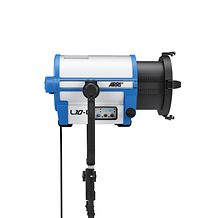
The ARRI L10-C is an original-generation RGBW LED Fresnel for larger studio keys, longer-throw backlights and broad Fresnel coverage from a substantial lens. Its 274 mm / 10-inch class lens provides mechanical spot-to-flood control alongside variable white, tint and saturated-colour operation.
This is the discontinued original L10-C, as specified in ARRI’s October 2022 data sheet and operating manual. Its power, mounting, connectors and photometric figures belong to that model rather than to the newer L-Series Plus.
Key specifications
| Specification | Details |
|---|---|
| Model generation | Original L10-C; discontinued model documentation |
| Type / engine | Focusable LED Fresnel / RGBW |
| Fresnel aperture | 274 mm / 10-inch class |
| Focus range | 15–50° half-peak |
| White / tint | 2800–10000 K; full minusgreen to plusgreen |
| Colour modes | Hue and saturation / RGB+W gamut |
| CRI / TLCI, data-sheet averages | >95 / >91 |
| Dimming | 0–100% continuous |
| Maximum input power | 510 W |
| AC supply | 100–240 V, 50/60 Hz |
| Battery input | No native battery input listed in the cited data sheet |
| Control | Onboard; 5-pin DMX in/thru; RDM |
| Wireless | External compatible receiver; not native CRMX |
| Service | Mini-USB for setup, status and firmware |
| Manual / pole-operated mass | 19.0 kg / 20.5 kg |
| Mount / tilt | 28 mm Junior pin / ±90° |
| Protection / ambient | Class I, IP20; −20 to +45°C |
Strengths and limitations
Strengths
- A focusable colour LED provides beam shaping and remote white matching.
- Electronic controls support repeatable settings.
Limitations
- Spot, flood and saturated settings have different exposure behaviour.
- Check generation, firmware and the installed wireless hardware.
Practical uses
| Setup | Working approach |
|---|---|
| Shaped key | Focus for the required area, then use doors or flags for spill. |
| Colour accent | Check the actual hue and level through the camera. |
Output and colour
These lux values are transcribed from ARRI’s October 2022 model data sheet. The table preserves its spot, middle and flood labels at two white settings. They are on-axis references for the stated lens focus, not a claim that the whole beam or every saturated colour has that intensity.
The sheet’s maximum electrical rating is 510 W. Its introductory text also mentions 400 W; use the explicit maximum-power specification for electrical planning.
Focus changes both central intensity and coverage. Add barndoors or flags for spill control, and assess the final field on the subject. A bounce or softbox changes the apparent source and transmission; use the appropriate setup rather than the focused spot figure when estimating a soft key.
| CCT / focus | 3 m, lux | 5 m, lux | 9 m, lux |
|---|---|---|---|
| 3200 K, spot 15° | 13,744 | 4,948 | 1,527 |
| 5600 K, spot 15° | 15,422 | 5,552 | 1,714 |
| 3200 K, middle 30° | 4,722 | 1,700 | 525 |
| 5600 K, middle 30° | 5,278 | 1,900 | 586 |
| 3200 K, flood 50° | 1,922 | 692 | 241 |
| 5600 K, flood 50° | 2,133 | 768 | 237 |
The RGBW engine provides continuously variable 2800–10000 K white and green/magenta correction. Hue/saturation operation provides a broad colour gamut. Matching CCT alone does not guarantee identical camera response to another source; test critical skin, fabrics and mixed-fixture scenes.
The listed CRI and TLCI values are data-sheet averages for this original model. They should not be replaced with Plus-generation claims. Saturated-colour output can differ greatly from a white-light photometric row, so meter the final cue.
ARRI describes additional gel and source-selection workflows with compatible control software. Confirm the actual fixture firmware, DMX profile and control arrangement before relying on features demonstrated on a newer L-Series or SkyPanel.
Power and batteries
ARRI’s specification accepts 100–240 V AC at 50/60 Hz and lists 510 W maximum consumption. The documented mains connection is powerCON TRUE1 TOP, with the appropriate switched cable arrangement. Check the installed unit’s connector and cable revision rather than treating all production years as identical.
The data sheet lists AC input, not a low-voltage V-mount battery socket. Portable use therefore requires an appropriate complete AC power arrangement. Do not transfer the original L5-C’s four-pin battery input to the L10-C.
The design includes active cooling and fan-mode selection. Check the selected fan behaviour, actual output and sound at the microphone after warm-up. Keep vents clear and retain the manual’s operating clearances; the fixture’s Class I / IP20 rating identifies an earthed indoor system.
Control, cooling and camera operation
Five-pin DMX input and through connections provide wired control. RDM supports setup, status information and the hour counter. Match the console personality and fixture mode, and verify blackout, low fades and signal-loss response through the intended control route.
Mini-USB provides service, setup and firmware functions through the supported software. It is not the Plus generation’s Ethernet interface or a USB-C charging input. Any wireless link requires a suitable external receiver and its own power/control arrangement.
The data sheet references the SkyLink receiver as an external wireless option. It does not claim a built-in CRMX radio. Verify the actual rental or used package rather than assuming wireless functionality from a seller’s generic “wireless capable” description.
Modifiers, rigging and the working package
The L10-C suits larger studio keys, longer-throw backlights and broad Fresnel coverage from a substantial lens. Its real Fresnel lens and mechanical focus provide a different workflow from placing an optional lens on a COB engine. Adjust beam size, then shape the field using the matching barndoors and external flags.
The manual version is listed at 19.0 kg, with a 20.5 kg pole-operated reference. This is a substantial studio fixture requiring a suitable Junior receiver and rated support. A larger lens and longer working distance do not make the complete unit a lightweight location lamp.
Manual and pole-operated models use different yokes and weights. Pole operation provides pan, tilt and focus access in a studio installation; it is not remote electronic pan/tilt. Include accessories, cable movement and the actual suspension arrangement in clearance planning.
ARRI lists matching four- and eight-leaf barndoors, filter frame, snoot, softbox/Chimera options, cables and safety hardware. Check the exact model and accessory diameter. A barndoor or frame from a different Fresnel size is not automatically compatible.
Inspect the lens, accessory retention, focus travel, sliding stirrup, tilt lock, fan, display and mains connection. Test warm/daylight whites, tint, saturated colour and low dimming. On pole-operated units, check all three mechanical adjustments; on the original L5-C, test the intended DC route as well.
ARRI now files this original model under discontinued products. For a used fixture, confirm firmware, operating hours, service history, actual engine revision and parts support with the relevant service provider. A published LED-life estimate is not proof of a particular used unit’s remaining life.
The original L7-C occupies another size in the legacy range. The L5-C Plus and L7-C Plus are separate models with Ethernet and revised optical/output specifications; there is no basis here for describing this fixture as a Plus model.
Alternatives and related fixtures
| Fixture | Choose it for |
|---|---|
| ARRI L-Series Plus | A newer Fresnel generation; compare its own photometrics and connectivity. |
| ARRI tungsten Fresnels | A lamp-based alternative with different power, colour and heat behaviour. |
What people are saying
Good Dog Digital: the original L-Series
Good Dog Digital’s NAB 2015 presentation introduces the L5, L7 and L10 family. It gives historical context for the original L10-C rather than the output or network features of later Plus fixtures. View the source.
Videos
ARRI L10-C (original): family guide
An original-generation L-Series overview including L10.
Rental and used-fixture checks
Check the exact model and revision, complete power package, mounting hardware and control leads. Inspect emitting surface, connectors and support points. Test the intended operating level, fade and camera settings before rigging.
Documentation and specifications
official discontinued-model page, model data sheet with photometrics and mechanical drawing and operating manual.
Product photograph: ARRI official original L10-C product photograph.
Browse Arri lights · LED Fresnels · all equipment.